Vaccine Refrigerator With Battery Backup: The 72-Hour Standard VFC-Registered Practices Actually Need
 By Lee Arnold
Medical Solar Power Backup Specialist | 8+ years in the field
Quick Answer:
A vaccine refrigerator with battery backup isn’t mandated by CDC’s toolkit for every practice, but the toolkit does set the rules once you have one: a generator needs 72 hours of fuel on hand, and a battery backup system must meet that same quarterly-test, annual-service standard.
The harder problem is the math. A vaccine fridge’s compressor cycles on and off all day, so its real average draw is much lower than its nameplate — but running one for a genuine 72-hour outage still adds up to more capacity than most single battery units hold without solar input to recharge them.
One CDC rule catches most buyers off guard: one storage unit per electrical outlet, no power strips, no switch-controlled outlets. That decides how many real AC outlets your backup power source needs, not just how many watts.
Most content on this exact keyword is written by vendors selling dedicated UPS hardware to vaccine clinics and blood banks. It’s aimed at that buyer specifically, not the home CPAP or oxygen user this site normally covers.
This guide is for that same clinic buyer: a practice manager, VFC coordinator, or pharmacist sizing backup power for a real compressor-driven vaccine fridge, not a home mini-fridge.
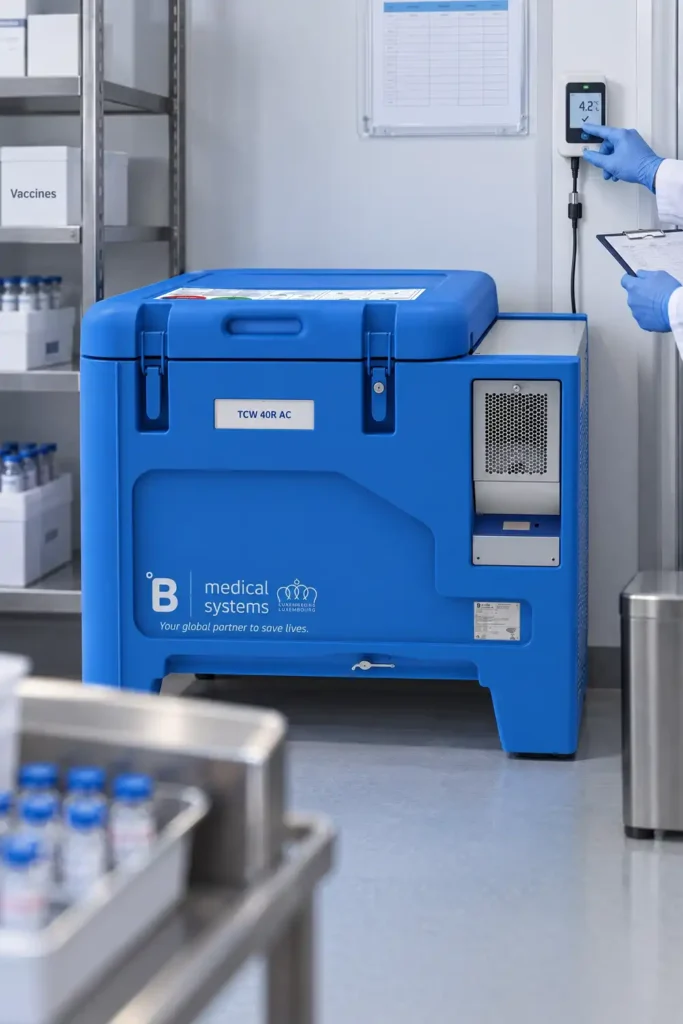
Table of Contents
What CDC Actually Requires (Not What Most Guides Assume)
The CDC Vaccine Storage and Handling Toolkit doesn’t require every practice to own a generator or battery backup system. What it requires is a written emergency plan — and if you do have backup power, specific maintenance standards for it.
For a generator, that means keeping enough fuel on hand to run it continuously for at least 72 hours, tested quarterly and serviced annually. A battery backup system can substitute for a generator, but CDC holds it to the same quarterly-test, annual-service standard, checked against the manufacturer’s own guidance.
The toolkit also requires a written agreement with at least one alternative storage facility with 24-hour access, in case backup power isn’t enough. That’s worth having regardless of what backup power you buy.
The Real Power Math: Why “72 Hours” Is Harder Than It Sounds
Here’s the detail most vendor pages skip. A vaccine fridge’s compressor doesn’t run continuously — it cycles on and off to hold temperature, typically active somewhere around 30 to 35 percent of the time.
A unit with a 350-to-750-watt running draw might average closer to 100-300 watts, according to MediProducts’ own breakdown of compressor duty cycles.
That’s a household-refrigerator figure, not a vaccine-specific one — medical-grade units generally don’t carry Energy Star ratings, so there’s no single universal number here. Check your specific unit’s nameplate amperage, or measure it directly with a kilowatt-hour meter, before sizing anything.
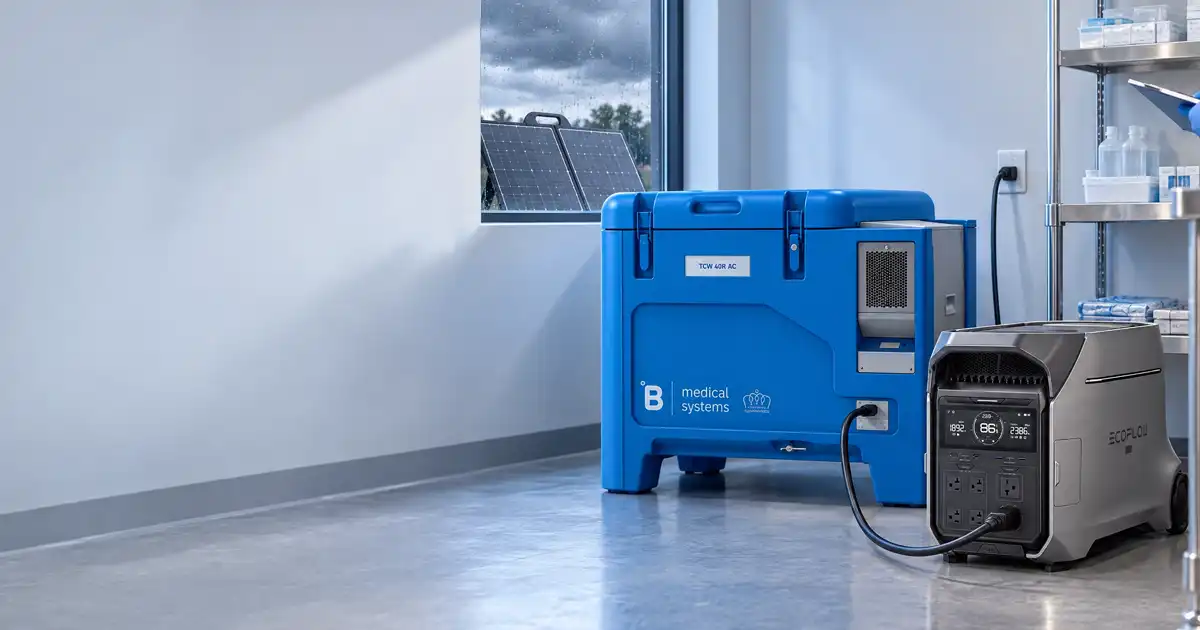
Even using a conservative 150-watt average, 72 hours of continuous runtime works out to roughly 10,800 watt-hours. That’s well beyond what a single portable power station holds fully charged — which is the real reason solar input matters for this use case, covered next.
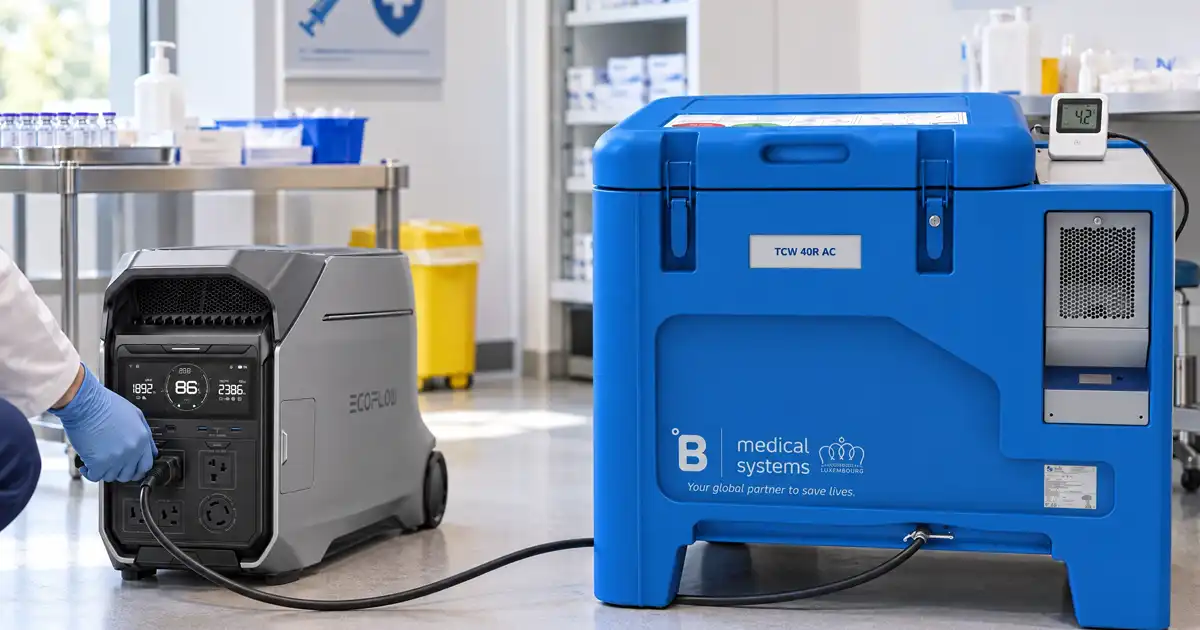
Battery-Only vs. Battery Plus Solar: Why Solar Changes the Math
Most of the commercial UPS systems built for vaccine clinics are battery-only — sized to bridge a short outage, then recharge from the wall once utility power returns. That works fine for the outages that resolve in a few hours.
It doesn’t work for the scenario CDC’s own 72-hour generator guidance is actually planning for: a multi-day outage during a regional storm or grid event, the kind where the wall isn’t coming back online anytime soon either.
A solar generator setup changes that math, because it isn’t just drawing down a fixed battery — it’s recharging throughout the outage as long as there’s daylight. Sized correctly, that’s the difference between a battery that buys you a few hours and a system that can realistically sustain a multi-day event.
That gap is what separates “backup power” from backup power that actually meets CDC’s own 72-hour planning horizon.
Sine Wave Quality Matters for a Compressor, Not Just Electronics
A vaccine fridge’s compressor is a motor, and motors are sensitive to the quality of the power driving them the same way CPAP machines and dialysis equipment are, which we cover in more depth in our solar vs. gas generator comparison.
Modified sine wave power — the cheaper, stepped approximation some budget generators produce — can run a compressor motor less efficiently and generate more heat than clean power does. Pure sine wave output, standard on most quality portable power stations, is the safer default for this kind of continuous motor load.
The Outlet Rule Most Buyers Miss
CDC’s toolkit includes an electrical-safety detail that directly affects which power station actually works for this job: avoid multi-outlet power strips, avoid outlets controlled by a wall switch, and use only one storage unit per electrical outlet.
Applied to backup power, that means your power station needs its own dedicated AC outlet for the fridge. Not a power strip plugged into one outlet, feeding the fridge alongside a monitor, a router, or anything else.
More than one temperature-sensitive unit changes the math further. You need a power station with enough independent outlets to give each one its own connection, not one outlet split three ways.
Temperature Monitoring During an Outage
CDC requires a continuous digital data logger for routine vaccine storage, with a buffered probe placed centrally among the vaccines and its display mounted outside the unit. That setup matters even more during an outage, since it lets staff confirm the fridge is holding temperature without opening the door and losing cold air.
The target range is 36°F to 46°F (2°C to 8°C) for refrigerated vaccines. If a reading falls outside that range, CDC’s toolkit is specific about next steps: label the affected vaccines “DO NOT USE—TEMPERATURE EXCURSION,” isolate them, and document the date, time, readings, duration, and lot numbers before contacting the manufacturer or your state health department about viability.
VFC Compliance Varies by State
Practices receiving publicly funded vaccines through the Vaccines for Children program answer to their state’s VFC coordinator, on top of CDC’s baseline — sometimes down to approved data logger models or documentation formats. Those specifics vary enough by state that we won’t generalize them here; check directly with your state immunization program before finalizing any backup power purchase for VFC-stocked inventory.
How This Differs From the Rest of This Site
Most of what we cover here is home backup power for a patient’s own CPAP machine, oxygen concentrator, or insulin supply — see our guide on keeping insulin cold during a power outage for that home-patient version of this same cold-chain problem.
This guide is deliberately different: it’s written for a practice sizing backup power for a compressor-driven, compliance-monitored vaccine fridge, not a single patient’s home refrigerator. The stakes, the wattage, and the regulatory rules are different enough that the two shouldn’t be treated as the same question.
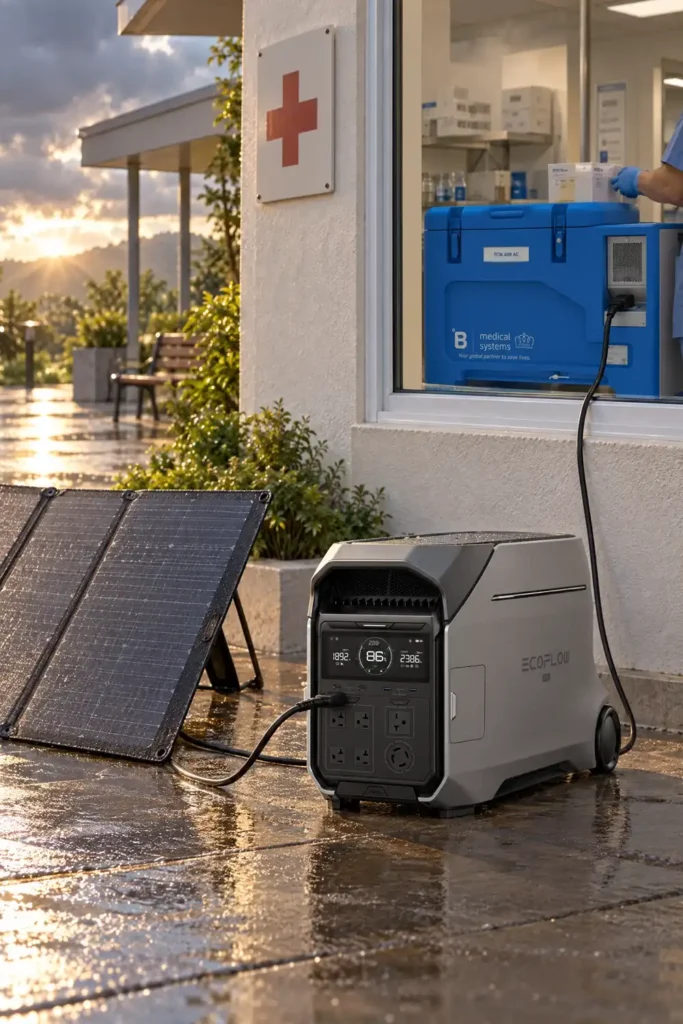
FAQs
Does CDC require every vaccine-storing practice to have battery backup power?
No. CDC’s toolkit requires a written emergency plan, but backup power itself isn’t mandatory for every practice. If you do have a generator or battery backup system, it must be tested quarterly and serviced annually, per the manufacturer’s guidance.
How many watts does a vaccine refrigerator actually use?
It varies by unit and isn’t standardized the way household Energy Star appliances are. A comparable household compressor fridge runs 350-750 watts when the compressor is active, averaging roughly 100-300 watts across a full cycle. Confirm your specific unit’s nameplate rating or measure it directly rather than assuming a generic figure.
Can a portable power station really cover a full 72-hour outage?
Only with solar recharging in most cases. A conservative 150-watt average draw over 72 hours works out to around 10,800 watt-hours, more than most single battery units hold fully charged. Solar input during daylight hours is what closes that gap for a genuinely multi-day outage.
Why does the “one outlet per unit” rule matter for choosing a power station?
Because CDC’s toolkit prohibits running a vaccine storage unit off a power strip or a switch-controlled outlet. Your backup power source needs a real, dedicated AC outlet for the fridge — a power station with only one or two outlets shared across multiple devices won’t meet that standard if you’re running more than one temperature-sensitive unit.
What should we do if the fridge temperature goes out of range during an outage?
Label the affected vaccines “DO NOT USE—TEMPERATURE EXCURSION,” isolate them from usable stock, and document the date, time, temperature readings, duration, and lot numbers. Contact the manufacturer or your state health department to determine viability before discarding or administering any affected doses.
Bottom Line
A vaccine refrigerator with battery backup isn’t a single-product decision — it’s a sizing problem, and the honest starting point is your fridge’s actual average draw, not its nameplate number. Battery-only backup bridges short outages; solar recharging is what makes a multi-day outage survivable, which is the scenario CDC’s own 72-hour generator guidance is really planning for.
Whatever you choose, make sure it gives the fridge its own dedicated outlet, confirm it meets the quarterly-test, annual-service standard if it’s substituting for a generator, and keep a written alternative-storage agreement as backup to the backup.
A Note on Cost
Backup power for vaccine storage is typically a practice or business expense rather than a personal medical deduction, so this doesn’t carry the same HSA/FSA framing as the home-patient content elsewhere on this site. Talk to your practice’s accountant about how equipment purchases like this are categorized for your specific situation.
This article reflects the CDC Vaccine Storage and Handling Toolkit current as of October 2026. Backup power requirements, wattage figures, and VFC program specifics vary by equipment model and state — confirm exact requirements with your equipment manufacturer and state immunization program before purchasing. This is not medical, legal, or compliance advice; consult your practice’s vaccine coordinator and state health department for guidance specific to your facility.

Best for: daily errands, short outings, setting 1 patients, and users with regular outlet access.
Best for: daily errands, short outings, setting 1 patients, and users with regular outlet access.
Best for: daily errands, short outings, setting 1 patients, and users with regular outlet access.