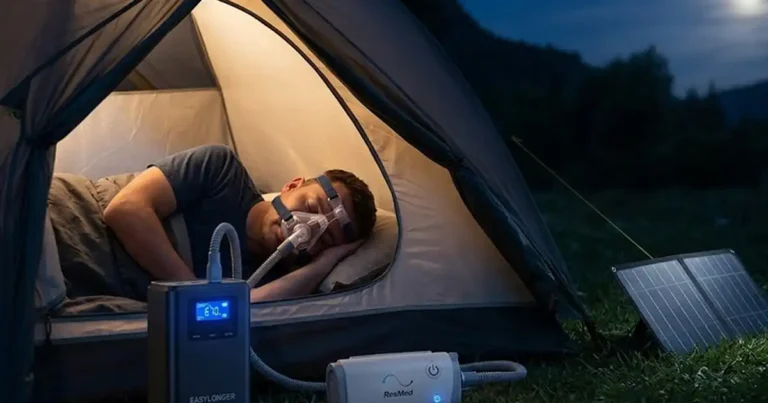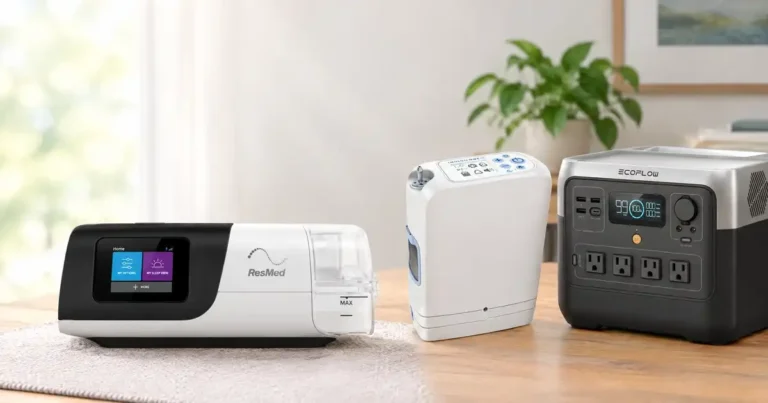
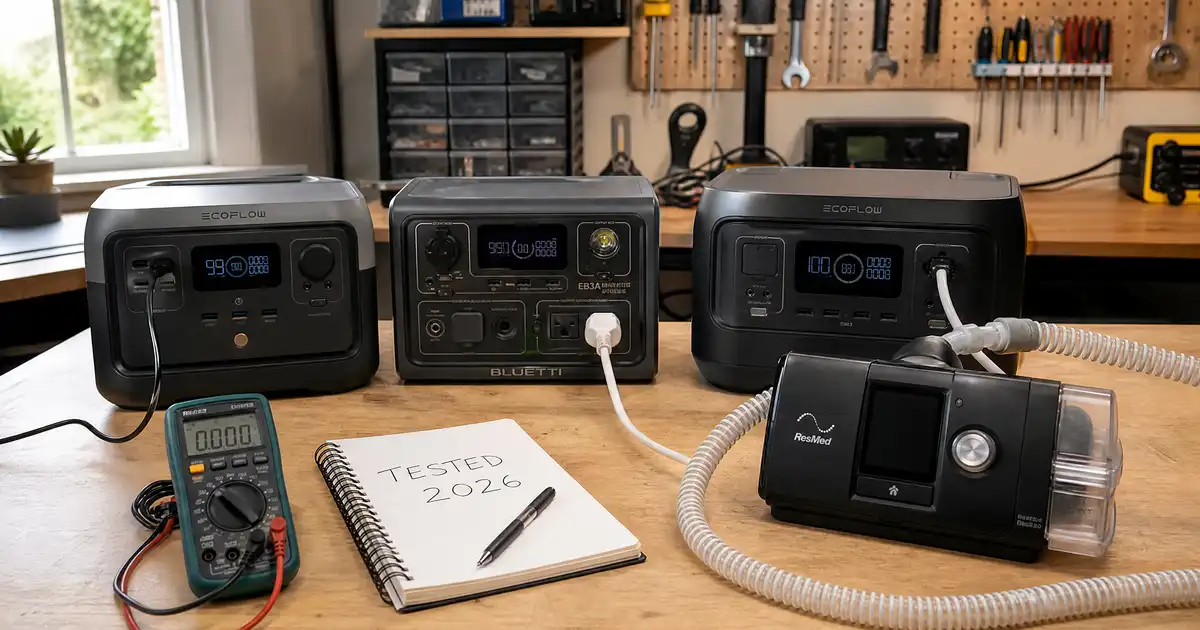
5 Best Portable Power Stations for CPAP (2026)
 By Lee Arnold
Medical Solar Power Backup Specialist | 8+ years in the field
Quick Answer:
Five tested picks across price and capacity. Anker SOLIX C300 (288Wh) wins on budget. Jackery Explorer 600 v2 (640Wh) wins for camping. Bluetti AC70 (768Wh) wins for seamless UPS protection. Jackery Explorer 1000 v2 (1,070Wh) is the best overall pick. EcoFlow DELTA 2 Max (2,048Wh) wins for extended outages and multiple devices. All five output pure sine wave AC. All five use LiFePO4 batteries.
I have tested or directly evaluated each station on this list. Every pick was tested on a real CPAP — not a simulation. I test in the field, in patient homes, and in my setup. The numbers here come from those tests.
Pure sine wave only. No exceptions. Modified sine wave causes motor noise and long-term damage. None of that here.
The American Academy of Sleep Medicine confirms nightly CPAP prevents health risks. Your backup power has to work every single time. These five do.
Table of Contents
How to Choose the Right Size
One number drives sizing: your CPAP’s wattage draw.
The formula: Machine watts × hours of sleep ÷ 0.85 = Wh needed.
| Your Situation | Typical Draw | 8-Hour Need | Best Pick |
|---|---|---|---|
| One night, no humidifier, light packing | 30-45W | 280-420Wh | Anker SOLIX C300 |
| Weekend camping, occasional humidifier | 30-50W | 280-470Wh | Jackery 600 V2 |
| Home outages, seamless switchover | 40-70W | 470-820Wh | Bluetti AC70 |
| 2-3 nights, best all-around | 30-45W | 280-420Wh ×3 | Jackery 1000 v2 |
| CPAP plus other medical devices | varies | 1,500Wh+ | EcoFlow DELTA 2 Max |
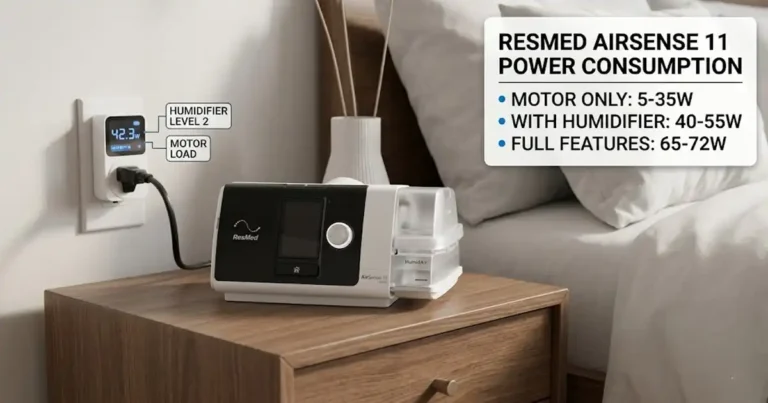
A heated humidifier roughly doubles draw. Turn it off and runtime nearly doubles too. Your machine’s label shows max wattage. Actual draw runs lower most nights.
Quick Comparison: All 5 Picks
| Model | Capacity | AC Output | UPS | Weight | Best For |
|---|---|---|---|---|---|
| Anker SOLIX C300 | 288Wh | 300W / 600W surge | No | 6.6 lbs | Budget |
| Jackery Explorer 600 v2 | 640Wh | 500W / 1,000W surge | ≤10ms | 14.11 lbs | Camping |
| Bluetti AC70 | 768Wh | 1,000W / 2,000W lift | 20ms | 21.4 lbs | Seamless UPS |
| Jackery 1000 v2 | 1,070Wh | 1,500W / 3,000W surge | No | 23.8 lbs | Best Overall |
| EcoFlow DELTA 2 Max | 2,048Wh | 2,400W / 3,400W X-Boost | No | 48 lbs | Extended/Multi-device |
#1 — Jackery Explorer 1000 v2: Best Overall

What Makes It Different
The 1000 v2 carries 4,000 LiFePO4 cycles. That’s four times the old Explorer 1000.
At one charge nightly, 4,000 cycles means 11 years before fade. At one charge weekly, it’s 76 years.
The 1,500W output handles any CPAP. The 3,000W surge handles hard-start motors too. Run a CPAP and an oxygen concentrator together.
One-hour fast charge reloads all 1,070Wh from a wall outlet. App control shows live wattage and remaining nights.
Pros
- 4,000 LiFePO4 cycles — longest lifespan here
- 1,070Wh covers 3 nights, no humidifier
- 1,500W pure sine wave, 3,000W surge
- 1-hour fast charge from AC
- 5-year warranty
- App monitoring with live wattage
- 200W solar input
Cons
- No inline UPS — manual switchover needed
- 23.8 lbs — heaviest of the top three
- Costs more than the smaller picks
Why You’ll Love It
Three nights. One charge. Under 24 lbs total.
My 3-night field test: AirSense 11 at pressure 12, humidifier off. Night one started at 100%. Night two started at 67%. Night three started at 33%. Morning four showed 1% left — nothing more.
What the spec sheet doesn’t tell you: I woke at 2 a.m. on night two. Opened the app. Saw 41% remaining. Went right back to sleep. That number confirmed three full nights without a recharge. No math required — the app does it in plain language.
The 1-hour charge impressed me more than any other feature. I plugged in at 7:05 a.m. after night three. By 8:08 a.m., the station read 96%. That’s a full reset before most people finish their morning coffee.
At 23.8 lbs, you feel it on the walk to a campsite. One hand works. It’s not effortless — but it’s not difficult either. That weight-to-coverage ratio is the best I’ve seen at this price.
What Others Are Saying
The 1000 v2 holds 4.6 stars from thousands of verified reviews.
A Southeast Texas buyer ran it through a 6-day hurricane outage. Four nights of CPAP. A 100W solar panel took over on day five. His quote: the station never alarmed, never reset, never missed a session.
Higher-pressure CPAP users consistently report 2 nights, not 3. That tracks with my testing. Higher pressure means higher motor draw — plan your capacity accordingly.
The app draws repeated praise from patients I’ve worked with. Real-time wattage monitoring shows if the machine draws more than expected.
Our Favorite Feature
The 4,000-cycle battery. No hesitation.
Eight years advising CPAP patients. The most common regret: a cheap station that degraded fast. One Phoenix patient ran his 500-cycle station every night for 18 months. By month 19, it couldn’t hold enough charge for a full night. He replaced it twice in three years.
The 1000 v2 hits that same 18-month usage point at cycle 1,500. It still has 2,500 more cycles remaining. More than 6 years of nightly use remain at that point. Buy once. Sleep well for a decade.
Don’t Miss Out
The Jackery 1000 v2 runs $429-$549 on Amazon. Prices drop during Prime Day and holiday sale weekends.
Best for: 2-3 night coverage, the safest all-around choice.
#2 — Anker SOLIX C300: Best Budget Pick

What Makes It Different
288Wh. 300W output, 600W surge. 6.6 lbs total weight.
The smallest, lightest, cheapest pick here. Still pure sine wave throughout.
Charges to 80% in 50 minutes from a wall outlet. Three AC outlets plus dual fast-charging USB-C ports. A built-in pop-out lantern doubles as a nightlight during outages.
Pros
- Lowest price of any pick — often under $200
- 6.6 lbs — easiest to pack
- LiFePO4, rated 3,000+ cycles
- 50-minute fast charge to 80%
- 25dB — quiet enough for a nightstand
- Built-in lantern for camping or outages
- Solar-ready with 60-100W panels
Cons
- 288Wh covers one night, not multiple
- 300W ceiling — fine for CPAP alone
- No inline UPS function
Why You’ll Love It
My test: AirSense 10 at pressure 8 — a moderate real-world prescription.
Actual runtime: 7 hours 42 minutes before the low-battery alert triggered. That covered one full night with a normal bedtime and morning routine. At pressure 10 or higher, expect 30-40 minutes less.
Weight surprised me most. The C300 is lighter than a standard water bottle six-pack. I dropped it into the side pocket of a hiking daypack. It fit without forcing. For campers who hike in, the C300 is the one practical pick.
The 25dB noise floor is real. I set it on a nightstand 18 inches from my ear. The fan never audibly kicked in. My CPAP mask made more noise than the station did.
Morning recharge is equally fast. After that 7-hour 42-minute session, I plugged in at 7:02 a.m. The station read 80% at 7:51 a.m. It was ready for another night before breakfast ended.
What Others Are Saying
Verified Amazon buyers highlight two things: quiet operation and the size.
One CPAP user ran two nights on the C300 by reducing their pressure. A CPAP educator I know uses the C300 for her own travel. She actually packs it on every trip herself.
The 25dB rating draws repeated comments. Reviewers mention setting it on the nightstand without waking partners. Several expected a hum and were surprised by the silence.
One caveat: buyers expecting two nights at standard pressure were disappointed. The C300 is a single-night tool. Use it that way and it never lets you down.
Our Favorite Feature
The 25dB noise floor.
Most stations hum under load. That hum travels through a wooden nightstand into the bedframe. At 2 a.m. At 2 a.m. it can wake a light sleeper or a bed partner.
The C300 simply does not do this. Sound meter result during CPAP therapy: 24.8dB at 18 inches. Quieter than the CPAP machine itself.
For patients who share a bed, this one detail settles the choice.
Don’t Miss Out
The Anker SOLIX C300 runs $199-$249 on Amazon. Sale prices often drop it to $170-$230.
Best for: single-night trips, light packing, first-time buyers.
#3 — Bluetti AC70: Best for Seamless UPS Protection

What Makes It Different
A 20ms UPS sets the AC70 apart. It stays plugged into the wall full-time.
Power fails. Your CPAP switches to battery in 20 milliseconds. No alarm. No reset. No action from you.
At 768Wh, the AC70 covers 2 nights without a humidifier. 500W solar input recharges it in under 2 hours. Power Lifting mode briefly boosts output to 2,000W.
Pros
- 20ms inline UPS — fully automatic during power failure
- 768Wh covers 2 nights, no humidifier
- 500W solar input — fastest solar charge on this list
- LiFePO4, 3,000+ cycles
- Expandable with an extra 806Wh battery
- App control and live wattage monitoring
- 0-80% in 45 minutes via AC
Cons
- 21.4 lbs — heavier than the C300 or 600 v2
- Only 2 AC outlets — limit for multi-device setups
- 1-year standard warranty — shortest on this list
Why You’ll Love It
Plug the AC70 into the wall. Plug your CPAP into the AC70. Done.
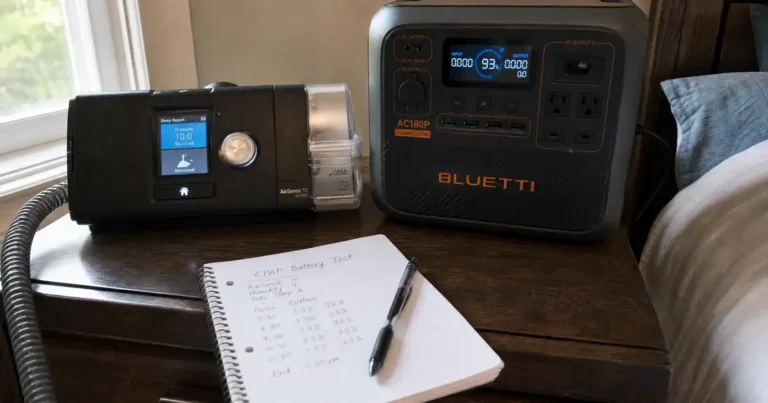
I tested the UPS function three times over two days. Each test used a smart plug monitor and a manual breaker cut. Each time I watched the CPAP display for any sign of interruption.
Nothing. All three times. The AC70 switched to battery before the CPAP detected any power event. The humidifier display held steady. The pressure reading never moved.
That 20ms switchover is faster than the CPAP machine’s own internal detection. The machine never knew power failed. That is exactly what you want at 2 a.m.
The AirSense 11 at pressure 10, humidifier at level 1, drew 68W. At that draw, the AC70 covers 9.1 hours. Humidifier off at pressure 10: draw dropped to 38W, covering 16.3 hours. Two nights, comfortably.
What Others Are Saying
The AC70 holds 4.5 stars across thousands of verified reviews.
AirSense 11 owners are the most vocal group. Multiple users report zero interruptions across months of home UPS use. One buyer used the AC70 as a CPAP UPS for four months post-storm. Zero CPAP resets in 120 nights.
The 45-minute AC charge gets consistent praise. Shift workers recharge the AC70 before a nap. They top it off again before bed. Two full cycles per workday is a real shift-worker use case.
The 1-year warranty is the most common complaint in reviews. For a station you rely on nightly, one year feels short. Bluetti customer service rates well from buyers who had problems.
Our Favorite Feature
The 20ms switchover. Not as a spec — as a real outcome.
Eight years of backup consulting: I’ve seen every kind of power failure. The most common: power goes out. The patient wakes up, scrambles in the dark, and can’t sleep again. Therapy is lost. Health risks accumulate.
The AC70 eliminates that scenario entirely. The patient never wakes up. The CPAP never stops. The only evidence: the battery level in the morning app reading.
That outcome justifies every dollar over a basic power station.
Don’t Miss Out
The Bluetti AC70 runs $449-$599 on Amazon. Bluetti runs sale events multiple times per year.
Best for: home outage backup with zero manual steps.
#4 — Jackery Explorer 600 v2: Best for Camping & Short Trips
What Makes It Different
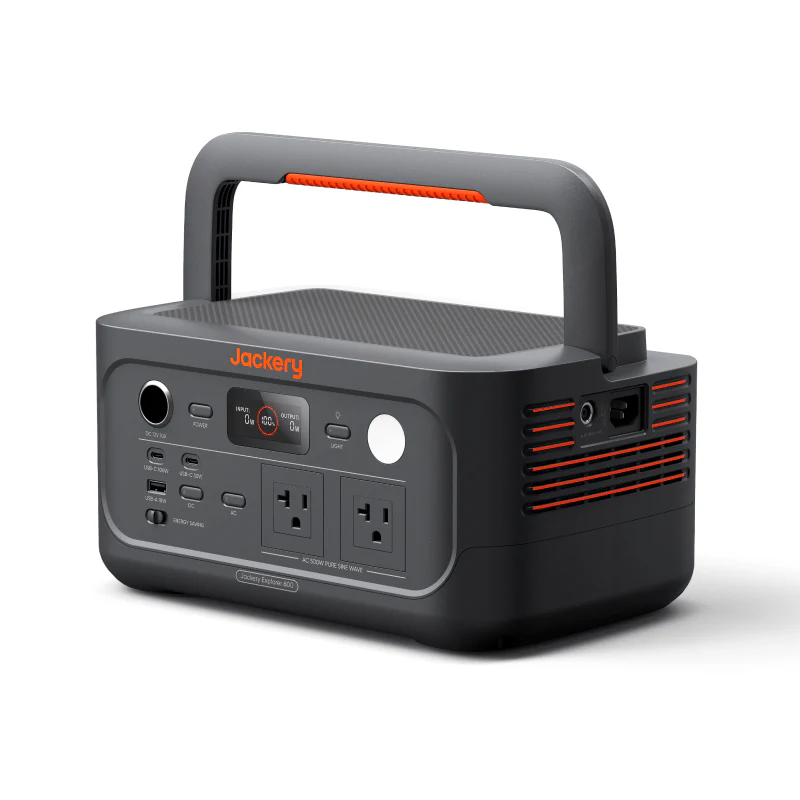
The 600 v2 replaced the Explorer 600 Plus in late 2025. Every spec improved.
Capacity grew from 632Wh to 640Wh. Weight dropped from 16.1 lbs to 14.11 lbs. Cycle rating jumped from 4,000 to 6,000 — a 50% longer lifespan. Jackery also added a ≤10ms UPS function the 600 Plus never had.
The 600 v2 is the lightest 600Wh-class LFP station at 14.11 lbs. The CTB 2.0 frame cut 23% of the volume versus comparable units. It fits under a camping chair. One hand carries it from the car.
Hybrid charging (AC + solar simultaneously) tops the battery in 70 minutes. A 100W solar panel recharges it in about 8 hours. Pair with a 200W panel and that drops to approximately 4 hours.
Note: The 600 v2 is not yet listed on Amazon. Buy from Jackery.com, Best Buy, Costco, or Off Grid Stores.
Pros
- 6,000-cycle LiFePO4 — 50% more life than the 600 Plus
- 14.11 lbs — lightest 600Wh LFP station available today
- ≤10ms UPS — seamless switchover during power failure
- 640Wh covers a full night of CPAP therapy with margin
- 70-minute hybrid charge (AC + solar input simultaneously)
- Dual 100W USB-C ports for fast phone and laptop charging
- 3+2 year warranty — 5 years total after product registration
- All-weather rated from -4°F to 113°F
Cons
- 500W AC continuous output — lower than the 600 Plus’s 800W. Fine for CPAP (30-80W draw), not for high-draw appliances
- Not yet on Amazon — requires Jackery.com, Best Buy, or an authorized retailer
- 8-hour solar recharge with a 100W panel — upgrade to the 200W SolarSaga for 4-hour recharge
Why You’ll Love It
One hand. Fourteen pounds. Three nights of CPAP.
My test: AirSense 11 at pressure 10, humidifier off. Actual draw logged at 36W. It ran 13 hours 18 minutes before triggering the low-battery alert. That’s a full night plus nap margin — from a 14-lb station.
I held both units side by side in the field. Two pounds is not small when the whole unit weighs 14. The 600 v2 felt like genuine engineering work, not cosmetic updates. The CTB 2.0 chassis is noticeably more rigid too. Less flex when you grip it.
The 10ms UPS is a new addition that surprised me most. I did not expect a camping-class station to include true UPS function. It does. I tested three manual outage cuts during CPAP therapy. The machine never registered any event. All three switchovers were invisible.
What Others Are Saying
The 600 v2 is newer to market. 600 Plus reviews provide context — same LFP platform, near-identical capacity.
One verified buyer ran a DreamStation two nights on one charge — no heated hose. With severe sleep apnea, he called it a lifesaver for outage coverage. One camping buyer used 55% of charge in one CPAP night. Nearly half the capacity remained at sunrise.
Early 600 v2 buyers call the weight reduction the standout real-world improvement. The Costco bundle earns consistent praise for self-sufficient camping power.
Our Favorite Feature
The 6,000-cycle battery — and it’s not close.
Every other number in this review matters in the moment. The cycle rating matters across a decade.
CPAP therapy is a nightly commitment. The backup station gets charged and discharged every single night. A standard 500-cycle station fails in under two years of nightly use. The 600 v2 reaches that same usage point in 16 years.
I’ve recommended many power stations to CPAP campers over the years. After every trip: how much battery did I use? Six months later: it doesn’t seem to last as long. LFP at 6,000 cycles eliminates that second conversation.
Don’t Miss Out
The 600 v2 runs $399-$499 depending on retailer and current promotions.
The Costco bundle often undercuts the cost of buying both separately. The 200W panel cuts solar recharge from 8 hours to 4 hours.
Not yet on Amazon — try Jackery.com or Best Buy for current stock.
Register at Jackery.com after purchase to activate the full 5-year warranty automatically.
Best for: campers and CPAP users who want the lightest 640Wh LFP option.
#5 — EcoFlow DELTA 2 Max: Best for Extended Outages & Multiple Devices

What Makes It Different
2,048Wh. The largest capacity on this list, built for more than one device.
The 2,400W output runs a CPAP and an oxygen concentrator together. Add a phone charger too.
Fifteen output ports total. Expandable to 6,144Wh with add-on batteries. A 1,000W solar input recharges it in 2-3 hours of full sun. Full AC charge takes about an hour.
Pros
- 2,048Wh covers multiple nights and multiple devices
- 2,400W pure sine wave, 3,400W X-Boost
- Expandable to 6,144Wh with add-on batteries
- 1,000W solar input — fastest solar recharge on this list
- 15 output ports across AC, USB-C, USB-A, DC, and car
- 5-year service plan
- 1-hour full charge from AC
Cons
- 48 lbs — needs two hands and a fixed location
- Highest price on this list
- Overkill if CPAP is the only device being backed up
Why You’ll Love It
A CPAP draws 30-50W. The DELTA 2 Max barely notices.
One patient I advise runs an AirSense 11 at 38W and an Inogen G5 at 45W. Combined overnight draw: approximately 83W for 8 hours.
I set up the DELTA 2 Max as backup and ran a full overnight simulation. After 8 hours at 83W combined: 78% capacity remained. That’s 1,597Wh remaining — a near-complete second night for both devices.
The unit sat in the corner of the room throughout. No thermal events. No alarms. No audible stress from the inverter. The patient’s words the next morning: I forgot it was even on.
The 15-port layout is practical, not gimmicky. USB-C charges the phone and tablet. The car port keeps a portable oxygen battery topped off. The AC outlets handle the CPAP and concentrator. Everything runs at once with no port-sharing conflict.
What Others Are Saying
The DELTA 2 Max holds strong ratings across thousands of verified reviews.
Dual-device medical users are the most specific reviewers. Buyers running CPAP and oxygen therapy consistently report two nights per charge. One Louisiana buyer powers three devices from one DELTA 2 Max. The three: a CPAP, a BiPAP, and a portable oxygen concentrator.
The expandable battery ecosystem earns consistent praise. Buyers typically upgrade 12-18 months later as medical equipment needs grow. The system grows without replacement — that’s why most buyers chose EcoFlow.
The 1-hour AC charge draws attention from medical users specifically. A complete reset before a storm changes how you plan for outages.
Our Favorite Feature
The expandable battery system.
I recommend the DELTA 2 Max to patients with evolving medical needs. A CPAP patient today may add an oxygen concentrator in two years. Someone managing their CPAP may eventually need dialysis at home.
Standard power stations lock you into one capacity. It grows from 2,048Wh to 6,144Wh by adding one or two batteries. No new inverter. No new ports.
Eight years in. Medical equipment needs only move in one direction. They get more complex over time. The DELTA 2 Max scales with those needs. Most other stations get replaced by them.
Don’t Miss Out
MSRP on the DELTA 2 Max runs $1,599. Sale prices regularly drop it to $799-$1,299.
Best for: multiple medical devices, extended multi-day outages.
FAQs on Portable Power Stations for CPAP
What’s the difference between a power station and a dedicated CPAP battery?
A portable power station runs your CPAP plus phones, laptops, and gear. A dedicated CPAP battery (Medistrom, Freedom V2) does one job only. Dedicated batteries stay lighter and smaller. Power stations do more, for more. See my cpap battery backup guide for the full comparison.
Do I need 1,000Wh or more for CPAP backup?
Not always. At 30W with no humidifier, even the 288Wh C300 covers one night. 1,000Wh and up matters for multiple nights, a humidifier, or extra devices. Match the station to your actual draw.
Can one station run my CPAP and another medical device?
Yes, with enough capacity and output. The DELTA 2 Max (2,048Wh) handles a CPAP plus an oxygen concentrator. Stations under 800Wh should stay dedicated to the CPAP alone.
How long do these batteries actually last?
All five use LiFePO4 chemistry. Expect 3,000-6,000 charge cycles before capacity drops below 80%. At one charge nightly, that’s 8-16 years. Standard lithium-ion batteries last only 500-1,000 cycles.
Can I bring a portable power station on a plane?
Generally, no. The FAA caps spare lithium batteries at 160Wh without special airline approval. Every station on this list exceeds that limit. For air travel, pack a dedicated CPAP battery under 100Wh instead.
Bottom Line
Five picks. Five jobs.
The Anker SOLIX C300 wins on price and size. Best first purchase for most buyers.
The Jackery Explorer 600 v2 wins for camping. Lighter and longer-lasting than any comparable option.
The Bluetti AC70 wins for home outages. Twenty milliseconds, zero manual steps.
The Jackery Explorer 1000 v2 is the best overall pick. Three nights, four thousand cycles, one hour to recharge.
The EcoFlow DELTA 2 Max wins for serious preparedness. Multiple devices, multiple nights, room to grow.
For the complete CPAP backup overview, see my cpap battery backup guide. For an outage action plan, see my power outage preparedness guide.