Transcend CPAP Battery: PowerAway Review & P8 Status
 By Lee Arnold
Medical Solar Power Backup Specialist | 8+ years in the field
Quick Answer:
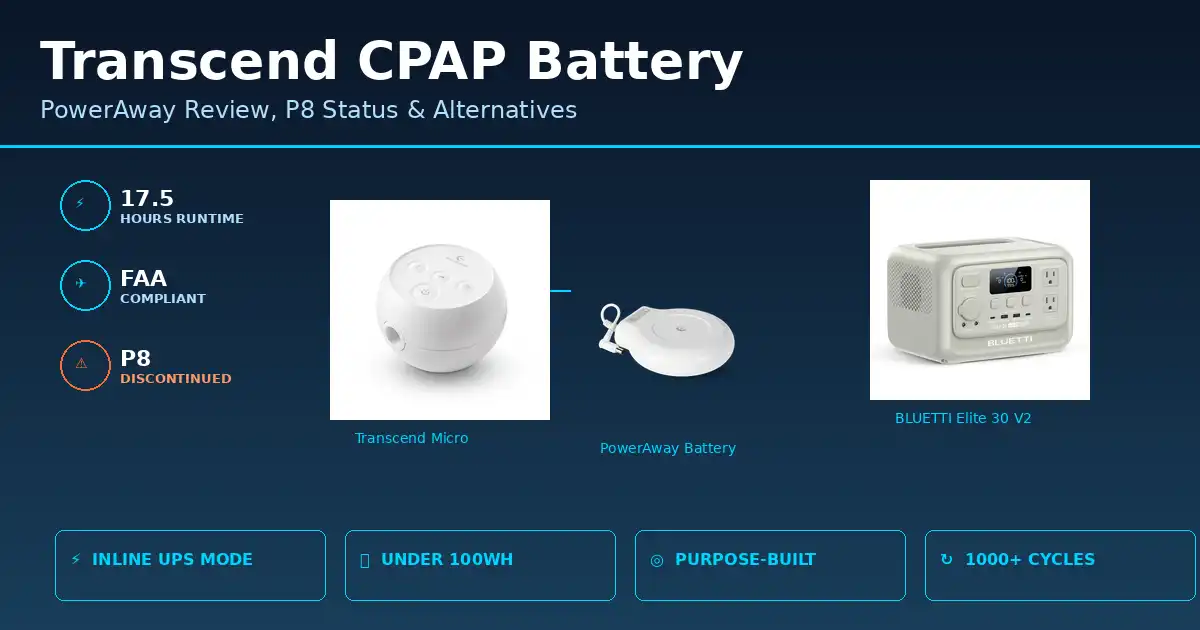
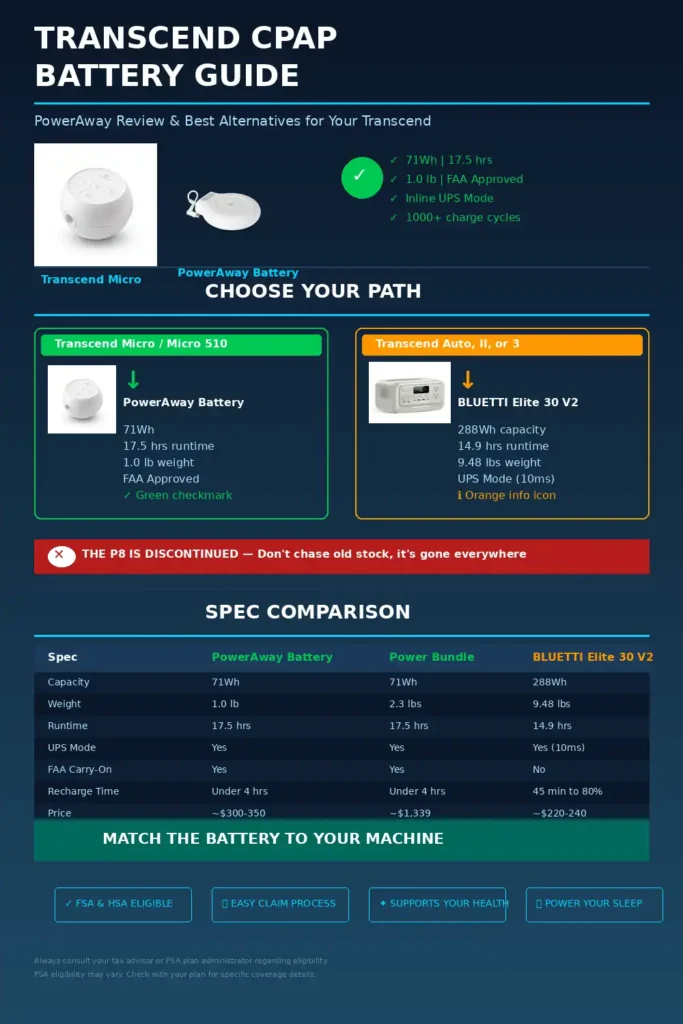
Your machine decides your battery. Own a Transcend Micro or Micro 510? The PowerAway Battery (71Wh, 17.5 hours, via CPAP.com) is built for it. No adapters, no guesswork. Own an older Transcend Auto, II, or 3? The dedicated P8 battery is discontinued and out of stock everywhere. Your best move: a power station with pure sine wave AC output. My current pick is the BLUETTI Elite 30 V2. It preserves the P8’s inline UPS behavior.
Transcend uses a proprietary DC connector across its miniCPAP line. An EASYLONGER or Medistrom cable won’t plug in. The port shape is different. That single fact splits this guide in two. Dedicated-battery path for Micro owners. Power-station path for everyone else.
Table of Contents
What Happened to the P8 (and P4)
Somnetics discontinued both. The P4 went first. The P8 followed. The company shifted engineering entirely to the Micro line.
I want to be direct: outdated reviews still send people chasing it. The P8’s Amazon listing still exists as a page. Stock is unreliable, and CPAP retailers now list it flatly as discontinued. Don’t build a travel plan around finding one.
If you already own a working P8, keep using it. Li-ion cells in these units typically last two to three years, nightly. Capacity drops noticeably after that. If yours failed, or you’re buying new, skip the P8 entirely.
Transcend Micro PowerAway Battery
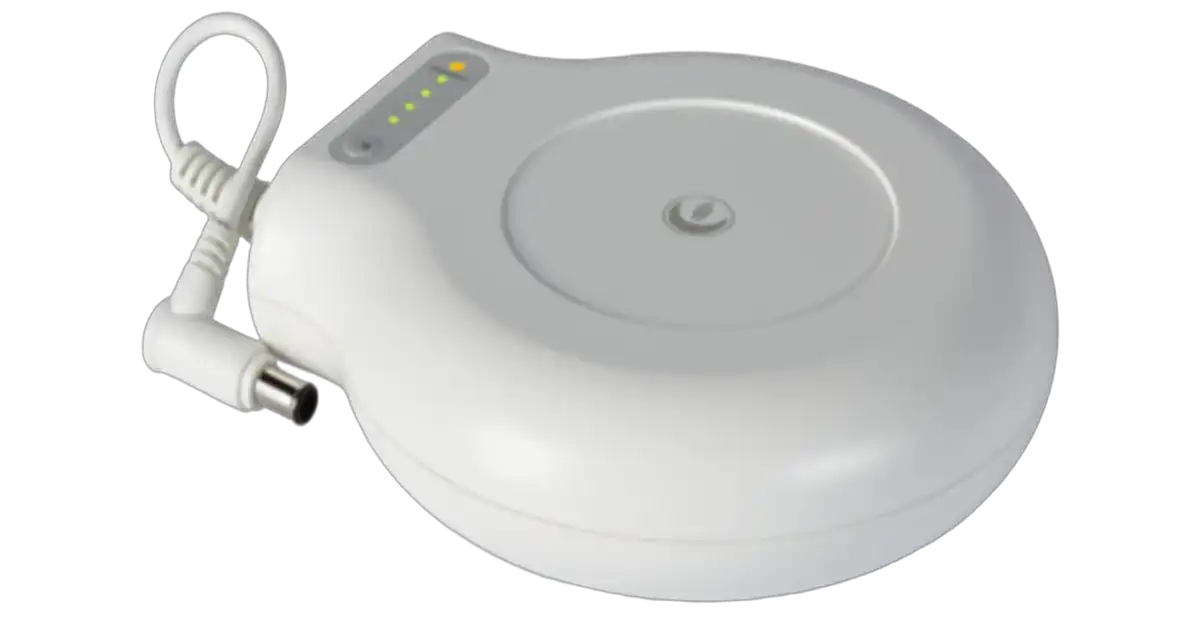
Price: ~$349-439 | 71Wh | 16 oz (1.0 lb) | Requires a valid prescription to ship
This is the battery Somnetics actually engineered for its current machine. It shows. At 16 ounces, it’s about as heavy as a deck of cards. Paired with the Micro 510’s 0.48 lb, the kit stays sub-1.5-lb.
The specs that matter:
- 71Wh capacity — comfortably under the FAA’s 100Wh carry-on threshold, so it flies without airline notification.
- 17.5 hours of stated runtime, covering two full nights for most users at moderate pressure with the humidifier off.
- Under 4 hours to full charge, using the same 40W power supply that came with your Micro. No second charging brick to pack.
- 1,000+ charge cycles — roughly double what standard Li-ion CPAP batteries deliver before capacity starts dropping.
(Note: CPAP.com needs a valid prescription on file before this ships. Same as the machine. Have it ready, or upload it after checkout.)
The standout feature is the inline UPS mode.
It’s the reason I’d pick this battery over a generic power bank, even at a higher price. Leave the PowerAway plugged into wall power with your Micro connected through it. The machine runs on grid power all night, while the battery trickle-charges in the background. If the grid drops at 2 AM, the switch to battery power happens automatically. You don’t wake up, and you don’t have to do anything. This is the same behavior the old P8 offered on older Transcends, carried into the newer battery. The American Academy of Sleep Medicine links consistent nightly CPAP use to better outcomes — exactly what an inline UPS protects.
Real-world runtime tracks close to the stated 17.5 hours if the mask seal holds. A leaking mask forces the motor to work harder. That drains the battery faster than the spec sheet accounts for. True of every CPAP battery. Your exact number depends on pressure and mask fit. Run both through the CPAP Solar Runtime Calculator instead of guessing.
The PowerAway doesn’t include its own power supply. It shares the Micro’s — a smart weight-saving choice. It means you can’t buy the battery standalone. You need the machine or its charger.
Transcend Micro 510 Power Bundle
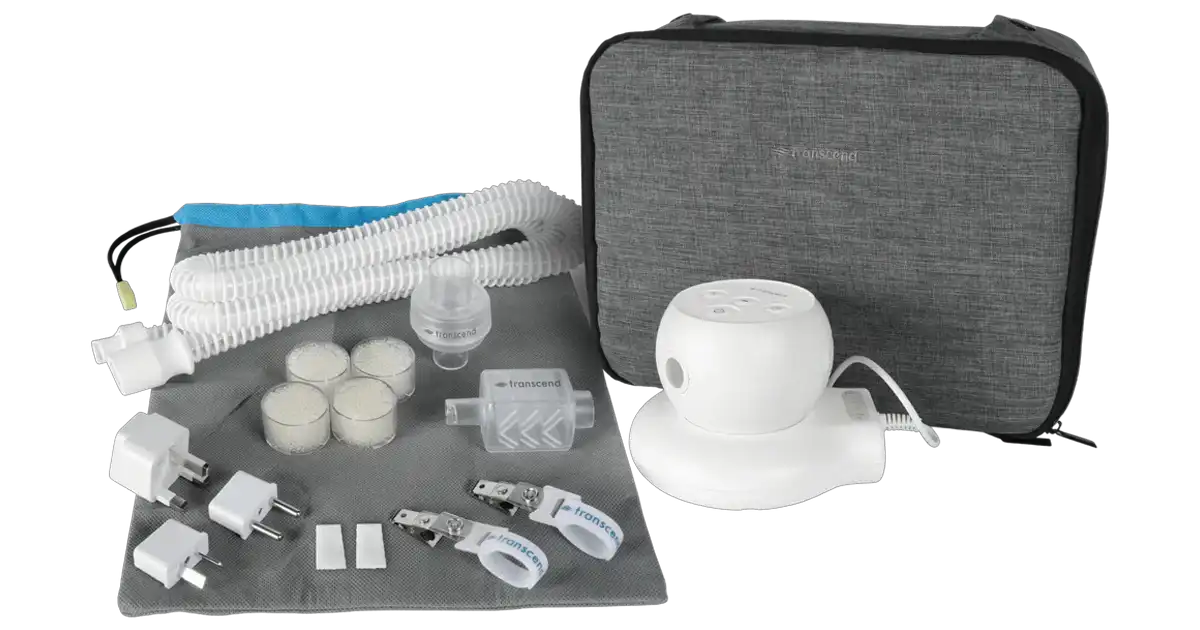
Price: ~$1,339 | Machine: 0.48 lb | Battery: 1.0 lb | Requires a valid prescription to ship
Buying into the Transcend system fresh, rather than upgrading? This is the bundle. It pairs the current Micro 510 with the PowerAway battery. Plus a full year of accessories, in one checkout.
The Micro 510 is a genuine upgrade over the original Micro. It takes any standard 22mm mask. Unlike the battery, there’s no proprietary connector. Keep using whatever mask already fits you. It ships with the AirMist HME waterless humidification kit built in. That matters more than it sounds. No water chamber means one less thing to leak in a suitcase. The warranty runs three years, up from two on the original Micro. A 30-minute drying cycle pushes air through the hose and mask afterward. It cuts mold risk while packed.
(CPAP.com also lists a “Transcend Micro 510 Off Grid Bundle” near $1,500. Same setup, plus the solar charger. Worth it if multi-day off-grid charging matters more than $160. Confirm exact contents on the product page — bundle contents shift.)
Buying the machine and battery together removes compatibility guesswork. No voltage adapters, no separate cable purchase, no wondering if it fits.
Best Alternative for Older Transcends: BLUETTI Elite 30 V2
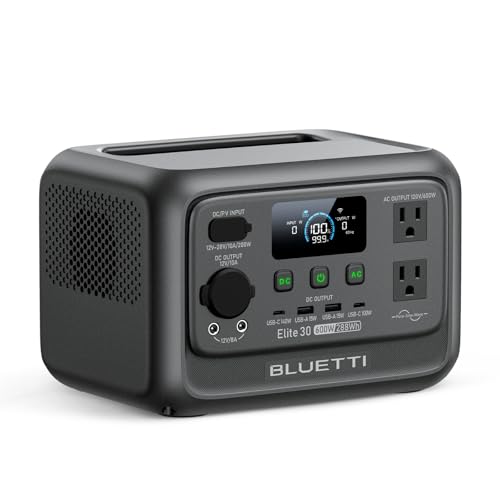
Own a Transcend Auto, II, or 3? No dedicated battery is coming back. The P8 is gone. Somnetics isn’t building a replacement for the older line. The workaround is straightforward. Plug your Transcend’s AC charger into a power station, not the wall.
Any power station with an AC outlet technically works here. My top pick: BLUETTI Elite 30 V2.
Why this one specifically, over more commonly recommended options:
It has a real UPS mode — most budget power stations don’t. This is the deciding factor for me. A CPAP battery used overnight needs to switch to backup power without you doing anything, and the Elite 30 V2 does it in 10 milliseconds. Most competing power stations in this price range either skip pass-through charging entirely or switch over slowly enough to interrupt therapy. Plug the Transcend’s charger into the Elite 30 V2, plug the Elite 30 V2 into the wall, and you’ve rebuilt the P8’s inline UPS behavior in a general-purpose device.
288Wh of LiFePO4 comfortably outlasts a night. At a typical 10-15W draw for an older Transcend at moderate pressure, that capacity clears a full night, even after the AC conversion loss of running through an inverter rather than a direct DC connection.
Pure sine wave output, confirmed independently. I don’t take manufacturer claims at face value. This unit has been oscilloscope-tested by outside reviewers, which is more scrutiny than most budget power stations get. Pure sine wave matters because a CPAP’s internal power supply expects clean AC — modified sine wave can shorten the life of some switch-mode supplies over time.
Recharges fast enough to matter during multi-day outages. 45 minutes gets you to 80% on wall power. If a storm knocks the grid out in waves, that recharge speed is the difference between a topped-off battery and a half-charged one by the next outage.
(The tradeoff: at 9.48 lbs, it’s two pounds heavier than budget picks. It costs more too. For a unit staying plugged in at a bedside, neither cost matters much.)
Running the runtime math:
BLUETTI publishes its own runtime formula: capacity × 95% depth-of-discharge × 90% inverter efficiency. Divide by device wattage, plus idle draw. Idle draw runs about 4.5W on AC-only mode.
For a Transcend Auto at a moderate 12W draw:
288Wh × 0.95 × 0.90 ÷ (12W + 4.5W) = ~14.9 hours
That’s short of a full second night. It clears one night with margin, though. This battery isn’t going anywhere, unlike the P8.
Skip the manual math. The CPAP Solar Runtime Calculator gives an exact number for your Transcend. Curious what the AC conversion actually costs you? Check the DC vs AC Runtime Calculator. A direct DC connection typically recovers 10-15% of what an inverter loses.
Spec Comparison
| Transcend Micro PowerAway | Transcend Micro 510 Power Bundle | BLUETTI Elite 30 V2 | |
|---|---|---|---|
| Best for | Micro / Micro 510 owners | New Transcend buyers | Older Transcend Auto, II, 3 |
| Capacity | 71Wh | 71Wh (same battery) | 288Wh |
| Weight | 1.0 lb | 1.48 lb combined | 9.48 lbs |
| Runtime | ~17.5 hrs | ~17.5 hrs | ~14.9 hrs (via AC) |
| Chemistry | Li-ion | Li-ion | LiFePO4 (3,000+ cycles) |
| UPS / pass-through | Yes, native | Yes, native | Yes, 10ms switchover |
| FAA carry-on | Yes (under 100Wh) | Yes (under 100Wh) | No (exceeds 100Wh) |
| Recharge time | Under 4 hours | Under 4 hours | 45 min to 80% |
| Price | ~$300-350 | ~$1,339 | ~$220-240 |
What I’ve Seen in the Field
Eight years of setting up backup power for CPAP travelers. The Transcend question follows the same pattern every time.
Someone finds an old review recommending the P8. They spend twenty minutes hunting a live listing, then give up frustrated. The fix isn’t a better search. It’s knowing the product line moved on. Once patients understand PowerAway replaced P8, the confusion clears fast.
The second recurring situation: an older-Transcend owner assumes their machine is orphaned. It isn’t. The AC-adapter-into-a-power-station workaround is a real solution, not a consolation prize. I’ve had patients run this exact setup through multi-day outages without issue. The only mistake I see repeatedly: skipping pass-through charging. Then being surprised it doesn’t behave like the old P8.
FAQs
Is the Transcend P8 still available anywhere?
Sporadically, through third-party CPAP retailers clearing old stock. Somnetics has discontinued it, and Amazon availability is unreliable. Don’t plan a purchase around finding one. For dedicated Transcend battery power today, the PowerAway is the option. Micro and Micro 510 only.
Can I use a Medistrom or EASYLONGER battery with my Transcend?
Not through a direct DC connection. Transcend’s power port is proprietary. Universal CPAP battery cables don’t fit. A power station with an AC outlet works around this. Your Transcend’s own AC adapter plugs in normally.
Does the PowerAway work with older Transcend machines?
No. It’s built exclusively for the Transcend Micro and Micro 510. Older Auto, II, and 3 owners need the power-station route instead.
Is the BLUETTI Elite 30 V2 FAA-approved for carry-on?
No. At 288Wh, it exceeds the FAA’s 100Wh carry-on threshold. It isn’t airline-legal without special approval. Most airlines won’t grant it at this size. It’s built for home and camping backup, not air travel. Older Transcend and flying? Look for a sub-100Wh unit instead. Expect shorter runtime.
Do I need a prescription to buy the PowerAway battery?
Yes, through CPAP.com. Federal law requires a prescription on file before it ships. Same as any CPAP accessory through a licensed retailer. Amazon listings for CPAP-adjacent batteries don’t always enforce this. Requirements vary by seller.
Final Verdict
Match the battery to the machine you own. Not the one the internet used to recommend.
Micro or Micro 510 owner? The PowerAway is the only battery worth considering. It’s purpose-built, it flies without paperwork. Its inline UPS mode means a night outage doesn’t wake you up.
New to Transcend? The Power Bundle removes every compatibility question. Machine and battery, paired from day one.
Older Transcend Auto, II, or 3 owner: stop looking for the P8. It’s gone. Run through the Transcend’s AC adapter, it replicates the P8’s best trick. Automatic switchover — still being made, unlike the P8.
My cpap battery backup guide covers every dedicated and universal battery brand. Air travel with any of these? Check the FAA’s carry-on lithium battery rules first.