12 Volt CPAP Machine Guide: DC Models and Off-Grid Power Setup
 By Lee Arnold
Medical Solar Power Backup Specialist | 8+ years in the field
Quick Answer:
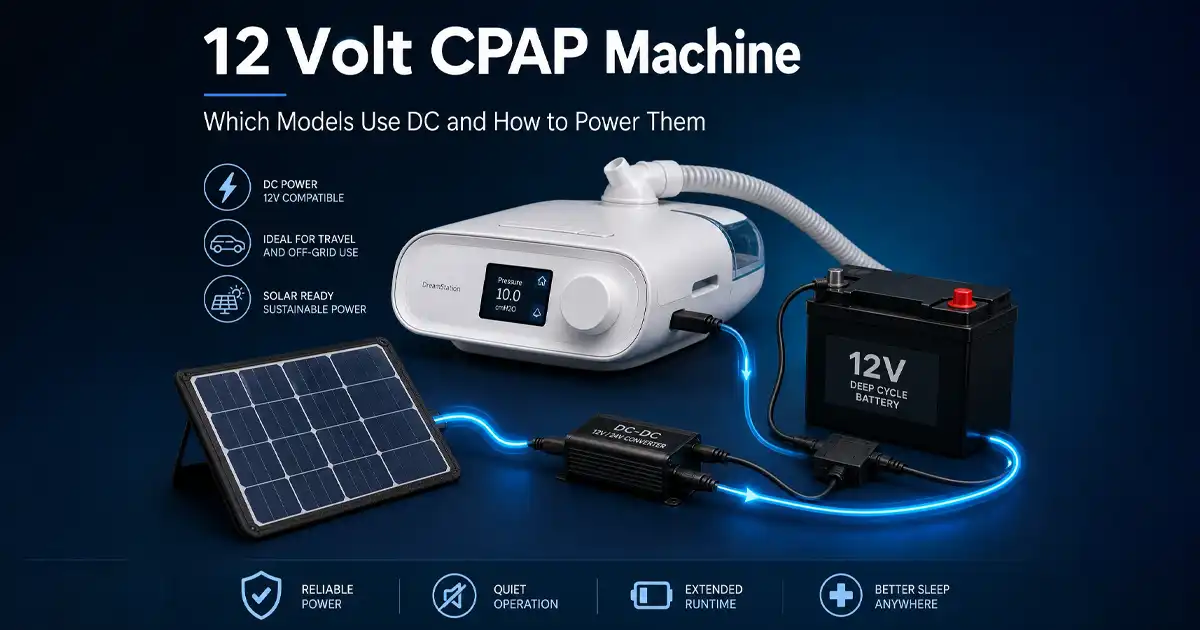
A 12 volt CPAP machine accepts 12V DC power directly from a battery. This direct connection skips the power inverter entirely. Bypassing the AC inverter saves roughly 10 to 15 percent of your total battery capacity. The Philips DreamStation 1 and 2 represent the most popular 12V native machines on the market. ResMed AirSense and AirCurve models run on 24V DC. You must use a step-up converter to power a 24V ResMed machine from a standard 12V battery.
Well, a dead CPAP battery can easily ruin a good camping trip. Believe me, I learned this the hard way during my early days of building off-grid rigs in the Mojave Desert. As a Medical Solar Power Backup Specialist with over 8 years of hands-on experience, I troubleshoot these setups constantly.
Actually, the secret to endless off-grid therapy is shockingly simple. You just need a native 12 volt CPAP machine.
Table of Contents
Why Native 12V DC Matters for Off-Grid Power
Every standard CPAP plugs into a regular house wall outlet. That wall outlet pushes alternating current (AC). Your machine uses a heavy adapter box to turn that AC into direct current (DC).
Things change fast when you leave the house. Solar panels, car batteries, and portable power banks all store energy as DC.
A native 12V CPAP connects straight to a 12V battery. We call this a direct DC path. You lose zero power to clunky conversions. A 24V machine forces you to plug in an inverter or a step-up converter. Both of those devices waste precious battery juice as heat. At night, that wasted energy adds up fast. You might lose an entire extra night of sleep over a long weekend just from conversion loss.
Which CPAP Machines Are 12V?
The following CPAP machines accept 12V DC input with the appropriate cable:
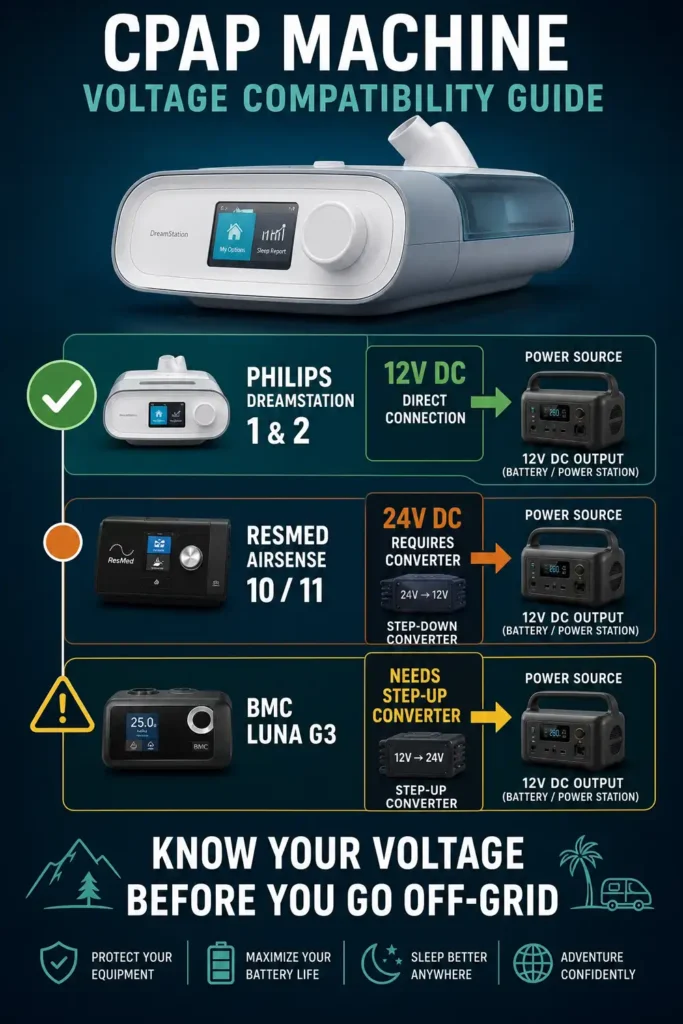
Philips DreamStation 1 and 2: These serve as the gold standard for off-grid users. Both generations accept 12V directly. You simply buy the official Philips 12V DC adapter cord to connect straight to a battery.
BMC Luna G3 (24V DC — requires step-up converter) The Luna G3 operates at 24V DC internally. It does NOT accept direct 12V input. The Luna G3 needs a 12V-to-24V step-up converter for any 12V source. ‘Luna G3 compatible’ batteries provide a 24V DC port — not 12V direct. Verify the adapter rates at 24V output before any Luna G3 use.
ResMed S9 (24V DC, some configurations) The ResMed S9 used a climate control module that complicates voltage. Some S9 configurations accept 12V with a specific converter. Verify before purchasing any adapter — the S9 has multiple power configurations.
HDM Z1 and Z2 (7.4V DC) The Z1 and Z2 are dedicated travel CPAPs with proprietary battery systems. They do not accept standard 12V input. Use only HDM-branded battery accessories.
Transcend Auto (12–15V DC range) Transcend machines accept a range of DC input voltages. They are compatible with the Transcend P4 and P8 battery systems. Verify your specific Transcend model’s voltage requirement before using a 12V source.
Which CPAP Machines Are 24V?
Many folks accidentally fry their equipment right here. The following machines do not accept 12V.
- ResMed AirSense 10 and 11: Both require a strict 24V power supply. The official ResMed DC converter safely steps 12V car battery power up to 24V for these devices.
- ResMed AirCurve Series: These BiPAP machines also demand 24V.
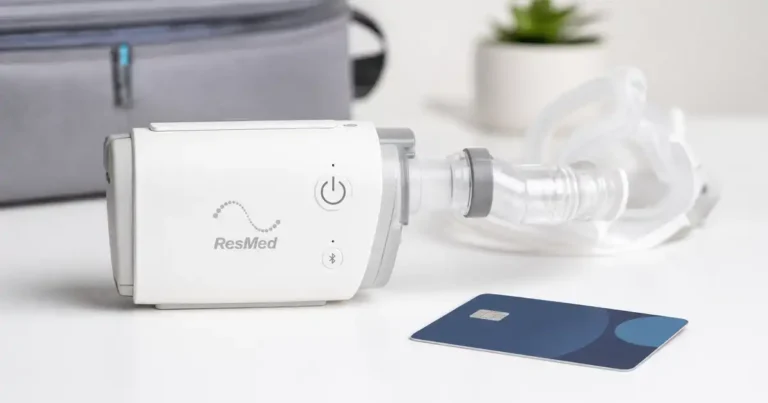
- ResMed AirMini: The tiny travel version still needs 24V to operate.
- BMC Luna G3: The manufacturer label specifies 24V internally. You must buy a special 12V-to-24V converter cord to use a standard car battery.
Do not plug a 12V cord into a 24V machine. The unit will beep, show an error code, or fail to start completely.
These machines will not work correctly on 12V DC. A 24V machine connected to a 12V source receives insufficient power. The machine may alarm, fail to start, or run at incorrect pressure. A step-up converter boosts 12V to 24V but introduces conversion losses.
Why 12V DC Matters for Off-Grid CPAP Use
Car Battery and Vehicle Power
A standard vehicle battery delivers 12-12.6V at rest. This matches the 12V DC input requirement exactly. A 12V CPAP connects to any car or RV battery via DC cable.
A car battery carries approximately 600-800Wh at a safe depth of discharge. At 30W CPAP draw, 600Wh covers 20+ hours of therapy.
A 12V CPAP with house battery and solar is the simplest off-grid setup. No power station needed. No inverter. Just a DC cable and a battery.
Solar Charging Compatibility
Solar panels output DC power, typically at 12V or higher. A 12V MPPT charge controller connects solar panels to the battery bank. A 12V CPAP machine draws from that battery directly. The solar panel recharges the battery. The loop runs indefinitely with adequate sun. A 100W solar panel refills a depleted 500Wh battery in 4-6 hours of direct sunlight — enough to recharge between camp nights.
This is a fundamentally different approach than the 24V power station setup. The 12V setup uses commodity parts: batteries, panels, and controllers. A 24V setup needs a purpose-built power station — at higher cost.
See my 12v dc cpap solar guide for the full solar setup. For travel CPAP setups, see my travel cpap with battery guide.
Humidifier Power Reality
The heated humidifier is the biggest variable in 12V CPAP battery planning. CPAP with heater off: 10-15W. CPAP with heater on: 50-60W. That 4-5x gap determines one night of coverage versus a full weekend.
At 15W with humidifier off, a 50Ah car battery covers 20 hours. At 55W with humidifier on, the same battery lasts under 5 hours. Most experienced 12V CPAP campers run without the humidifier. A passive HME filter preserves airway moisture without any power draw.
Efficiency Advantage
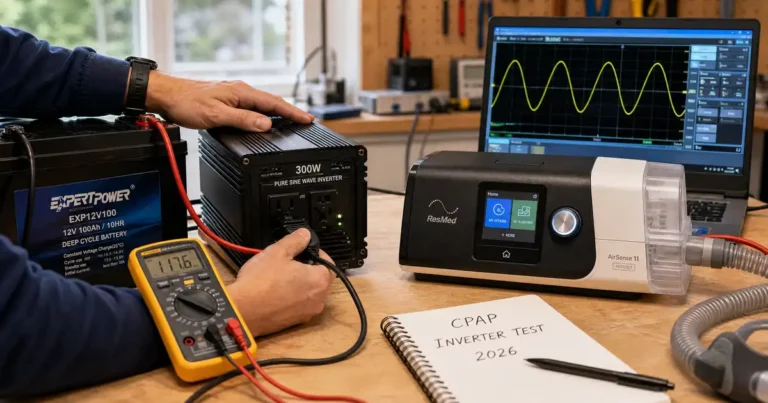
A CPAP running via its native DC voltage skips the inverter entirely. An inverter converts DC to AC — losing 8-15% of usable energy. At 30W over 8 hours, that’s 2.4-3.6Wh of wasted energy nightly. Over a week of camping, that adds up to one extra night.
The AASM recommends consistent nightly CPAP therapy without interruption. The NSF links power failures to inconsistent CPAP use. The efficiency advantage of 12V DC helps the battery last all night.
What You Need to Run a 12V CPAP from a Battery
1. Confirm Your Machine’s DC Voltage
Check your CPAP manual or the label on the AC adapter. Adapter labels print the output voltage — usually 12V or 24V. Do not guess. Wrong voltage damages the machine.
2. Get the Correct DC Cable
Every 12V CPAP needs a specific DC cable with the right connector. A generic 12V car charger cable will not fit most CPAP machines. Brand-specific cables are sold by:
- The CPAP manufacturer (highest reliability)
- Third-party cable makers on Amazon (widely available, verify reviews)
- Dedicated CPAP battery brands (EASYLONGER, Medistrom, and others include cables in the box)
3. Choose Your Power Source
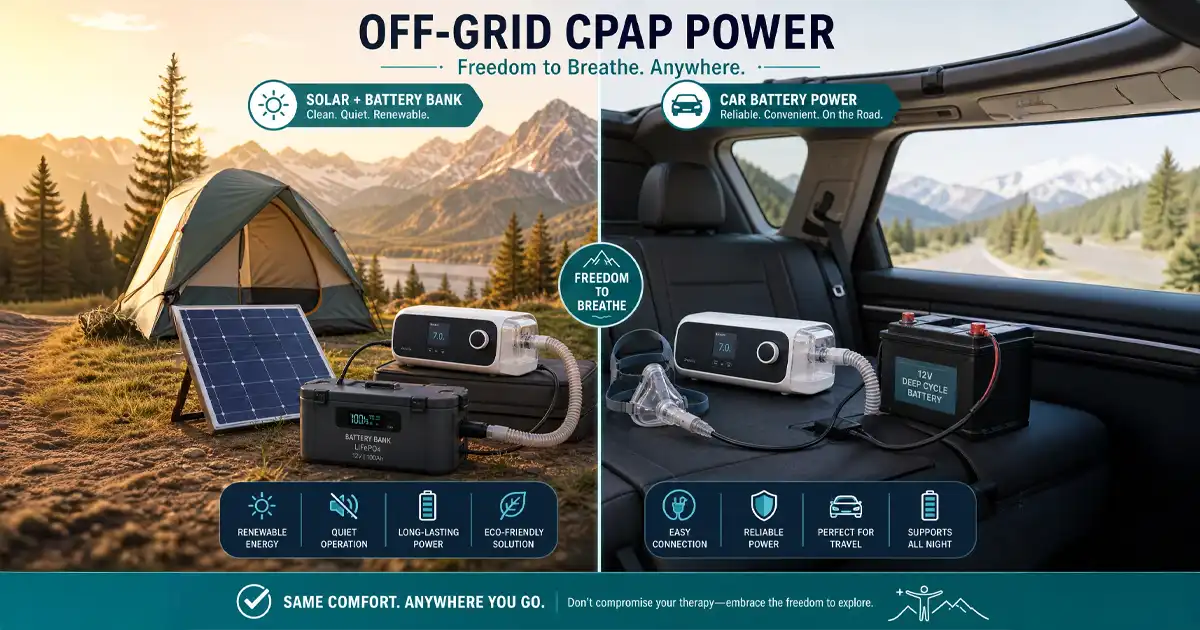
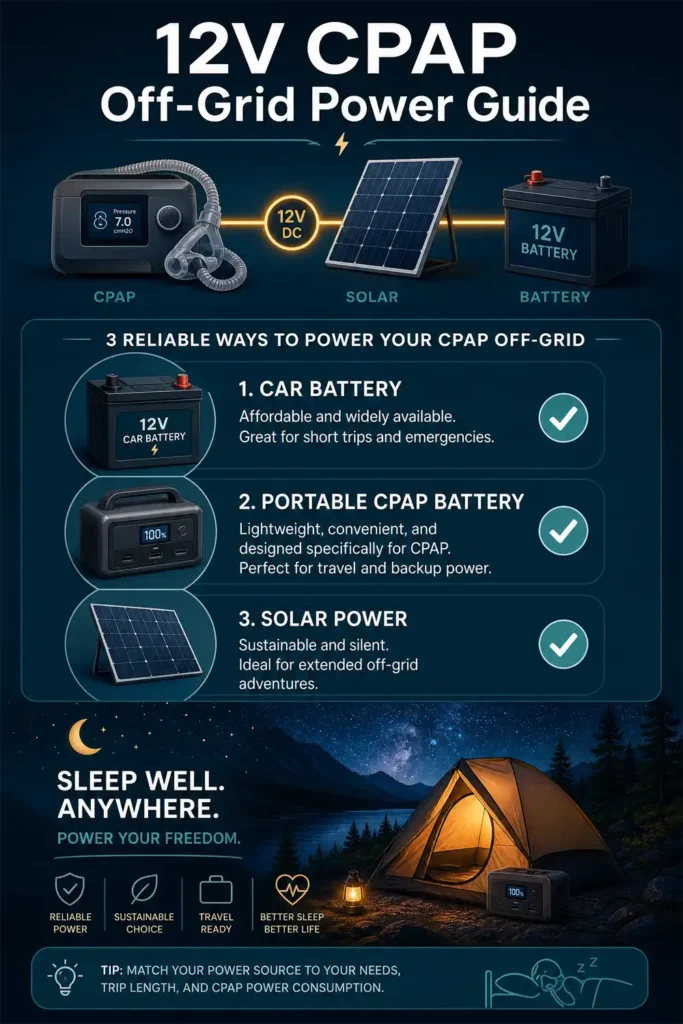
Car or RV battery: Your car battery holds a massive amount of power. A standard vehicle battery rests right around 12.6V. This perfectly matches your 12V CPAP. You just plug a specific CPAP 12V adapter into your vehicle’s cigarette lighter port. A healthy 50Ah car battery easily powers a basic CPAP for over 20 hours.
Dedicated CPAP battery: Brands like Medistrom and EASYLONGER sell small lithium battery banks. These spit out 12V DC exactly. You skip the wall plug completely. These lightweight battery packs slide right into a backpack for easy travel. To pick the right model for your machine, read my full CPAP battery backup guide.
Solar Panel Setups: Solar remains my absolute favorite method. You connect a 100W solar panel to a small charge controller. That controller feeds a 12V LiFePO4 battery. Your CPAP runs directly off that battery all night. The sun refills the tank the next day. You can camp for weeks like this. Ensure you check your exact CPAP machine’s wattage draw to size your battery correctly.
Portable power station via DC socket: Most portable power stations include a 12V car-style DC socket. The CPAP connects via a 12V car adapter cable. This adds a small conversion step but is more efficient than AC.
Portable power station via AC: The CPAP’s original power adapter connects to the station’s AC outlet. Most efficient for machines that also use a humidifier — the humidifier requires AC anyway.
The Heated Humidifier Problem
We need to talk about water. The heated humidifier drains power faster than anything else in your setup.
A basic CPAP pulls about 10W to 15W of power. Turn on the heated plate, and that draw jumps to 50W or 60W. That massive spike will drain a small car battery before morning. I always advise my clients to leave the humidifier at home. Try a passive HME (Heat and Moisture Exchanger) filter instead. These tiny discs capture your own breath moisture and cost zero electricity.
My Top Off-Grid CPAP Mistakes to Avoid
Over the years, I’ve troubleshot hundreds of off-grid CPAP setups. Here are the four fastest ways to ruin your battery or your machine:
Using a 12V adapter on a 24V machine: This is the number one error I see. Verify your machine’s voltage requirement before purchasing any DC adapter. A 24V machine connected to a 12V source will alarm, fail to start, or deliver the wrong pressure.
Skipping the inline fuse: Connecting directly to a car battery without an inline fuse risks a fire if the circuit shorts. Always use a fused cable (most reputable CPAP DC cables include one).
Running the humidifier on DC power: Most 12V CPAP machines disable the heated humidifier during DC operation by design. Heating water draws massive wattage. If you are building a CPAP battery backup system, plan to use a passive HME filter (like a HumidX) and accept dry therapy to save power.
Cheap Generic Cables: Generic laptop chargers will ruin sensitive medical equipment. Buy the brand-name DC adapter for your specific machine model.
Overloading a small battery: A compact jump-starter battery might not supply the sustained amperage a CPAP needs all night. Always verify your battery’s sustained output against your specific CPAP machine’s wattage draw.
FAQs
Can I run any CPAP machine from a car battery?
Any CPAP runs from a car battery via AC through an inverter. A 12V CPAP machine can also run directly via DC cable. A 24V CPAP needs a step-up converter or inverter for 12V sources.
Does running a CPAP on 12V DC damage the machine?
Not when done correctly. The machine’s internal power supply is designed for its specified DC voltage. Use the correct voltage and cable — the machine runs normally.
Can I use the humidifier during 12V DC operation?
The DreamStation runs its heated humidifier on DC with the correct Philips cord. Many simpler DC cables do disable the humidifier. Confirm cord compatibility before assuming humidifier access during DC use. The Luna G3 disables its humidifier during DC operation. It also needs a step-up converter for any 12V source.
What cable do I need for DreamStation 12V operation?
The DreamStation uses a proprietary DC input connector. A DreamStation-specific 12V cable is needed — sold by Philips Respironics or third-party sellers on Amazon. Confirm compatibility with DreamStation 1 or DreamStation 2 before ordering.
How long will a car battery power a 12V CPAP?
A 12V battery at 50Ah has 600Wh of total capacity. At a 50% safe depth of discharge, 300Wh is usable. At 30W, 300Wh gives 10 hours — a full night with margin. Most standard car batteries carry 40-60Ah. A 100Ah RV battery provides 500Wh usable — 16+ hours at 30W.
Bottom Line
A 12V CPAP is the best starting point for off-grid therapy. Direct DC connection to any battery eliminates inverter losses.
The DreamStation 1 and DreamStation 2 are the main 12V CPAP machines. For DreamStation campers, a 12V DC cable is the highest-value add. The Luna G3 needs 24V: step-up converter or 24V-output CPAP battery.