Pure Sine Wave vs Modified Sine Wave for Medical Devices: What ResMed Actually Says
 By Lee Arnold
Medical Solar Power Backup Specialist | 8+ years in the field
Quick Answer:
ResMed’s own official battery guide recommends a pure sine wave inverter rated at 300W continuous with a 500W peak/surge rating for their CPAP and BiPAP devices — not a vague “use pure sine wave” suggestion, a specific documented spec. The mechanism is real: modified sine wave power is a stepped approximation of true AC, and the resulting electrical noise can interfere with a motor’s pressure-control feedback loop and a humidifier’s heating circuitry. One nuance almost every article on this topic skips: it’s often specifically the humidifier’s heating control, not the blower motor itself, that’s most sensitive — some CPAP flow generators tolerate modified sine wave for the motor alone while their humidifier does not.
Nearly every article on this exact topic repeats the same claims — 25% to 30% more heat, motor damage, warranty voiding — without citing where those numbers come from. I went looking for the actual source. This one is built from ResMed’s own published battery guide and documented forum exchanges with ResMed technical support, not another repost of the same uncited figures.
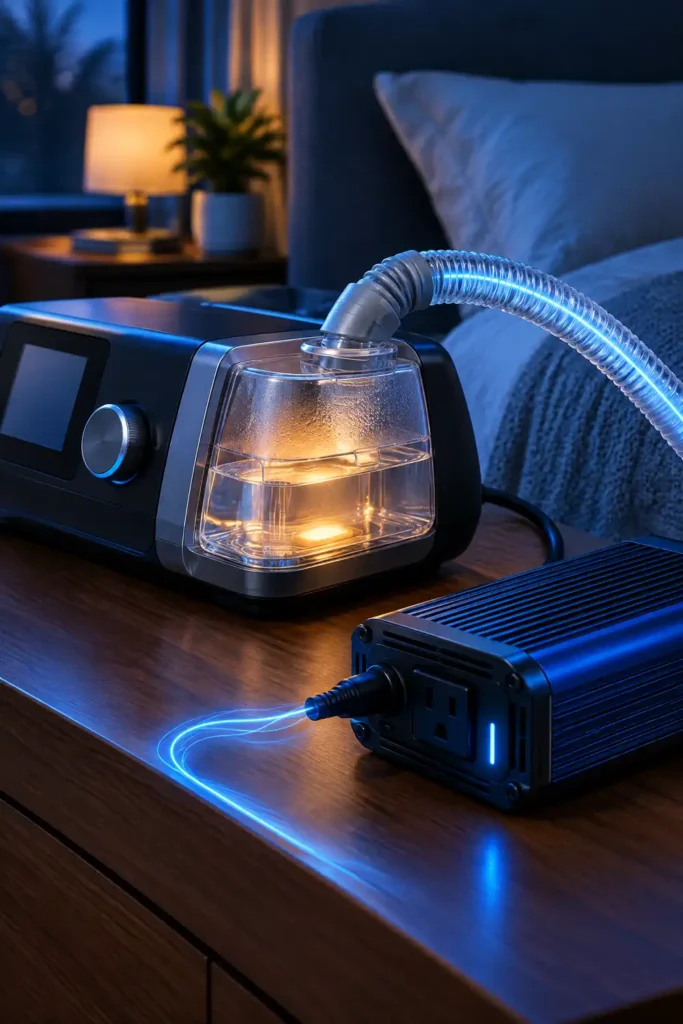
Table of Contents
What’s Actually Different, Electrically
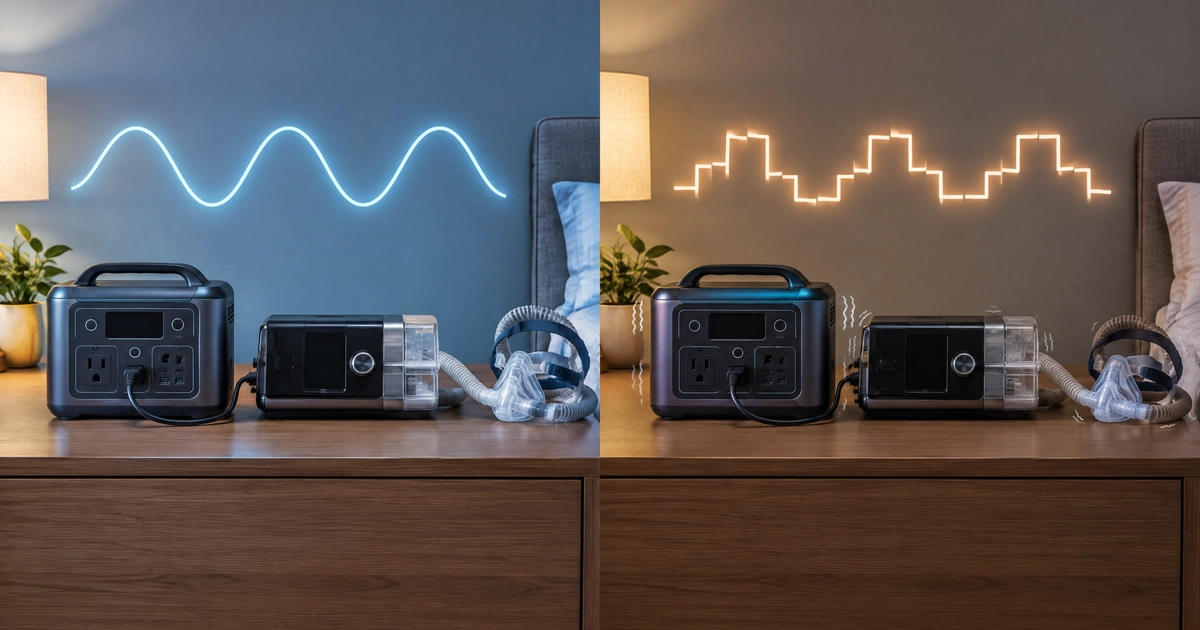
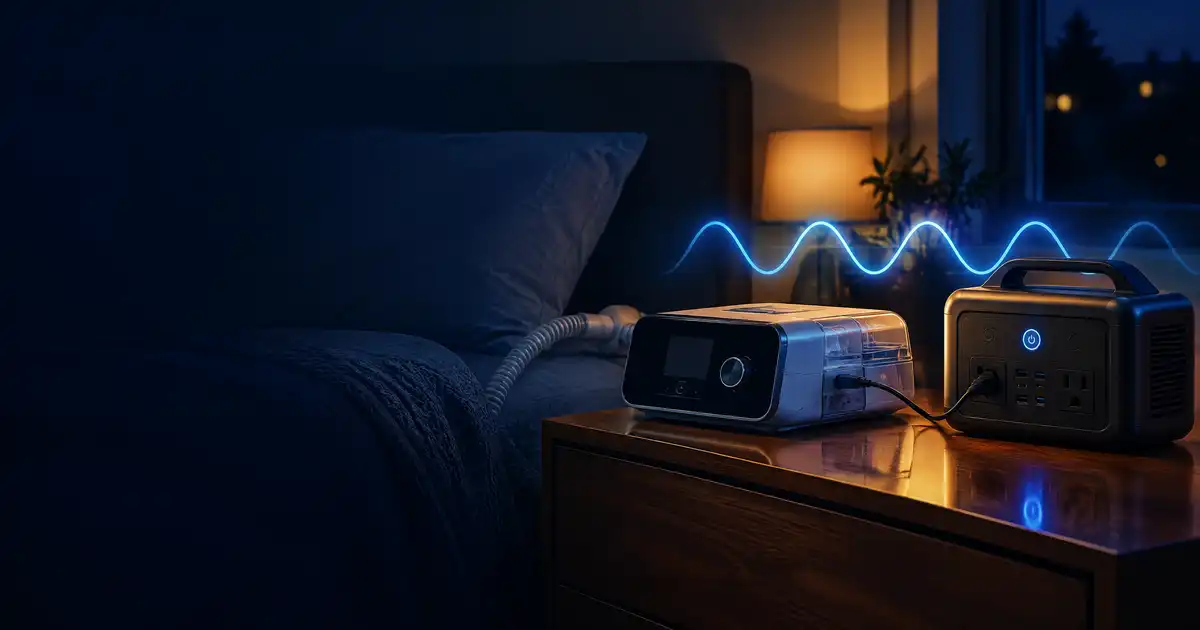
A pure sine wave is a smooth, continuous curve — identical in shape to the AC power coming out of a wall outlet. A modified sine wave is a stepped, blocky approximation: it gets the voltage roughly right on average but arrives in abrupt jumps rather than a smooth curve. That abruptness is measurable as total harmonic distortion (THD) — a real, standard electrical engineering metric, not a marketing term. Pure sine wave inverters typically run under 3% THD; modified sine wave units run dramatically higher.
For a simple resistive load — an incandescent bulb, a basic space heater — that distortion barely matters, since the load just converts current to heat or light regardless of waveform shape. It matters more for anything with a motor or a microprocessor-controlled feedback loop, which describes most of what’s inside a CPAP, BiPAP, or oxygen concentrator.
What ResMed’s Own Documentation Actually Requires
ResMed’s official battery guide states plainly: “We recommend using a pure sine wave inverter with a continuous power rating of 300 watts and a peak/surge rating of 500 watts,” with an additional warning to use only inverters certified by an accredited testing organization — VDE, TSU, BSI, CE, or UL. That’s a specific, documented spec from the manufacturer, not a general “pure sine wave is safer” suggestion.
There’s a genuine nuance buried in ResMed’s own guidance, though, that most third-party articles flatten into a blanket rule: older ResMed devices using H2i, H3i, or H4i humidifiers specifically need the full 300W/500W pure sine wave spec, while some non-humidified configurations have historically tolerated a 150W-or-higher modified sine wave inverter, per ResMed’s own travel guide. Documented exchanges with ResMed technical support go further: the S7 and S8 flow generators reportedly run fine on modified sine wave power, but their humidifiers specifically require pure sine wave. The blower motor and the humidifier’s heating control aren’t equally sensitive — the humidifier is consistently the more fragile piece.
This doesn’t mean modified sine wave is fine for the current AirSense/AirCurve generation — it isn’t, and current ResMed guidance is unambiguous about the full 300W/500W pure sine wave spec for their current lineup. It means the reason is more specific than “medical devices are sensitive,” and understanding which component is actually at risk explains why some older or humidifier-free setups seemed to tolerate modified sine wave in ways that confused people for years.
What Modified Sine Wave Actually Risks
Based on ResMed’s own documentation and consistent, independently-reported technical patterns — not the recycled heat-percentage claims:
Humidifier and heated-tube malfunction. The heating element’s control circuitry can behave unpredictably on distorted power, ranging from inconsistent heat output to the device shutting the heater down entirely.
Motor feedback noise. CPAP and oxygen concentrator blowers rely on precise current sensing to regulate pressure or flow accurately — electrical noise from a stepped waveform can interfere with that feedback loop, which for a device whose entire job is delivering an accurate, prescribed pressure is a therapy-accuracy concern, not just a comfort one.
Audible buzzing. Motor windings can vibrate audibly on modified sine wave power — an actual reported symptom, not a comfort exaggeration, and a reasonable early warning sign something’s wrong before a bigger failure shows up.
Warranty exposure. Multiple manufacturers’ documentation excludes damage caused by non-approved power sources from warranty coverage — worth checking your specific device’s terms rather than assuming coverage either way.
On the widely-repeated “25% to 30% more heat” figure: I could not trace this to a primary source despite it appearing near-verbatim across several unrelated sites. It’s plausible in direction — distorted power does generally produce more waste heat in switch-mode power supplies — but I’m not going to present someone else’s uncited number as a verified fact. Treat it as directionally true, not a precise measurement.
How to Verify a Power Station Is Genuinely Pure Sine Wave
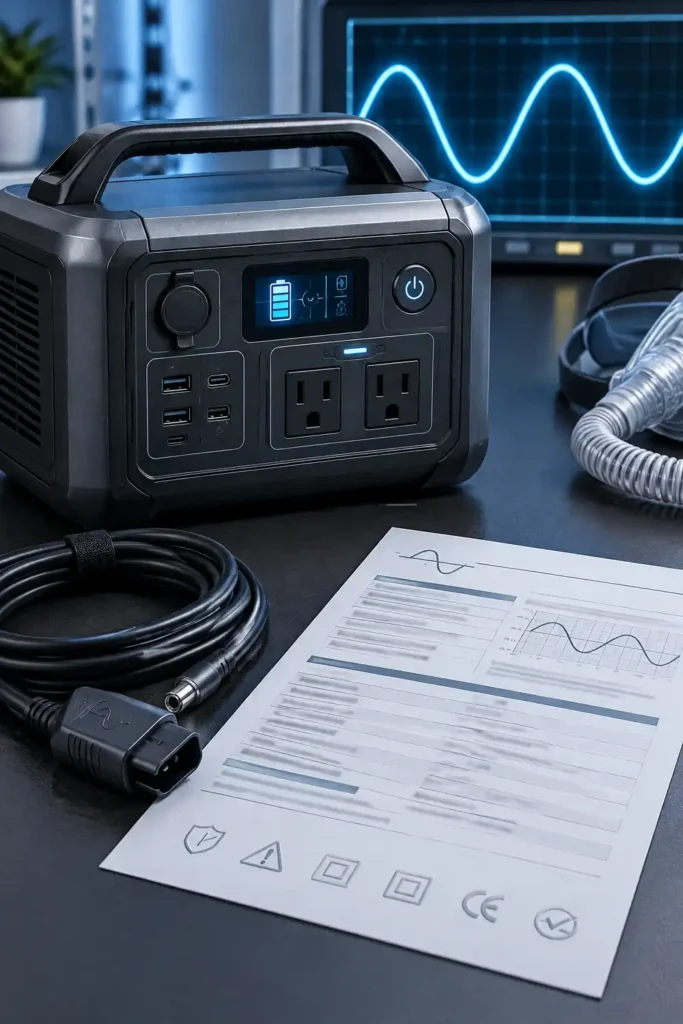
Check the spec sheet for “pure sine wave” stated explicitly, not just “AC output” or “inverter included.” Some budget units bury a modified sine wave inverter behind vague marketing language.
Match or exceed ResMed’s documented benchmark: 300W continuous, 500W peak/surge, as a reasonable general target even if you don’t use ResMed equipment specifically — it’s a real, manufacturer-published number worth using as a baseline.
Look for third-party certification — UL, CE, VDE — the same standard ResMed’s own guidance calls out directly, rather than trusting “pure sine wave” as a bare marketing claim with no certification behind it.
Every power station recommended across this site — the Jackery and EcoFlow units covered in the Inogen Rove 6 solar charging, Inogen At Home solar backup, and DreamStation 2 solar backup guides — is confirmed genuine pure sine wave for exactly this reason, not a default assumption.
Real Devices, Real Numbers
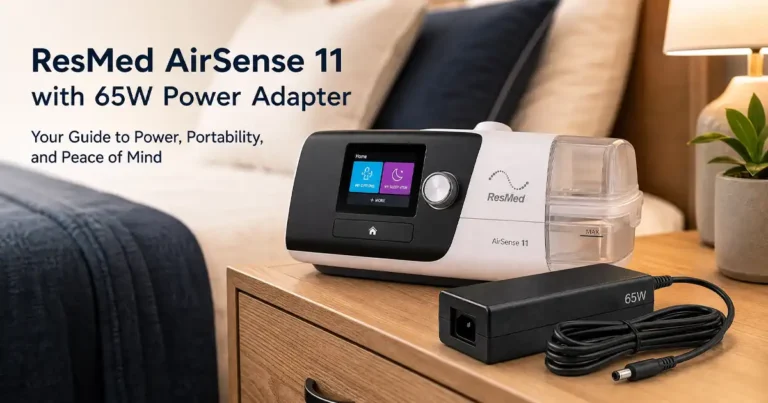
This isn’t abstract for the equipment already covered in depth on this site. The ResMed AirSense 11 draws up to 65W and uses a third-pin handshake that’s particular about its power source to begin with. The Inogen Rove 6 runs a 120W compressor — a genuine motor load, not just electronics, where feedback-loop noise matters. The Inogen At Home runs continuously for hours at a stretch, meaning any waveform-related stress compounds over a much longer exposure window than an 8-hour CPAP night. Different devices, same underlying requirement.
FAQs
Will a modified sine wave inverter damage my CPAP immediately?
Not necessarily immediately — damage from waveform distortion is often gradual, showing up as reduced component lifespan or intermittent malfunction rather than instant failure. That gradual pattern is part of why the risk gets underestimated; nothing visibly goes wrong the first night.
Can I use modified sine wave if I don’t use a heated humidifier?
Some older devices have historically tolerated this for the motor alone, per ResMed’s own documented guidance — but current-generation devices (AirSense 10/11, DreamStation 2, and similar) are specified for pure sine wave across the board by their manufacturers. Don’t extrapolate an old device’s tolerance to a current one.
Does this apply to oxygen concentrators too, or just CPAP?
Yes — any device with a compressor motor and microprocessor-controlled feedback, which describes portable and stationary oxygen concentrators as much as CPAP and BiPAP machines. The specific component at risk (motor feedback vs. heating control) varies by device type, but the pure sine wave requirement is consistent across this equipment category.
How do I know if my current power station is pure sine wave without buying a new one?
Check the manufacturer’s spec sheet or product manual directly — “pure sine wave” should be stated explicitly. No confirmation anywhere means treating it as unconfirmed rather than assuming it’s fine.
Bottom Line
ResMed’s own battery guide gives a specific, documented spec — 300W continuous, 500W peak, genuine pure sine wave — not a vague safety suggestion, and that’s a stronger basis for this rule than the uncited heat-percentage claims repeated across most articles on this topic. The real nuance most guides miss: it’s often the humidifier’s heating control specifically, more than the blower motor, that’s the fragile piece — which explains why some older or humidifier-free setups seemed to get away with modified sine wave in ways that don’t apply to current-generation equipment.
For verified pure sine wave gear already matched to specific devices, see the Inogen Rove 6, Inogen At Home, and DreamStation 2 solar backup guides, and for the pillar-level picture on solar generators for medical devices, the best solar generator for medical devices guide.