LiFePO4 Batteries for Medical Devices: A Safety Guide
 By Lee Arnold
Medical Solar Power Backup Specialist | 8+ years in the field
Quick Answer:
LiFePO4 is the most thermally stable lithium chemistry available for medical backup power, with a meaningfully higher runaway threshold than other lithium types and cells sealed enough that there’s no free-flowing electrolyte to leak even if the case is cracked. The real safety questions aren’t about whether it’s “safe” in the abstract — they’re specific and easy to get wrong: what certification actually means something (UL 2054), how it needs to be disposed of when it’s done, and a rule almost nobody checks before a flight — LiFePO4 batteries over 160Wh are barred from passenger aircraft entirely, in both carry-on and checked baggage. We’ll compare each of these against lead acid along the way, since the contrast is what makes the LiFePO4-specific numbers meaningful.
This guide is about what actually determines whether a LiFePO4 battery is safe in practice — failure modes, certification, disposal, and travel rules — not whether to buy LiFePO4 over lead acid in the first place, which we cover separately in our LiFePO4 vs lead acid comparison. Most content on this topic skips the practical rules entirely in favor of “lithium is safer” generalities, which is true in aggregate but not specific enough to act on.
Table of Contents
Fire & Thermal Risk: What Actually Happens When Each One Fails
LiFePO4’s safety reputation within the lithium family is genuinely earned, not just marketing. Compared to nickel-rich lithium chemistries (the type behind most lithium battery fire risk headlines), LiFePO4 has a higher onset temperature for thermal runaway and releases less energy if a runaway event does happen — a meaningful distinction when a battery management system (BMS) is actively limiting current and preventing the kind of dangerous escalation that makes headlines with other lithium types. Reaching that failure threshold in the first place generally requires physical damage, a manufacturing defect, or a BMS failure — not just ordinary heat exposure. This is also the honest answer to “are LiFePO4 batteries safer than lead acid”: yes, in aggregate, but the comparison only means something once you know what each one’s actual explosion or fire risk looks like, which is the point of this section.
Lead acid doesn’t have a thermal runaway event in the same sense, but it has its own distinct hazard: charging (and especially overcharging) produces hydrogen and oxygen gas, and in a hot, poorly ventilated enclosure, that gas buildup creates a genuine explosion risk if it meets a spark. Severe overheating can also warp a lead acid battery’s case, causing it to leak acid and potentially damage anything stored next to it.
Neither of these is a reason to panic about either chemistry in normal home use — proper installation, ventilation, and a functioning BMS matter more than chemistry choice alone. But they’re different failure modes with different warning signs, and conflating them (treating “no thermal runaway” as “no fire risk at all” for lead acid) is where a lot of general-purpose comparisons get sloppy.
Chemical Leak Risk: Sealed Cells vs. a Cracked Case
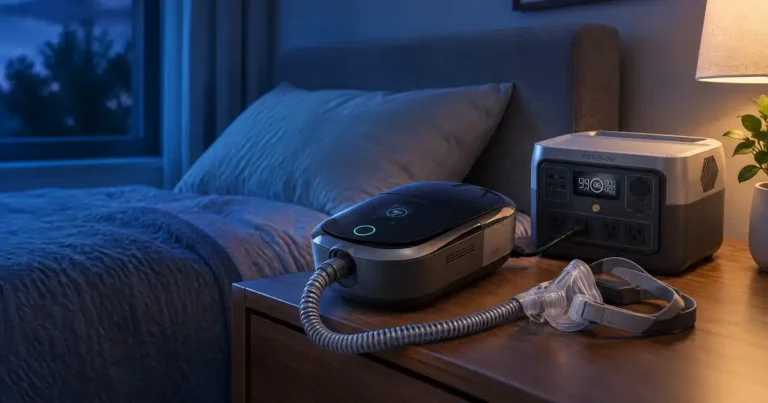
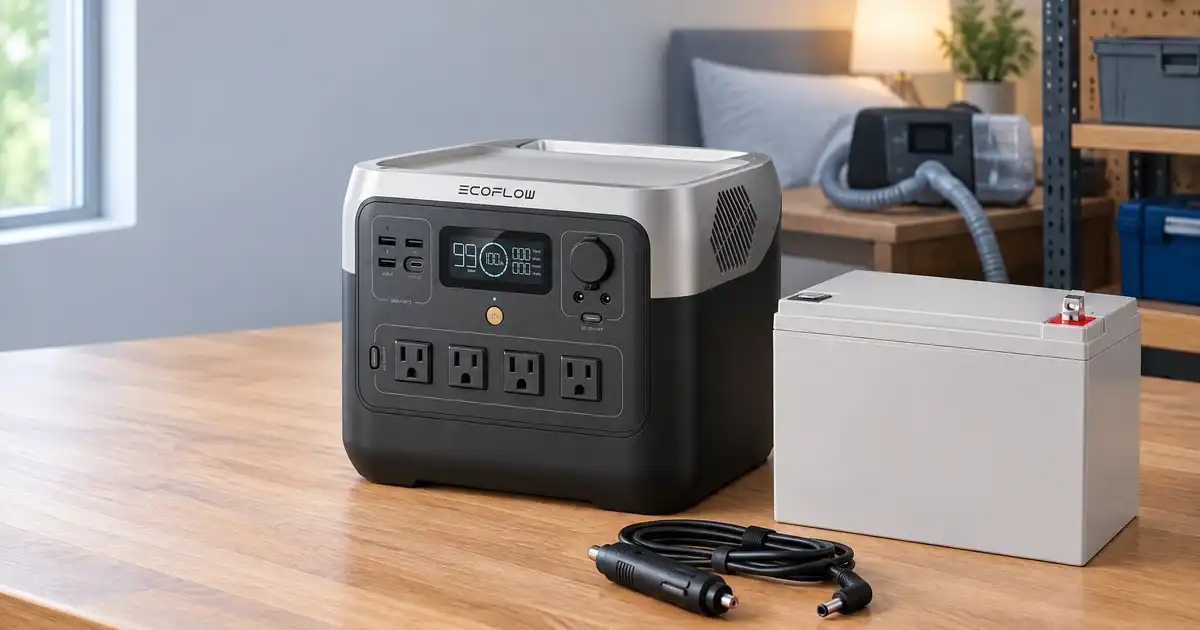
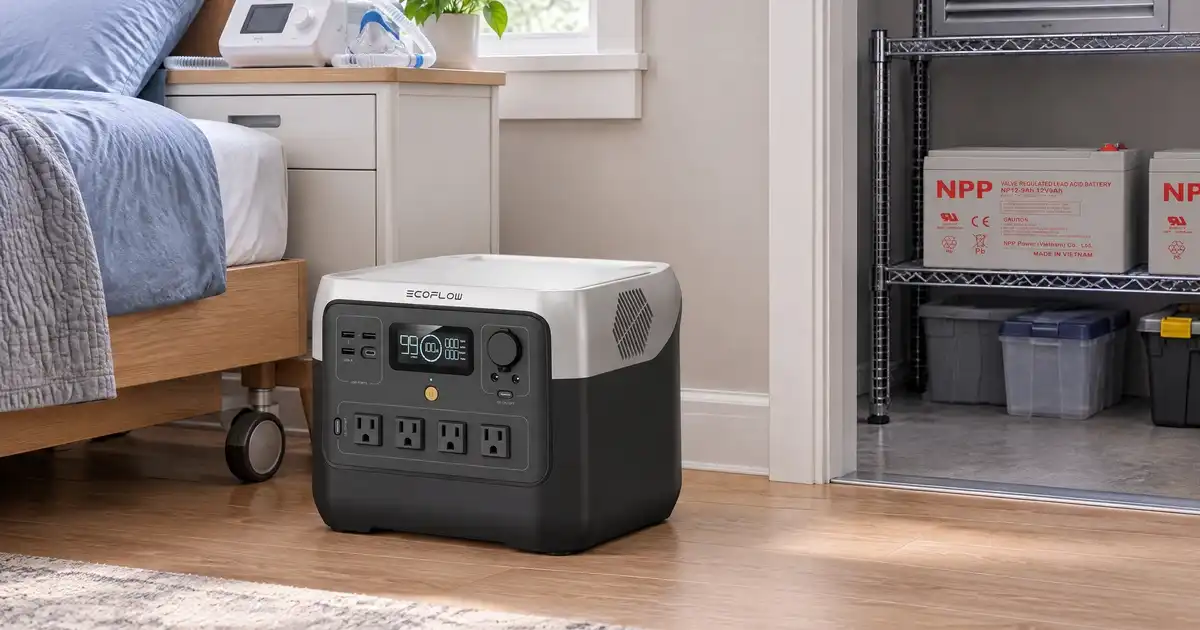
This is the safety difference that matters most for something sitting a few feet from where someone sleeps — and it’s the real answer to “are LiFePO4 batteries safe indoors” or “is a lithium battery safe in the house,” questions that usually get a one-word yes without this explanation. A LiFePO4 power station’s cells are sealed inside the housing, with no free-flowing electrolyte to leak even if the case is cracked. A lead acid battery — including the AGM type inside most medical UPS units — contains sulfuric acid electrolyte that can spill if the case is damaged, punctured, or simply tipped over hard enough. Sealed AGM lead acid absorbs its electrolyte in a mat rather than leaving it free-flowing like older flooded lead acid, which meaningfully reduces this risk but doesn’t eliminate it the way a sealed lithium cell does.
Practically: if a backup power unit is going to be on a nightstand, the floor next to a bed, or anywhere a fall or a kicked cord is plausible, a sealed LiFePO4 unit has a real edge here that’s separate from anything about fire risk. We go deeper on bedroom-specific placement and ventilation in our indoor solar generator safety guide — this section is about the chemical spill risk specifically, not airflow or off-gassing, which that guide covers in more depth.
Flying With Backup Power: The Lead Acid Half of the Rule Nobody Covers
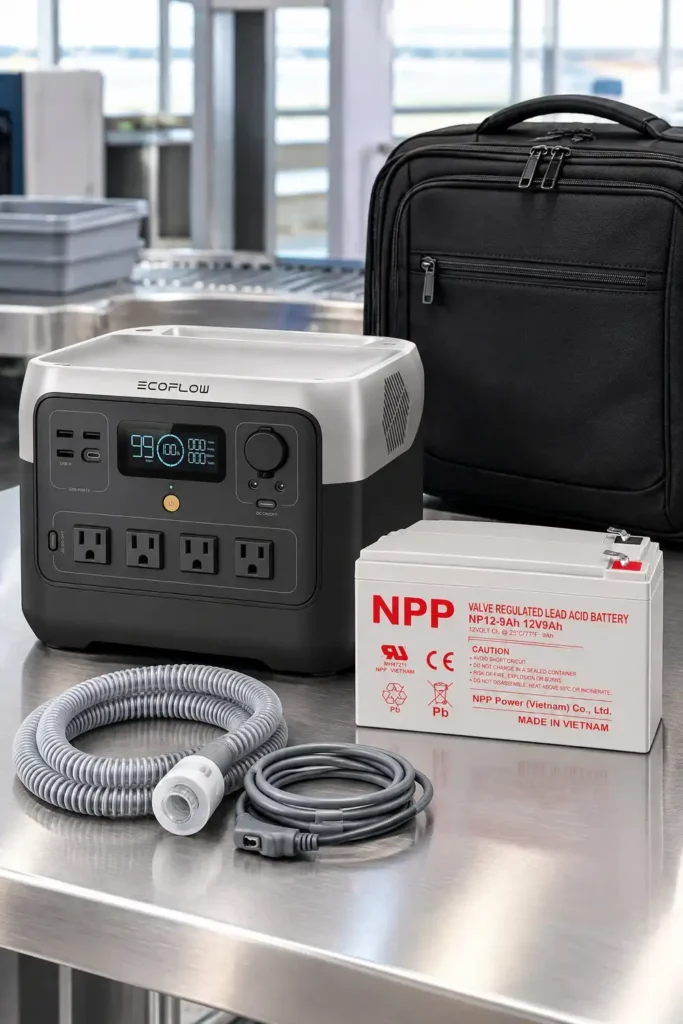
CPAP travelers carrying backup power run headlong into a real regulatory gap here, and it runs counter to what most people assume. Our own TSA rules for CPAP carry-on guide already breaks down the lithium battery watt-hour tiers in detail — under 100Wh flies freely, 101–160Wh needs airline approval and is capped at two spares, and anything over 160Wh is barred from passenger aircraft entirely, in both carry-on and checked baggage, with spare lithium batteries of any size never permitted in checked luggage — so we won’t repeat that breakdown here. What that guide doesn’t cover, because it’s scoped to lithium batteries, is the other half of the comparison: how lead acid is treated differently.
Sealed (non-spillable) lead acid is treated more permissively in FAA guidance than most people expect: “non-spillable wet batteries” using absorbed electrolyte technology — the AGM type inside most medical UPS units — are generally permitted in both carry-on and checked baggage when properly packaged and marked, with none of the tiered watt-hour restrictions lithium batteries face. Flooded (spillable) lead acid is a different story — it isn’t covered by that same permission, and airlines generally treat it as restricted or prohibited for passenger flights due to spill and corrosion risk. The FAA’s own documentation doesn’t spell out flooded lead acid rules in detail, which is itself a sign to contact your airline directly rather than assume.
The practical upshot: a large LiFePO4 power station (over 160Wh, which describes most of the higher-capacity units covered elsewhere on this site) genuinely cannot fly as checked or carry-on cargo, while a smaller sealed lead acid UPS battery often can — the opposite of what “lithium is the more travel-friendly chemistry” would predict. If air travel with backup power is part of your plan, check both the watt-hour rating on your specific unit and your airline’s policy before you’re at the gate, and see our TSA CPAP travel guide for the full lithium tier breakdown with real battery examples.
What Actually Makes a Battery “Safe” — Certification to Check For
Chemistry alone doesn’t determine safety; build quality and testing do, and there’s a real certification to look for rather than trusting “safe” as a marketing claim. UL 2054 is the relevant US standard for battery packs (not individual cells) used in consumer products, including portable medical devices. It tests packs for how they respond to overcharging, short circuits, forced discharge, and abnormal charging conditions — packs must not catch fire, explode, or leak electrolyte under these abuse tests — plus mechanical durability (crush, impact, drop, vibration) and environmental cycling (temperature, humidity, altitude). A pack that’s passed UL 2054 has been through meaningfully more abuse testing than one that hasn’t, regardless of which chemistry is inside it.
For lead acid, there’s no equivalent single consumer certification as widely referenced as UL 2054 — quality and safety are more a function of the manufacturer’s build standards and whether it’s sealed AGM versus older flooded construction. When comparing two power stations or UPS units, checking for UL 2054 (or the equivalent IEC 62133 international standard) on the lithium side is a more concrete safety signal than “LiFePO4 is generally safer,” which is true in aggregate but doesn’t guarantee any individual product’s build quality.
Disposal & End-of-Life: Neither One Goes in the Trash
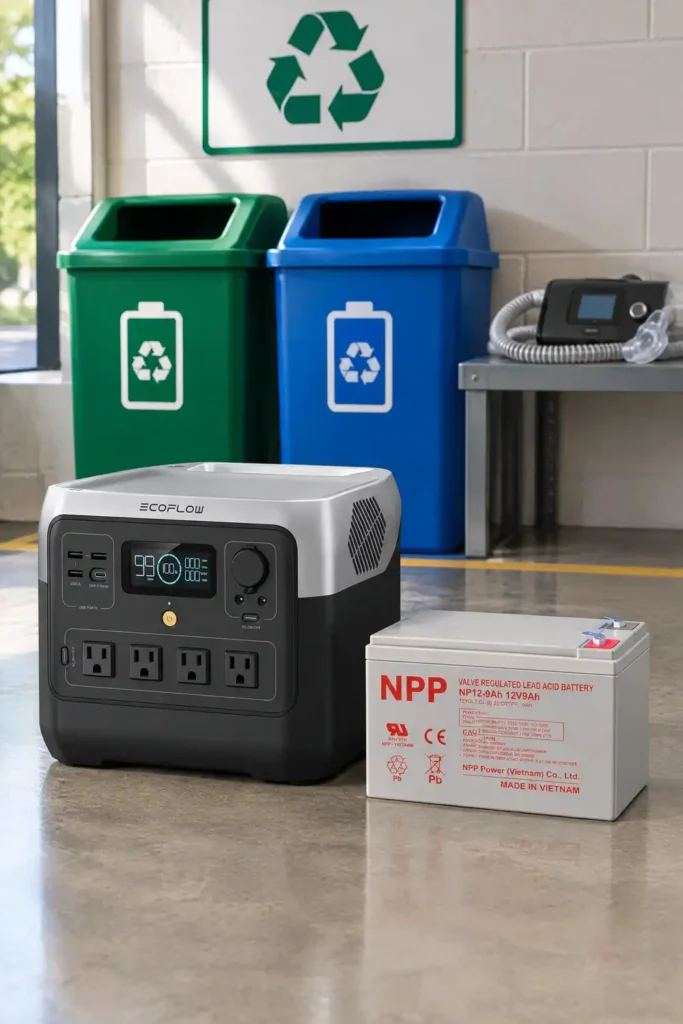
LiFePO4 battery disposal and lead acid battery disposal both require deliberate handling — neither goes in the household trash — but for different regulatory reasons.
Lead acid batteries are federally regulated hazardous waste under 40 CFR Part 266 Subpart G, the EPA’s rule governing spent lead-acid battery reclamation. In practice, this is why every auto parts store and most retailers that sell lead acid batteries are required to accept old ones for recycling — the lead and sulfuric acid inside are genuinely toxic if they end up in a landfill or waterway.
LiFePO4 and other lithium batteries aren’t classified as hazardous in the same regulatory sense, but they still shouldn’t go in household trash — a punctured or crushed lithium pack in a garbage truck or landfill is a real fire risk, which is why battery recycling programs (Call2Recycle and similar) accept them separately from regular waste. LiFePO4’s lack of cobalt and nickel also makes it a less environmentally hazardous lithium chemistry to begin with, but “less hazardous than other lithium batteries” isn’t the same as “safe for the trash.”
Neither chemistry is a “toss it in the bin” situation — both need a battery drop-off point or manufacturer take-back program, just for different underlying reasons.
How This Fits With Our Other Battery Guides
This guide covers what goes wrong and how to handle each chemistry safely — fire risk, leak risk, travel rules, certification, and disposal. If you’re deciding which chemistry to actually buy for CPAP, oxygen concentrator, or insulin refrigeration backup, our LiFePO4 vs lead acid comparison covers the performance side: weight, cycle life, voltage behavior under load, and cold-weather charging limits. If you’re specifically placing a power station indoors near where someone sleeps, our indoor solar generator safety guide goes deeper on ventilation and off-gassing than the leak-risk section above does. And for the full lithium battery watt-hour tier breakdown with real CPAP battery examples, see our TSA rules for CPAP carry-on guide.
FAQs
Is LiFePO4 actually less likely to catch fire than lead acid?
They fail differently rather than one being simply “less likely.” LiFePO4 has a high thermal runaway threshold and typically requires physical damage or a BMS failure to reach it. Lead acid’s fire risk comes from a different mechanism — hydrogen gas buildup during charging in a poorly ventilated space, which is a real but different hazard from lithium thermal runaway.
Can I bring my portable power station on a plane?
It depends entirely on its watt-hour rating, with lithium batteries over 160Wh barred from passenger aircraft in both carry-on and checked baggage. See our TSA CPAP travel guide for the full tier breakdown with real battery examples — the rules are the same whether the lithium pack is inside a CPAP battery or a larger power station.
Is it true that lead acid batteries are actually easier to fly with than lithium ones?
For sealed (non-spillable) lead acid specifically, yes, in the sense that FAA guidance generally permits it in both carry-on and checked baggage without the tiered watt-hour restrictions lithium batteries face. This runs counter to the general assumption that lithium is always the more travel-friendly chemistry — it depends on capacity, and it’s the one part of the air-travel picture that’s specific to this comparison rather than lithium batteries alone.
Do LiFePO4 batteries need to be disposed of as hazardous waste like lead acid?
Not in the same regulatory category — lead acid is federally regulated hazardous waste under EPA rules, while LiFePO4 generally isn’t classified that way. Both still need proper battery recycling rather than household trash disposal, just for different reasons: toxicity for lead acid, fire risk from damage for lithium.
Does a UL 2054 certification mean a battery is completely safe?
It means the pack has passed a specific, meaningful set of abuse tests — overcharge, short circuit, crush, drop, and environmental cycling — not that failure is impossible. Treat it as a real safety signal worth checking for, not a guarantee that overrides proper use, storage, and charging practices.
Bottom Line
LiFePO4 and lead acid don’t fail the same way, and treating “LiFePO4 is safer overall” as the end of the safety conversation misses real, practical differences: lead acid’s hydrogen-gas risk during charging versus LiFePO4’s thermal runaway threshold, a sealed cell’s leak resistance versus a cracked lead acid case, and — the detail most guides skip entirely — opposite-of-expected air travel rules where a large LiFePO4 battery can be barred from a flight while a smaller sealed lead acid one often isn’t. Check the watt-hour rating on your specific unit before flying with it, look for UL 2054 certification as a real safety signal rather than trusting chemistry alone, and route either battery type to proper recycling rather than the trash when it’s done.
For choosing between the two chemistries on performance rather than safety, see our LiFePO4 vs lead acid comparison; for indoor placement and ventilation specifics, see our indoor solar generator safety guide; for the full lithium watt-hour travel tiers, see our TSA CPAP travel guide.
HSA/FSA Note
Backup power equipment purchased to maintain a prescribed medical device’s operation during an outage can qualify as a deductible medical expense under IRS Publication 502, regardless of battery chemistry, typically with a prescription for the underlying device and supporting documentation. Confirm specific requirements with your HSA/FSA administrator before purchasing.
This article reflects UL, EPA, TSA, and FAA guidance current as of October 2026 . Airline battery policies can vary by carrier and route and are subject to change — always confirm current rules with your specific airline before traveling with any battery-powered backup device.