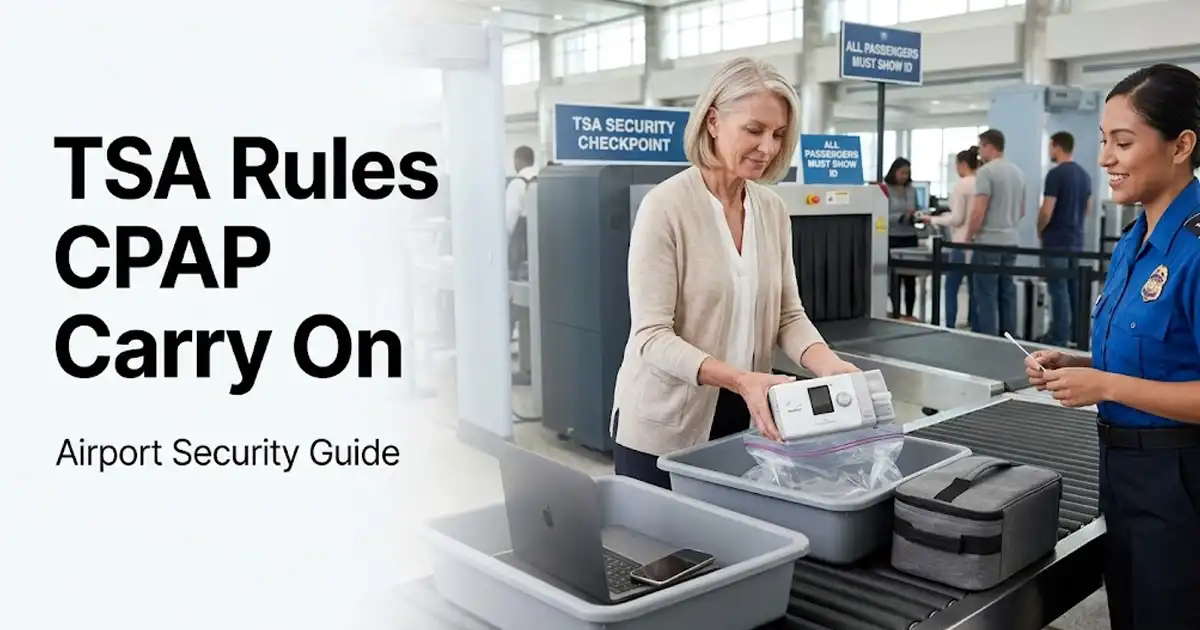
TSA Rules CPAP Carry On 2026: What to Expect at Airport Security
 By Lee Arnold
Medical Solar Power Backup Specialist | 8+ years in the field
Quick Answer:
A CPAP does NOT count as a carry-on under TSA rules. It’s medically necessary equipment, separate from your bag and personal item. Your lane decides what happens next. Standard lanes: the case stays closed. TSA may still pull the unit from your bag for X-ray. PreCheck: the case stays inside your bag — no separate bin. Battery rules run by watt-hours. Under 100Wh needs no approval. 100-160Wh needs airline notice. Over 160Wh isn’t permitted.
Eight years in, this question comes up with every traveling patient. I’ve cleared CPAP equipment through security in 14 US airports and at international checkpoints in Heathrow, Frankfurt, and Tokyo Narita. The rules below work everywhere. The rules are clear. Learn them before you get in line — everything goes faster.
Table of Contents
Does a CPAP Count as a Carry-On?
No. Under TSA regulations, a CPAP machine is classified as medically necessary equipment. It does not count against your standard carry-on or personal item allowance.
This means you can fly with:
- One standard carry-on (rollaboard suitcase)
- One personal item (laptop bag, backpack, purse)
- Your CPAP machine and its case
Three bags. Zero additional fees. No gate agent has the authority to charge for medically necessary equipment.
Pack a CPAP prescription or doctor’s note for airline gate issues. Not required at TSA. It settles any airline gate dispute instantly.
TSA CPAP Screening: Step by Step
Most CPAP travel guides get this wrong. The rule isn’t the same for everyone. Per TSA’s official CPAP guidance, your lane determines what happens.
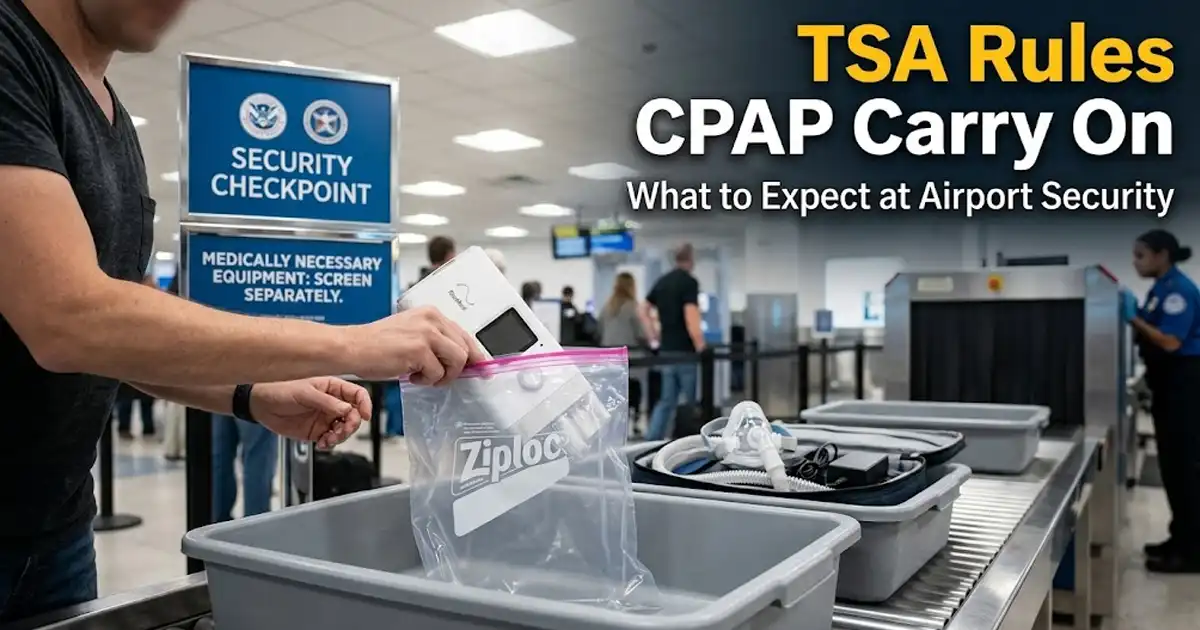
Standard screening lane: Your CPAP may stay inside its case for X-ray screening. TSA may still pull the case out and into its own bin. Plan to pull it out, case and all.
TSA PreCheck lane: Your CPAP may stay in its case and inside your carry-on bag. In most PreCheck lanes, nothing needs to come out at all. Frequent CPAP travelers name this as PreCheck’s biggest payoff.
Step-by-step for a standard lane:
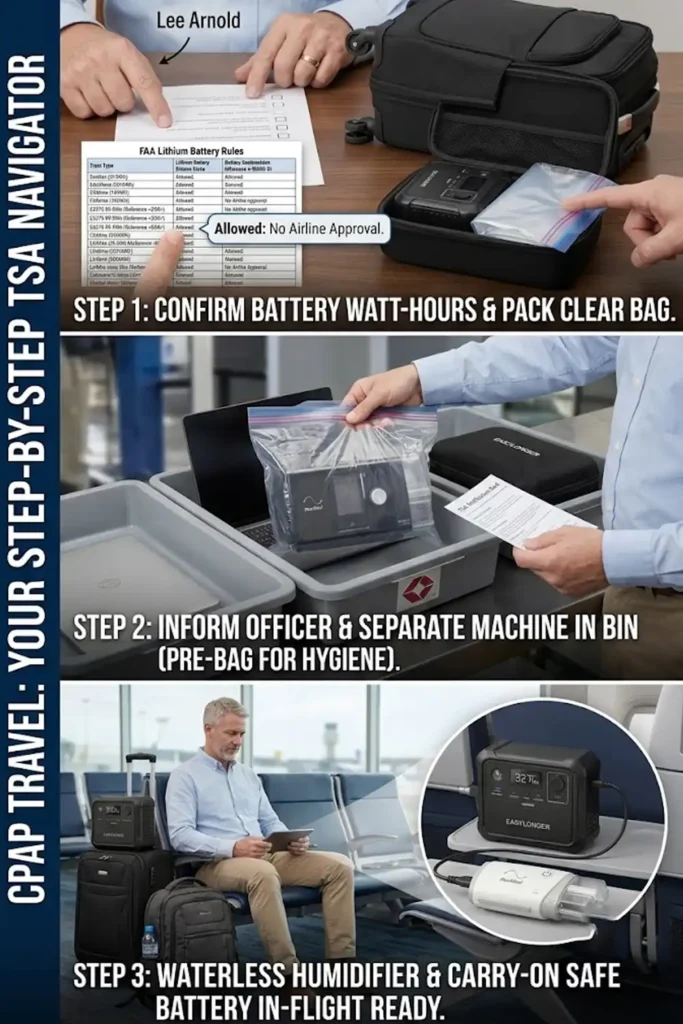
Step 1 — Pull the CPAP case out of your bag. Leave the machine inside its case if you want. TSA decides at the belt whether the case itself needs opening. The mask, tubing, and power adapter can stay in your main bag.
Step 2 — Use a clear plastic bag for hygiene. A clear bag around the case keeps it off a shared bin. Pack a gallon-size zip bag in your carry-on for this.
Step 3 — Tell the officer you have a CPAP before you start unpacking. This heads off confusion and speeds up the lane. Most experienced officers process CPAP travelers routinely. For international travel power needs, see my dual voltage cpap machine guide.
Step 4 — Expect a possible swab test. TSA may swab the case or machine for explosive residue. This is standard for medical equipment and isn’t a sign of suspicion. It takes under 60 seconds.
Step 5 — Repack once you’re through. Return everything to its case. Many travelers keep the bag folded inside the kit, ready to go.
CPAP Battery Rules: The FAA Watt-Hour Limits
CPAP batteries are lithium cells regulated by the FAA on commercial flights. The FAA’s lithium battery carry-on rules apply to every CPAP battery.
| Battery Capacity | Carry-On Status |
|---|---|
| Under 100Wh | Allowed with no airline approval |
| 100–160Wh | Allowed with airline pre-approval (up to 2 per person) |
| Over 160Wh | Not permitted as carry-on under any circumstances |
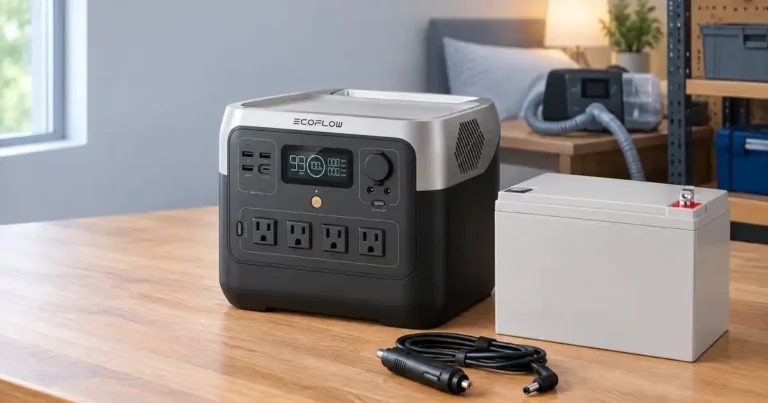
Under 100Wh — no approval needed: The Medistrom Pilot-24 Lite (95Wh), Medistrom Pilot Flex (98Wh), and EASYLONGER ES270 (99.9Wh) all fall below this threshold. Pack them, go.
100–160Wh — airline pre-approval required: The ES400 AIR (148Wh) and EXP48 Pro (153.6Wh) need airline approval. Most airlines approve this automatically. Call at least 24 hours in advance and keep the confirmation.
Over 160Wh — not permitted: The EASYLONGER ES720 (266.4Wh), ES960 (297.6Wh), and any power station over 160Wh cannot go in carry-on luggage. They cannot go in checked luggage either. Lithium batteries are prohibited in checked bags regardless of size.
Critical rule: lithium batteries must always be in carry-on. Never put a CPAP battery in checked luggage. The FAA prohibits lithium batteries in the cargo hold due to fire risk.
Water and Humidifier Rules
CPAP distilled water follows TSA liquid rules: 3.4 oz (100ml) or less. Larger containers go in checked luggage.
Practical options:
- Empty the humidifier chamber at home — not at the checkpoint. Water in the chamber triggers the TSA liquid rule at the line. Draining it there causes delays. Empty it the night before you fly.
- Buy distilled water after security. Most airport pharmacies and grocery stores carry distilled water in small bottles. Buy it past security and fill up at the gate.
- Use a waterless humidifier. The HumidX (for ResMed AirMini) and Transcend AirMist use no distilled water. Zero liquid restrictions at the checkpoint.
Using CPAP on the Plane
Airlines must allow FAA-compliant respiratory assistive devices on flights. Your CPAP qualifies as an assistive device under FAA regulations.
To use your CPAP in-flight:
- Notify your airline at least 48 hours before departure. Most airlines have a medical equipment request form on their website.
- Check your seat for an outlet. Not all seats on all aircraft include AC power. Check SeatGuru.com for your specific plane and seat.
- Bring a CPAP battery as backup. A 95Wh battery covers most long-haul flights and removes dependence on seat power.
The CPAP water humidifier must be turned off per most airline policies during flight. Passive humidifiers like the HumidX (AirMini) remain usable in-flight.
2025–2026 TSA Rule Changes That Affect CPAP Travelers
Three recent TSA and federal rule changes affect CPAP travelers directly.
Shoes no longer required (July 2025). TSA removed the shoes-off requirement for standard screening lanes nationwide. PreCheck passengers already had this benefit — now all travelers do. Expect some agents to still request shoes off during secondary screening.
REAL ID enforcement (in effect since May 7, 2025). Domestic flights require a REAL ID-compliant license or passport. Check your license for a star or bear-and-star symbol in the top right corner — that confirms REAL ID compliance. A non-compliant ID means extra screening, not an automatic denial, but CPAP travelers with tight connections cannot afford the delay. Confirm your ID before you leave home.
IATA 2026 lithium battery shipping rule (does not apply to your carry-on). As of January 1, 2026, IATA requires lithium batteries shipped as cargo or freight to carry no more than 30% state of charge. This rule governs manufacturers and shippers moving batteries in bulk — it does not apply to a CPAP battery you personally carry onto a plane. A fully charged CPAP battery in your carry-on remains fine under TSA and FAA passenger rules. Don’t discharge your battery before a flight based on this rule; it isn’t yours to follow.
Tips for Clearing Security Faster
Pack for the checkpoint, not just for the trip. Keep the CPAP in its own soft case with the clear plastic bag inside. At the checkpoint, pull it out, drop it in the bag, set it in the bin. One motion.
Call TSA Cares before you fly. TSA’s free helpline for travelers with medical needs (1-855-787-2227) provides advance support. Call at least 72 hours before your flight. A TSA Cares representative can coordinate with your departure airport to expedite screening.
Use TSA PreCheck. PreCheck passengers typically do not need to remove medical devices from their bags. Confirm current PreCheck rules when you book — policies can change.
Print your prescription. A one-page printout of your CPAP prescription settles any question from a gate agent or customs officer. Keep a copy in the CPAP case.
Use a TSA notification card. TSA offers a free notification card for passengers with medical conditions and devices. Present it to the officer before screening. It does not exempt you from screening — it explains the situation before questions arise. Download it at TSA.gov.
Label the case. A clear “Medical Equipment — CPAP” label on the outside of the bag communicates the contents before anyone asks.
FAQs
Do I need a doctor’s note to fly with a CPAP?
No. TSA does not require a prescription or doctor’s letter at the checkpoint. A CPAP prescription copy is smart for airline gate disputes and customs.
Can I put my CPAP in checked luggage?
Yes — the machine itself can go in checked luggage. Never put CPAP batteries in checked luggage. Avoid checking the CPAP — airlines lose bags and throw luggage around. Keep it with you.
Can TSA make me check my CPAP?
No. TSA cannot force you to check medically necessary equipment. If told to check the CPAP, ask for a supervisor. Cite TSA medical policy.
What if my CPAP triggers the X-ray alarm?
Standard procedure. TSA may physically inspect the machine or swab it. Stay calm, keep your prescription ready, and allow the inspection. The process takes 2-5 minutes in most cases.
Can I bring both a CPAP and a regular carry-on?
Yes. The CPAP counts as medical equipment — not carry-on, not personal item. You carry your standard bags plus the CPAP bag without extra fees.
How do I notify my airline about in-flight CPAP use?
Visit the airline’s accessibility or medical equipment page on their website. Submit the request at least 48 hours before departure. Major US carriers handle these requests routinely.
Bottom Line
The TSA rules for CPAP at airport security are clear and consistent. Medically necessary equipment — your CPAP doesn’t count against your carry-on limit. Take it out at the checkpoint. Clear bag. Separate bin. Tell the officer.
Battery rules require more planning. Anything under 100Wh flies without approval. Anything 100-160Wh needs airline notification. Anything over 160Wh stays home.
See my travel cpap battery operated guide for carry-on-safe battery picks. See my best portable battery for cpap machine guide for top carry-on-safe batteries. See my cpap battery backup guide for the full CPAP battery comparison.