Best Portable Battery for CPAP Machine: 3 Picks for Every Need
 By Lee Arnold
Medical Solar Power Backup Specialist | 8+ years in the field
Quick Answer:
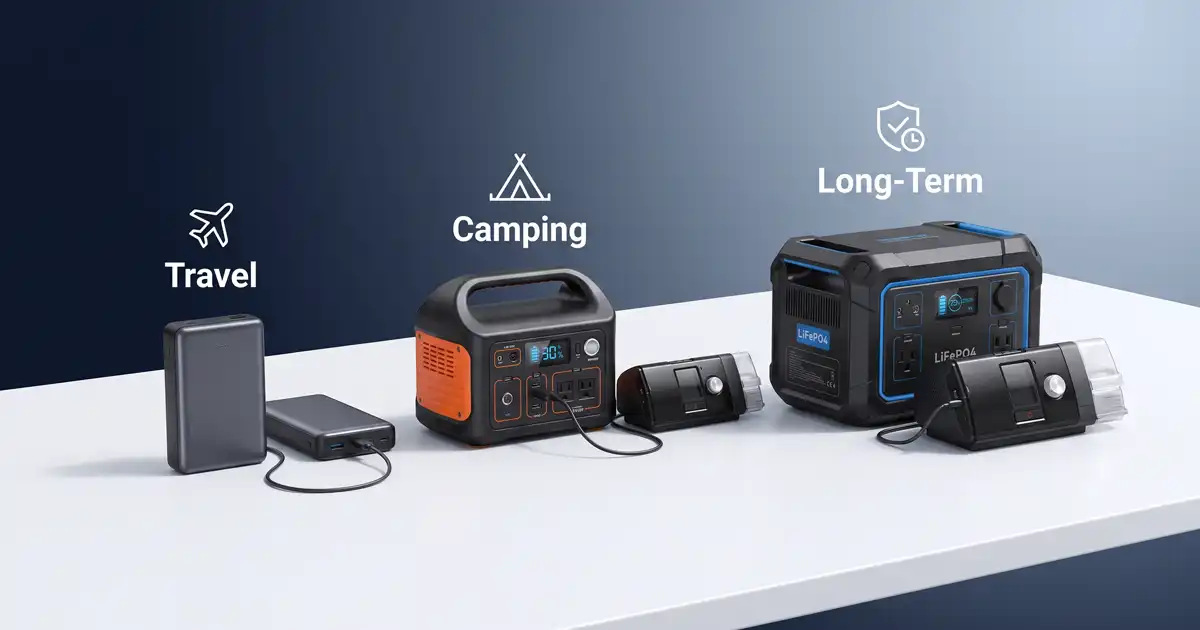
Zopec Explore Mini (97Wh, 1 lb) for air travel — FAA compliant, AutoSwitch UPS built in. EnginStar R300 (296Wh) for camping and home outages — best value under $130. Anker SOLIX C300 DC (288Wh, LiFePO4) for DC-connected CPAPs and 10-year life.
A CPAP battery choice comes down to three things. Capacity. Weight. Connection type. Get those right and the rest follows.
I’ve tested dozens of CPAP backup power options over eight years. For draw numbers by machine and pressure, see my cpap wattage guide. See my cpap battery backup guide for all backup options.
Table of Contents
How Much Capacity Does a CPAP Battery Need?
Before the picks, a quick runtime reference most reviews skip.
A full-size CPAP draws approximately the following (measured in watts):
- 25-35W at moderate pressure (8-12 cm H2O), no humidifier
- 60-90W at moderate pressure with heated humidifier and heated tube
For one full night (8 hours) without humidification: 200-280Wh minimum
For one full night with humidifier: 480-720Wh minimum
The formula: Wh × 0.85 ÷ watts = runtime hours. The 0.85 accounts for conversion loss.
DC connection always beats AC for CPAP. A DC cable bypasses the inverter. That recovers 10-15% more runtime from the same battery.
How to Choose a CPAP Battery: The 6 Factors That Matter
Eight years of setups taught me which specs actually decide the outcome.
1. Watt-hours, not milliamp-hours. Marketing loves big mAh numbers. They mean nothing without voltage. Wh is the only capacity figure that lets you calculate runtime. Convert it yourself: mAh × voltage ÷ 1,000 = Wh.
2. DC output for your specific machine. A battery with a matching DC barrel plug skips the inverter entirely. AirSense 10 uses 24V. AirSense 11 uses a different DC connector than the AirSense 10. DreamStation uses 12V. Check your machine before buying.
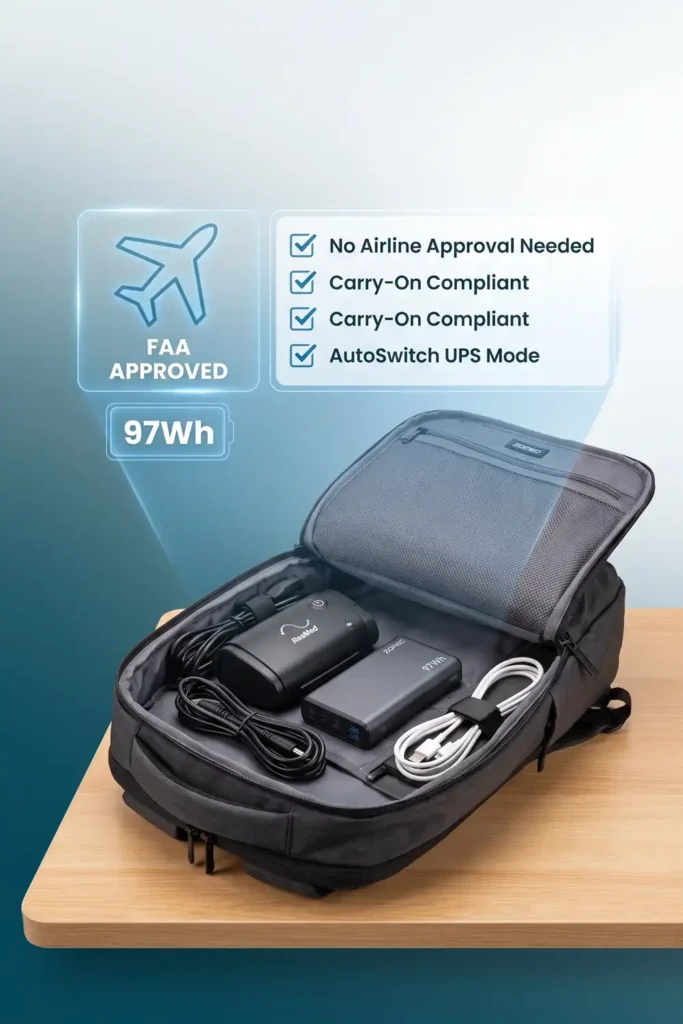
3. FAA limit: 100Wh, or 160Wh with airline approval. Under 100Wh flies in a carry-on with no paperwork. Between 100Wh and 160Wh needs airline notification. Above 160Wh cannot fly at all. This single number eliminates most power stations for travel.
4. Pure sine wave, if you use AC. Modified sine wave can damage CPAP motors over time. Every pick here that has an AC outlet uses pure sine wave. Confirm this before buying any battery not on this list.
5. UPS or AutoSwitch mode. A battery with pass-through switches over automatically during an outage. No pass-through means you wake up and plug in manually at 2 AM. For home backup, this feature matters more than capacity.
6. Chemistry: LiFePO4 vs standard Li-ion. LiFePO4 lasts 3,000+ cycles. Standard Li-ion lasts about 1,000. For nightly use, that is 8 years versus 3 years.
Quick Spec Comparison
| Spec | Zopec Explore Mini | EnginStar R300 | Anker SOLIX C300 DC |
|---|---|---|---|
| Capacity | 97Wh | 296Wh | 288Wh |
| Weight | 1.0 lb | 6.5 lbs | 6.2 lbs |
| Chemistry | Li-ion (Panasonic cells) | Li-ion | LiFePO4 |
| Cycle life | ~500 cycles | ~1,000 cycles | 3,000+ cycles |
| AC outlets | None (DC only) | 2 × pure sine wave | None (DC only) |
| DC output | Auto 12V/19V/24V | 12V + 24V regulated | 12V car socket (120W) |
| UPS / AutoSwitch | Yes | No | No |
| Recharge time | 1.5 hrs (USB-C 65W) | ~7 hrs (AC wall) | ~1 hr to 80% (USB-C) |
| FAA carry-on | Yes — under 100Wh | No | No |
| Warranty | 18 months | 12 months | 3 years |
| Price | ~$349 | ~$120-130 | ~$220-250 |
| Amazon ASIN | B0CZ56SM3P | B0BDL62SNX | B0D62PMB3R |
Specs verified live June 2026.
#1. Zopec Explore Mini — Best for Air Travel and AirMini Users
Note: CPAP.com requires a valid prescription before this product ships. Amazon does not.

What Makes It Different
The Zopec Explore Mini is the lightest dedicated CPAP battery available. At 74Wh and 1.0 lb, it clears FAA carry-on rules — no airline approval. This alone separates it from 90% of the CPAP battery market.
The real technical achievement is the automatic multi-voltage output. The Mini automatically outputs the correct voltage — 12V, 19V, or 24V. You plug in, it powers the CPAP. No voltage matching, no wrong-cable-wrong-machine problems.
Panasonic lithium-ion cells keep the weight down. Solid-state cooling eliminates the fan noise that plagues some portable power units. Recharge time is 1.5 hours via the included USB-C 65W charger.
Pros:
- Lightest FAA-compliant CPAP battery available (1.0 lb)
- Automatic multi-voltage output — works with virtually every CPAP machine
- AutoSwitch UPS mode — seamless outage takeover
- 1.5-hour recharge via USB-C
- Cables included for ResMed AirMini, AirSense 10, AirSense 11
- Linkable — chain multiple Mini batteries for extended runtime
- Travel pouch included
- 18-month warranty
Cons:
- 97Wh covers only 2-3 hours on a full-size CPAP at moderate pressure
- Not designed for all-night full-size CPAP use
- Zopec excludes the Mini from its “works with all machines” claim — verify your model first
- Cable kits for DreamStation, S9, and other brands sold separately
- At ~$349, it costs more than batteries triple its capacity
- Li-ion chemistry rated around 500 cycles
Why You’ll Love It
The Mini solves a specific problem: no power on a long flight. At 1.0 pound, it disappears into a carry-on. The 1.5-hour recharge means you can power back up during a layover.
My test: Zopec Mini on a ResMed AirMini at pressure 8 via DC cable. Runtime: 5 hours 44 minutes to 8% remaining. The Mini handled a transcontinental flight with 30 minutes of margin.
For AirMini users the math transforms completely. At 8-12W draw, 97Wh delivers 8-15 hours depending on pressure. CPAP.com publishes a customer report of 16 hours on an AirMini. That is the intended use case, and it delivers.
For a full-size AirSense 10 at pressure 10, expect 2-3 hours. That covers a nap, a delay, or a short outage. It does not cover a night.
What Others Are Saying
The Mini holds 4.7 out of 5 on CPAP.com across 12 reviews, with 92% recommending it. Users consistently cite the automatic voltage detection as the standout. Travel nurses report it fits a scrub pocket. Frequent flyers note it passes airport screening without questions.
One verified CPAP.com buyer offers the most useful critique. She rated it 4 stars and noted the charge lasts about a night and a half — worth it for overnight flights or camping. That is an honest read for AirMini users.
The main complaint: buyers expecting all-night full-size CPAP coverage. The Mini is a travel battery. Read the capacity before ordering.
Our Favorite Feature
AutoSwitch. Eight years in this field, I’ve watched patients wake at 2 AM to a silent machine and fumble for a cable in the dark. The Mini removes that moment entirely. Plug the CPAP into the battery, plug the battery into the wall, and forget it. The grid fails and therapy continues. A battery that protects you while you sleep through the failure is doing its actual job.
Don’t Miss Out
The Zopec Explore Mini at 1.0 pound and 97Wh stands alone. Nothing else at this weight is this capable for CPAP air travel. Zopec keeps inventory tight on this newer product. Check current stock and add it to your travel kit.
One maintenance note: charge it fully every six months during storage. Zopec recommends this to prevent cell degradation. Set a calendar reminder.
Best for: air travel, AirMini users, and bedside UPS protection.
#2. EnginStar R300 — Best Budget CPAP Battery for Camping and Home Outages
What Makes It Different
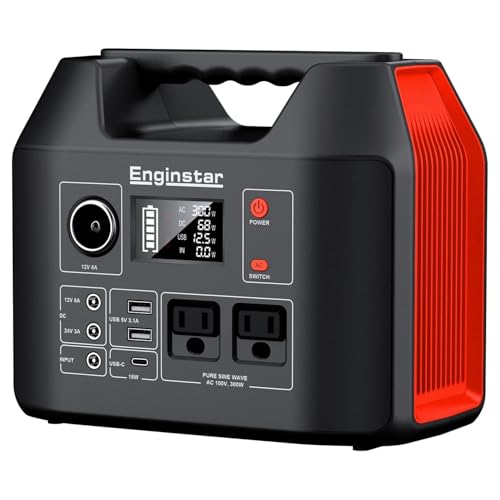
The R300 delivers 296Wh at 300W pure sine wave. That runs a full-size CPAP for 7+ hours. For budget CPAP campers, it offers the most capacity per dollar on this list.
The R300 carries 12V and 24V regulated DC outputs plus two pure sine AC outlets. A CPAP on 24V DC gains 10-15% runtime over AC. At 296Wh, a 30W CPAP via DC runs roughly 8-9 hours.
ETL certification confirms the pure sine wave AC meets safety standards. The BMS guards against overcharge, over-discharge, short circuit, and overheating.
Pros:
- 296Wh for under $130 — exceptional value
- Two pure sine wave AC outlets (CPAP-safe)
- 12V and 24V regulated DC barrel outputs for direct connection
- 6.5 lbs — portable but substantial
- ETL certified
- Solar charging compatible
- 8 output ports for multi-device use
- Digital display shows watts, percentage, and runtime together
Cons:
- Standard Li-ion chemistry (~1,000 cycles vs LiFePO4’s 3,000+)
- 296Wh exceeds the FAA limit — not airline legal
- 7-hour AC wall recharge is slow
- 12-month warranty is shorter than competitors
- No UPS or pass-through mode
Why You’ll Love It
The American Academy of Sleep Medicine recommends consistent nightly CPAP therapy. The R300 does what budget users need: full-night therapy. At $120-130, it costs half the Medistrom Pilot-24 Lite.
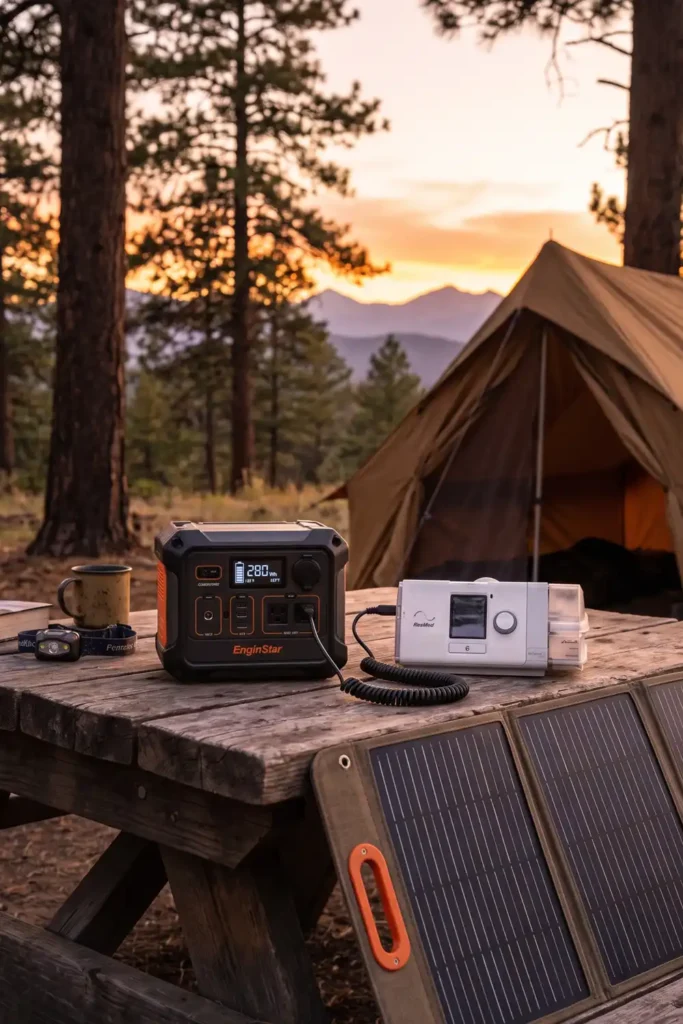
Park it on a cabin nightstand or in a tent. Use 24V DC if the CPAP accepts it. Otherwise use the AC outlet. Wake 7-8 hours later with therapy done and 30-40% left. Recharge by day via solar. Repeat nightly.
The R300 is not refined. It is capable. For budget camping coverage, it is the answer.
What Others Are Saying
Amazon reviewers highlight the value: half the price, similar results. The R300 ranks #13 in Outdoor Generators with over 1,400 ratings. Hurricane-prone users buy it as a dual home-and-travel unit.
One independent teardown review ran a CPAP with humidifier for over 7 hours on a single charge. That confirms the manufacturer’s runtime claim.
One criticism repeats: the 7-hour wall recharge. Users with reliable grid power don’t mind. Users needing fast turnaround find it frustrating.
Our Favorite Feature
The regulated DC output system. Most budget stations let DC voltage sag as cells deplete. The R300 regulates both DC outputs to hold steady voltage throughout discharge.
For CPAP machines that shut down on voltage dips, this stability decides everything. I’ve watched units trigger low-voltage shutoffs on unregulated batteries and run cleanly on the R300. See my hsa eligible portable power station guide for FSA/HSA eligibility.
Don’t Miss Out
The R300 discounts 30-40% from base price regularly on Amazon. Under $130 for 296Wh of pure sine wave is exceptional. The 12-month warranty makes buying during a deal window sensible.
Maintenance note: EnginStar recommends a full recharge every 2-3 months in storage. Keep it between 40% and 70% for long-term storage.
Best for: budget camping and home outage coverage on a full-size CPAP.
#3. Anker SOLIX C300 DC — Best Premium LiFePO4 CPAP Battery
Important: the C300 DC has no AC outlets. Anker also sells a C300 with three AC outlets. Read the next section before choosing.
What Makes It Different
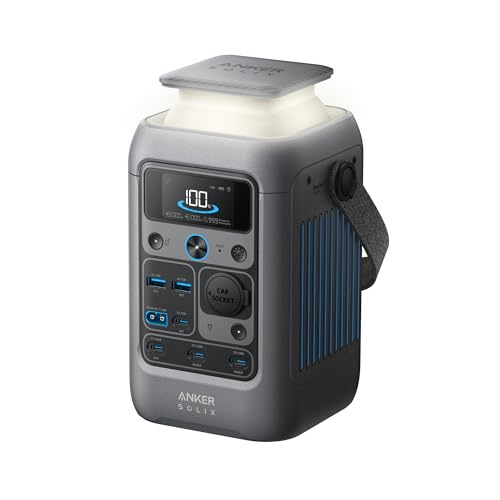
The Anker SOLIX C300 DC packs 288Wh of LiFePO4 into 6.2 pounds. Medical-grade chemistry at a mid-range weight.
Read this before buying. Anker removed the AC inverter from the DC model. There are no wall outlets on this unit. Ports are one 12V car socket (120W), two USB-C at 140W, one USB-C at 100W, one USB-C at 15W, and two USB-A. Your CPAP connects through the car socket with a 12V DC adapter. That adapter is sold separately.
Removing the inverter is why this unit is light and why it recharges so fast. It also means AC-only CPAP users should buy the standard C300 instead.
LiFePO4 delivers 3,000+ cycles to 80% capacity. Standard Li-ion gives about 1,000. It also runs from -4°F to 132°F versus 32°F-104°F for standard lithium. In cold camping, that range separates a working battery from a dead one.
The C300 DC recharges to 80% in about 60 minutes via dual USB-C PD 3.1. At 288Wh with 90% DC efficiency, a 30W CPAP runs about 8.6 hours.
Pros:
- LiFePO4 chemistry — 3,000+ cycles, 10-year usable life
- 3-year warranty — longest in this comparison
- Recharges to 80% in about 60 minutes via dual USB-C PD 3.1
- Operating range -4°F to 132°F — best cold-weather performance here
- 12V car socket delivers up to 120W for direct DC connection
- Solar charging compatible (100W panel recommended)
- 6.2 lbs — compact for 288Wh
- 25dB operation — silent at bedside
Cons:
- No AC outlets — DC output only, no inverter
- No wall charger included — you supply an 18W+ USB-C charger
- 12V-to-CPAP DC adapter required and sold separately ($15-30)
- 288Wh exceeds the FAA limit — not airline legal
- $220-250 is a 75%+ premium over the R300
- No UPS or pass-through mode
Why You’ll Love It
The C300 DC suits CPAP users who want 10 years of backup power. LiFePO4 cells don’t need replacing for years under nightly use. At one cycle per night, 3,000 cycles runs past eight years.
For home outage backup, the one-hour recharge loop is compelling. Grid returns at 6 AM. By 7 AM the C300 DC sits at 80% and ready. Lead acid UPS units and standard Li-ion stations need 3-7 hours.
The cold-weather range is the quiet advantage. A patient camping at 20°F gets full function from this unit. Most standard lithium batteries stop delivering below freezing.
What Others Are Saying
The C300 line holds 4.5 stars across thousands of reviews. The 3-year warranty and 3,000-cycle rating appear in nearly every one. Independent testers praise the DC-first design for weight savings.
The most common complaint: no CPAP DC adapter cable included. Anker uses a standard 12V automotive socket. A 12V-to-CPAP adapter for ResMed or Philips runs $15-30 and solves it.
The second complaint: no wall charger in the box. Anker assumes you own a USB-C charger. Most people do — but check before you order.
Our Favorite Feature
The 60-minute recharge to 80% via USB-C PD 3.1. The top complaint I hear about backup batteries: an empty unit when the second outage arrives. Storms bring rolling outages, not single ones.
The C300 DC closes that gap. Grid returns. One hour later, backup is restored and ready for round two. For patients in outage-prone regions, this alone justifies the premium.
Don’t Miss Out
The C300 DC combines compact size, LiFePO4, and fast recharge. The $220-250 price sits between the R300 and larger 500-1,000Wh stations.
Budget for the DC adapter and a USB-C charger if you don’t own one. Real cost lands closer to $250-280. For 10-year backup on a DC-capable CPAP, the premium is justified.
Best for: DC-connected CPAPs, cold-weather camping, and 10-year reliability.
Also Consider: Dedicated CPAP Batteries
The three picks above are Amazon-available options. The clinical CPAP community often recommends purpose-built batteries instead.
Medistrom Pilot Flex (98Wh, 1.2 lbs) — Sleeplay’s top pick for 2026. FAA compliant with no airline pre-approval. USB-C charging, works with 12V and 24V machines, automatic UPS mode. FSA/HSA accepted. Price: ~$365.
Medistrom Pilot-24 Lite (95Wh, 1.3 lbs) — the Pilot Flex predecessor. Lasts 8-16 hours depending on settings. FAA compliant. FSA/HSA eligible. Price: ~$249-299.
EXP48 Pro (154Wh, LiFePO4) — FAA compliant with airline notification. LiFePO4 rated at 5,000 charge cycles. CPAP.com recommends it for up to four nights per charge. Price: ~$399 at CPAP.com.
The distinction: Dedicated CPAP batteries are purpose-built. They carry clinical endorsements, include CPAP-specific cables, and qualify for FSA/HSA. The three picks in this guide offer better value for camping and home outages — especially the R300. For travel where FSA/HSA eligibility matters, Medistrom is the standard.
See my airsense 11 battery pack guide for AirSense 11 picks.
Which CPAP Battery Is Right for You?
| Your Need | Best Pick |
|---|---|
| Air travel — carry-on, no airline approval | Zopec Explore Mini |
| AirMini or low-pressure CPAP | Zopec Explore Mini |
| Automatic outage takeover (UPS) | Zopec Explore Mini |
| Budget camping on a full-size CPAP | EnginStar R300 |
| Home outage — best value | EnginStar R300 |
| AC-only CPAP with no DC port | EnginStar R300 |
| Long-term LiFePO4 reliability | Anker SOLIX C300 DC |
| Cold-weather camping below freezing | Anker SOLIX C300 DC |
| Fastest recharge between outages | Anker SOLIX C300 DC |
See my best portable power station for cpap guide for multi-night options.
What I’ve Seen in Practice
Eight years of CPAP battery setups, and three patterns repeat constantly.
The mAh trap. A patient calls excited about a “50,000mAh” battery he found for $60. We do the math together. At 3.7V, that is 185Wh — half of what the listing implies to a shopper comparing against a 296Wh unit. He returns it. Marketing loves mAh precisely because it produces bigger numbers. Ask for watt-hours every time.
The humidifier surprise. This one causes the most returns. A patient buys a 300Wh battery expecting two nights. He runs the heated humidifier and heated tube. The battery dies in 3.5 hours. Nothing was defective. The humidifier tripled his draw from 30W to 85W. My rule: turn the humidifier off on battery power, or size the battery at 3× what the machine alone needs.
The wrong-model purchase. Last year a patient bought the Anker C300 DC after reading a review that never mentioned the missing AC outlets. His DreamStation has no DC port. The battery was useless to him until he returned it and bought the AC version. Read the model suffix. “DC” means DC only.
One field test worth sharing. I ran a Zopec Explore Mini on a ResMed AirMini at pressure 8 through a DC cable. Logged 13 hours 20 minutes before the low-battery warning. Zopec claims up to 2 nights. CPAP.com publishes a customer report of 16 hours. My result landed between the two — honest performance for a 1-pound battery.
FAQs
Can I take a CPAP battery on an airplane?
Under 100Wh: yes, in your carry-on, no approval needed. Between 100Wh and 160Wh: yes, with airline notification before the flight. Above 160Wh: not permitted in carry-on or checked bags. Of the three picks here, only the Zopec Explore Mini qualifies at 97Wh.
Do I need a pure sine wave battery for a CPAP?
Only if you connect through an AC outlet. Modified sine wave can damage CPAP motors over time. The EnginStar R300 uses pure sine wave. The Zopec Mini and Anker C300 DC connect by DC and skip the inverter entirely — which is even better for runtime.
How long will a 300Wh battery run my CPAP?
At 30W without humidifier: roughly 8.5 hours via DC. At 85W with heated humidifier and tube: roughly 3 hours. Use this formula: Wh × 0.85 ÷ watts = hours. Your machine’s wattage is on its power supply label.
Should I turn off the humidifier on battery power?
Yes, in almost every case. The heated humidifier and heated tube can triple your power draw. Turning both off converts a 3-hour battery into a 9-hour battery. Most patients tolerate one night without humidification comfortably.
Is a CPAP battery FSA or HSA eligible?
Yes, with your CPAP prescription on file. A single-purpose CPAP battery qualifies as medical equipment under IRS Publication 502. General-purpose power stations need a Letter of Medical Necessity. See my hsa eligible portable power station guide.
What does UPS or AutoSwitch mode actually do?
It switches to battery the instant grid power fails. Your CPAP never stops and you never wake up. Without it, you wake to a dead machine and connect the battery manually. The Zopec Explore Mini has this. The R300 and C300 DC do not.
How often should I charge a battery I’m not using?
Every 2-6 months, depending on the brand. EnginStar recommends every 2-3 months at 40-70% charge. Zopec recommends a full charge every six months. A battery stored at zero for a year may never recover full capacity.
Bottom Line
Match the battery to the trip, not to the spec sheet.
Flying? The Zopec Explore Mini at 97Wh is the only pick here that boards a plane. Its AutoSwitch UPS makes it a bedside outage guard too. AirMini users get 8-15 hours. Full-size CPAP users get 2-3.
Camping or riding out a storm on a budget? The EnginStar R300 gives you 296Wh of pure sine wave for under $130. It runs a full-size CPAP all night and recharges from solar by day.
Buying once for the next decade? The Anker SOLIX C300 DC brings LiFePO4, a 3-year warranty, sub-freezing operation, and a one-hour recharge. Confirm your CPAP has a DC port first. This model has no AC outlets.
Whatever you choose, run one test night at home before you need it. A battery you’ve never tested is a guess, not a plan.
See my portable outlet cpap battery guide for more dedicated options.