Dual Voltage CPAP Machine: What It Means & Which Models Qualify
 By Lee Arnold
Medical Solar Power Backup Specialist | 8+ years in the field
Quick Answer:
A dual voltage CPAP machine (or its power supply) accepts both 110-120V (US) and 220-240V (international) AC input. Most major CPAP brands ship with universal 100-240V power supplies. This means the machine itself works in any country. What changes internationally is the wall outlet shape. A travel plug adapter ($10-15) handles that. A voltage converter is not needed.
The most common international CPAP travel mistake: buying an unnecessary voltage converter. People assume their US CPAP cannot handle European or Asian voltage. For virtually every name-brand machine from the last decade, it is false.
I travel internationally with a ResMed AirMini and a Type C adapter. Paris, Tokyo, London — same adapter, same machine, zero converters.
One patient called me from Frankfurt assuming her AirSense 10 was broken. She had bought a voltage converter before the trip. It emitted a high-pitched buzz from modified sine wave output. The machine was fine. The converter was the problem. I told her to unplug the converter. She plugged the OEM supply into a German outlet via a Type C adapter. Therapy ran perfectly that night.
Table of Contents
What “Dual Voltage” Means for CPAP Machines
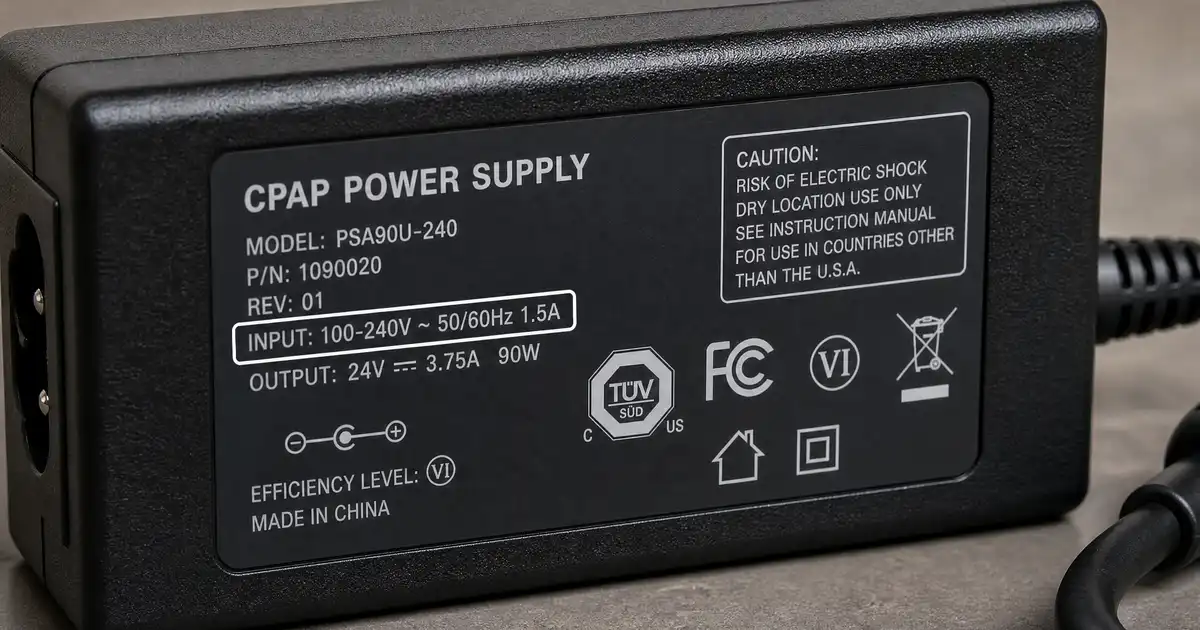
The CPAP power supply converts wall power to DC for the machine. That power supply has an input voltage range printed on its label.
A dual voltage power supply accepts 100-240V AC and 50-60Hz. It works in the US, Europe, Asia, South America, and Australia.
A single voltage power supply accepts only 100-120V AC (US and Canada). It destroys the machine on 220-240V without a converter.
The label on the adapter is the definitive check. Look for “Input: 100-240V ~50/60Hz” or similar language. This confirms the supply is universal.
How to Check Your CPAP Machine
Step 1: Find the power supply — the brick-shaped adapter between the wall and the machine.
Step 2: Read the label on the power supply. Look for the input voltage specification.
Dual voltage label reads: Input: 100-240V ~50/60Hz (or 100V–240V)
Single voltage label reads: Input: 100-120V ~60Hz (or 110V~)
Step 3: Confirm the same on the machine label (bottom or back). The machine label shows the input it accepts from the power supply.
A 100-240V supply means the machine works abroad. You need only a plug adapter.
Major CPAP Machines and Their Voltage Range
| Machine | Power Supply Input | International Ready? |
|---|---|---|
| ResMed AirSense 10 (all variants) | 100-240V | Yes |
| ResMed AirSense 11 AutoSet | 100-240V | Yes |
| ResMed AirMini | 100-240V | Yes |
| ResMed AirCurve 10 (all variants) | 100-240V | Yes |
| Philips DreamStation 1 (all variants) | 100-240V | Yes |
| Philips DreamStation 2 Auto | 100-240V | Yes |
| Fisher & Paykel SleepStyle | 100-240V | Yes |
| React Health Luna G3 | 100-240V | Yes |
| DeVilbiss IntelliPAP Standard Plus | 100-240V | Yes |
| 3B Medical Zesta G3 | 100-240V | Yes |
Every major CPAP brand in the US ships with a universal supply.
Where exceptions exist: Budget or older machines sometimes use single-voltage supplies. Off-brand CPAP machines from lesser-known manufacturers carry higher risk of single-voltage power supplies. Check the label — don’t assume.
What You DO Need for International Travel
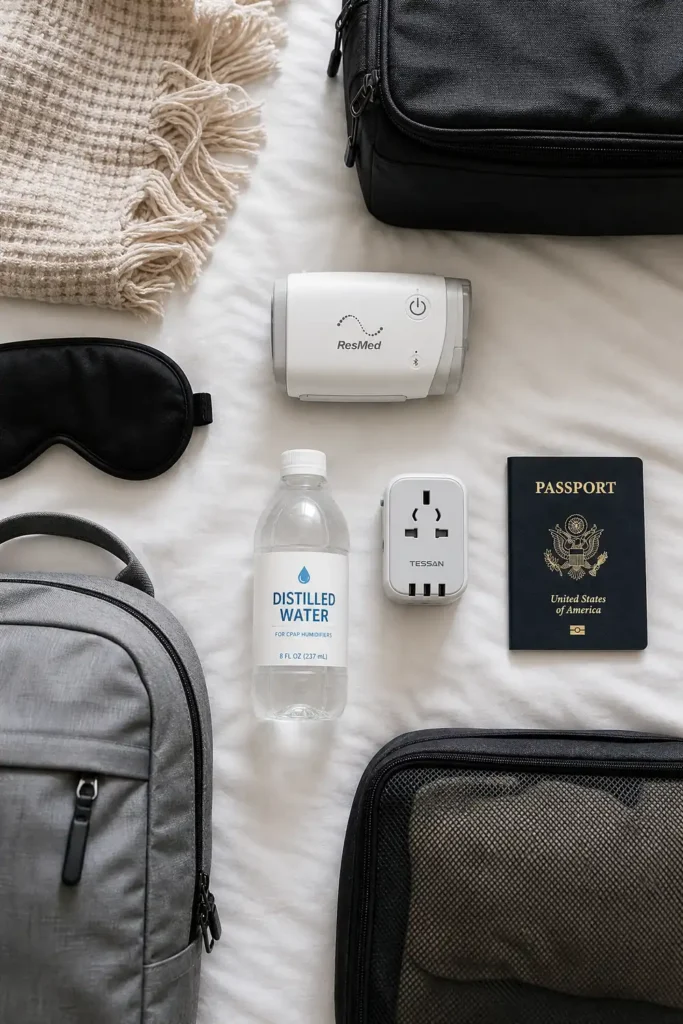
Even with a dual voltage CPAP, two things may still be needed.
1. A travel plug adapter
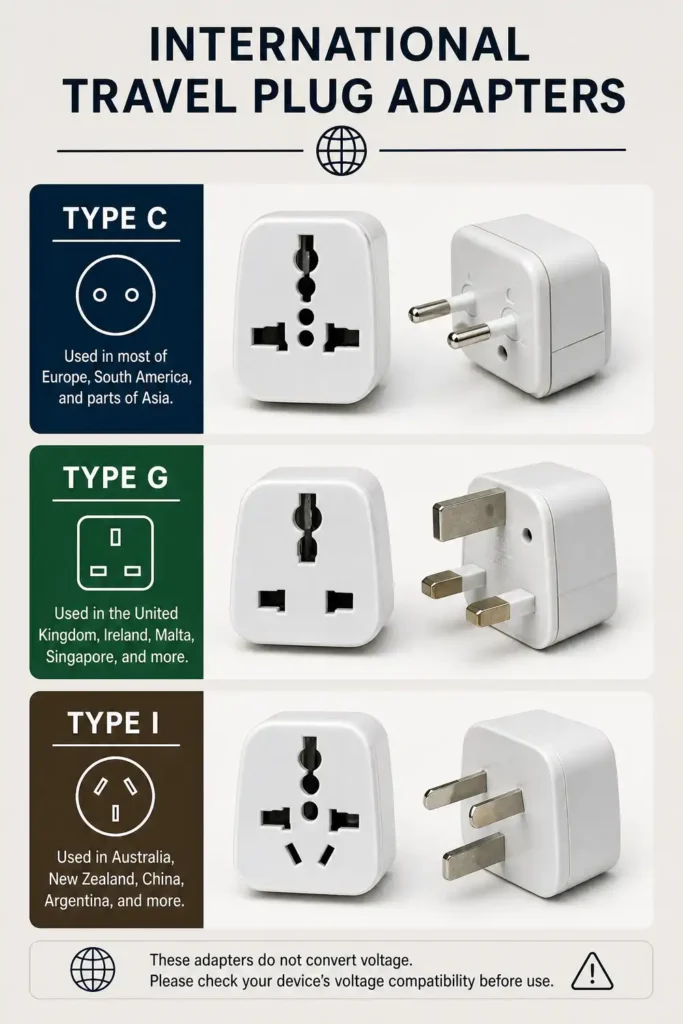
Wall outlet shapes differ by country. The US uses a flat two-or-three-prong plug (Type A/B). Other common outlet formats are listed above.
- Europe: Type C (round pins) — used across most of continental Europe
- UK/Ireland: Type G (large rectangular pins)
- Australia/New Zealand: Type I (angled flat pins)
- South Africa: Type M (large round pins)
A universal travel adapter ($10-20) covers all major outlet types. These are not voltage converters — they only change the plug shape.
2. Distilled water for the humidifier (at destination)
Most airlines prohibit liquid carry-ons over 3.4oz, including humidifier water. Purchase distilled water at the destination or run without humidification during travel.
What You Do NOT Need
A voltage converter — for any machine on the list above.
Voltage converters are heavy, expensive ($30-80), and unnecessary for dual voltage machines. One wastes money and bag space.
A transformer — same reason. Modern dual voltage CPAP supplies handle the conversion internally.
A new machine for international travel — your existing dual voltage machine works anywhere. Unless you need an airline-approved battery backup (different consideration), no replacement is needed.
When a Voltage Converter IS Needed
Two situations require a voltage converter.
Older CPAP machines (pre-2010) — Some machines from this era use single-voltage supplies. The label confirms. A step-down voltage converter handles 220V → 110V conversion for single-voltage machines.
Budget/off-brand machines: Machines purchased outside major US distributors sometimes lack universal power supplies. Again, the label is the definitive check.
Use a pure sine wave converter rated at double the machine’s wattage. Cheap modified sine wave converters can interfere with CPAP electronics.
International Travel Tips for CPAP Users
Carry the machine — never check it. Airlines classify CPAP machines as medical devices. The TSA explicitly permits CPAPs as carry-on medical equipment at no charge. Checked baggage risks loss or damage.
Carry the power supply too. A replacement power supply abroad is difficult to source. The HKY or KFD adapters ship internationally but may take days. Pack the OEM supply.
Skip the humidifier if traveling light. The HumidX (for AirMini) and similar passive humidification options require no power or water. Turning off active humidification removes the water-sourcing problem abroad.
Know the machine’s power draw. At a 220V outlet, draw drops in amps but stays the same in watts. A machine drawing 40W at 120V still draws 40W at 220V — same power, no issue. See my cpap wattage guide for draw numbers by machine.
Check battery rules before flying. CPAP-specific batteries (Medistrom Pilot-24 Lite, EXP48 Pro) have watt-hour limits for carry-on. The American Academy of Sleep Medicine recommends carrying medical device documentation for security screening. For the full CPAP battery travel guide, see my cpap battery backup guide.
FAQs on Dual Voltage CPAP Machines
Can I use my CPAP in Europe without any adapter?
Not directly — the plug won’t fit European outlets. You need a travel plug adapter (Type C for most of Europe). The power supply itself works on 220-240V European current once plugged in.
My CPAP humidifier shows an error at 220V. What’s wrong?
Some humidifiers need a reset after the supply adjusts to new voltage. Power cycle the machine. Persistent errors may mean the humidifier draws too much current at 220V. Run without humidification as a workaround.
Does the frequency (50Hz vs 60Hz) matter?
US power runs at 60Hz. Most international outlets run at 50Hz. Universal CPAP power supplies (100-240V, 50-60Hz) handle both frequencies. Check that the supply label includes 50/60Hz — standard for modern units.
Can I run my CPAP from a generator abroad?
Yes, if the generator outputs 100-240V AC within the machine’s range. A pure sine wave generator is preferred for sensitive CPAP electronics. Cheap modified sine wave generators occasionally cause motor interference or alarm triggers. For full generator guidance, see my cpap generator guide.
What’s the best CPAP for international travel?
The ResMed AirMini is the smallest full-featured CPAP and fully dual voltage. For dedicated travel CPAP options, see my travel cpap with battery guide.
Bottom Line
Most CPAP machines are already dual voltage. Check the power supply label for 100-240V input. That confirms no voltage converter is needed.
Abroad, a travel plug adapter ($10-20) covers the outlet shape. You don’t need a voltage converter, transformer, or new machine.
For machine-specific power cord replacement options, see my cpap power supply guide. See my hsa eligible portable power station guide for flight battery picks.