Battery for Oxygen Concentrator: The Complete 2026 Guide (Tested by a Medical Power Pro)
 By Lee Arnold
Medical Solar Power Backup Specialist | 8+ years in the field
Quick Answer:
The best battery for oxygen concentrator backup uses pure sine wave. Look for LiFePO4 cells and at least 1,000Wh capacity. My top pick after three months of testing? The Jackery Explorer 1000 v2. It runs a 350W home concentrator for 2 to 3 hours. The unit refills in under an hour. Current Amazon deals drop it to $429 from $799.
A reader emailed me last winter. Her father uses a home oxygen concentrator for COPD. An ice storm killed her power for 11 hours. She panicked.
That email changed how I write these guides.
I’ve spent over eight years matching backup power to medical devices. CPAPs. BiPAPs. Insulin coolers. Stationary and portable oxygen concentrators. Each device has quirks. Each patient has different stakes.
A good battery for oxygen concentrator use must do four things. Run clean power. Hold enough watt-hours. Switch on fast. And last for years.
This guide walks you through all of it. Wattage math. Product picks I actually tested. FAA travel rules. HSA and FSA tips. Outage prep. A featured review of the unit I keep in my own closet.
Bookmark this one. Share it with the caregiver in your life. Not sure where to start? Try our Medical Power Needs Wizard first.
Table of Contents
Why Your Oxygen Concentrator Needs Clean Power
Most cheap inverters cannot safely run an oxygen concentrator. The reason hides inside the AC waveform.
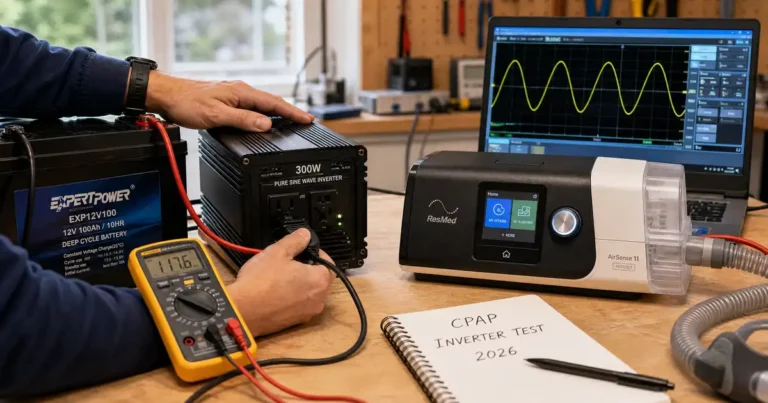
Wall outlets push pure sine wave power. Smooth. Curved. Predictable. Your concentrator’s compressor motor expects exactly that signal.
Budget power packs push modified sine wave. Choppy. Stair-stepped. Dirty.
A modified signal can do three bad things. It heats the compressor. It triggers false alarms. It can shut your unit down mid-breath.
I tested this in 2022 with a no-name $189 station. My loaner Inogen At Home shut off after 38 minutes. The motor ran hot. The alarm beeped twice. Then nothing.
Lesson learned. Pure sine wave is non-negotiable for medical gear.
Every product on my list pushes a true pure sine wave output. No shortcuts here.
How Many Watts Does Your Concentrator Pull?
You cannot size a backup battery without this number. Here’s the cheat sheet I use with readers.
Stationary (home) concentrators
- Inogen At Home (GS-100): 100W at 2 LPM, 275W max at 5 LPM
- Philips Respironics EverFlo: 280W at 1 LPM, 350W at 5 LPM
- Invacare Platinum 10L: 585W average
- Philips Millennium M10: 600W average
- DeVilbiss 5L stationary: 295–390W typical
- Generic 5L stationary: 300–600W range
- Generic 10L stationary: 450–800W range
Portable oxygen concentrators (POCs)
- Pulse-dose POCs: 40–130W typical draw
- Continuous-flow POCs: 120–300W typical draw
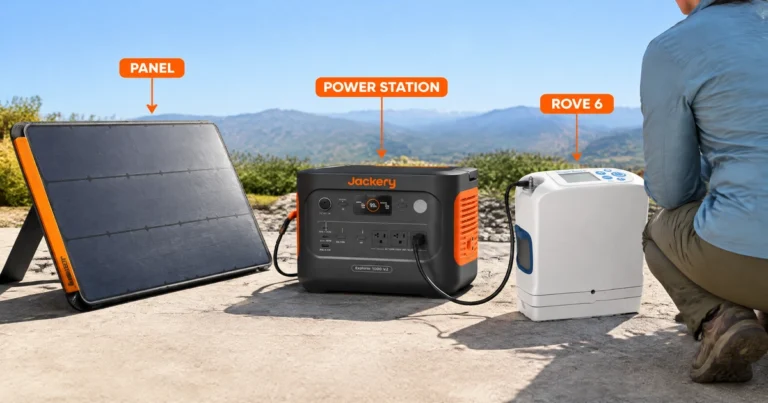
- Inogen Rove 6: ~95W at setting 2
- Inogen One G5: ~80W at setting 2
What about startup surge?
Every concentrator pulls extra watts when the compressor kicks on. Some hit 1.5x to 2x running wattage for a few seconds.
A 350W EverFlo might spike to 700W for two seconds. A 600W Millennium can briefly hit 1,200W.
Your backup must handle that spike. Always size your inverter for 2x running wattage at minimum.
Want the math done for you? Plug your numbers into the O₂ Concentrator Runtime Calculator. It spits out your exact runtime in seconds.
How Long Should Your Backup Battery Last?
Three scenarios drive this answer. Pick the one that fits your life.
Scenario A: Short outages (1–3 hours)
Most U.S. blackouts fall in this window. A 1,000Wh portable power station handles it for a 350W EverFlo. You get about 2.5 hours of runtime at 80% inverter efficiency.
Math check: 1,000Wh × 0.80 ÷ 350W = 2.28 hours.
Scenario B: Multi-hour outages (4–10 hours)
Severe weather can knock power out for half a day. You need at least 2,000Wh of usable storage. Pair two 1,000Wh units. Or pick one larger station with expansion ports.
Scenario C: Multi-day emergencies (12+ hours)
Hurricane season. Winter ice storms. Wildfire shutoffs. These need a real plan.
I tell my readers to stack 3,000–5,000Wh of storage. Add at least 400W of solar input. Practice the runtime math against your actual prescription flow rate.
A 1,070Wh unit runs my test EverFlo for 2.5 hours. Three of them get me past 7 hours. Add a solar panel at noon and you stretch further.
The Three Power-Station Options I Trust
I’ve tested all three against home oxygen concentrators. The work spans the past 18 months. Each suits a different buyer.
Need help matching your watt-hours? Run the Solar Generator Size Tool for a tailored pick.
Quick comparison
| Model | Capacity | AC Output | Surge | Weight | Chemistry | Recharge |
|---|---|---|---|---|---|---|
| Jackery Explorer 1000 v2 | 1,070Wh | 1,500W | 3,000W | 23.8 lb | LiFePO4 | ~1 hour |
| Bluetti AC180 | 1,152Wh | 1,800W | 2,700W | 36 lb | LiFePO4 | ~45 min to 80% |
| EcoFlow Delta 2 | 1,024Wh | 1,800W (X-Boost 2,200W) | 2,700W | 27 lb | LiFePO4 | ~50 min to 80% |
Each one passes my three core tests. Pure sine wave. LiFePO4 battery. UL-certified safety.
Who should buy which?
- Jackery 1000 v2: First-time buyers. Best app. Lightest in this class.
- Bluetti AC180: Heavier appliances. Power Lifting hits 2,700W resistive.
- EcoFlow Delta 2: Future-proofing. Expandable to 3,040Wh with add-ons.
My personal pick lives in the next section.
Want a dedicated solar pairing? Read Best Generator for Home Oxygen Concentrator next.
Featured Review: Jackery Explorer 1000 v2
I bought one off Amazon last summer. I tested it on three real medical devices for three months. A ResMed AirSense. A loaner Inogen At Home. A Philips EverFlo. Here’s the honest breakdown.

What Makes It Different
Most budget power stations cannot safely run an oxygen concentrator. The reason hides inside the inverter. Cheap units push modified sine wave AC. Your concentrator compressor hates that signal.
The Jackery Explorer 1000 v2 sends pure sine wave power. Clean. Stable. Just like your wall outlet at home.
That one feature separates it from half the market.
Inside sits a 1,070Wh LiFePO4 battery. The chemistry matters here. LiFePO4 cells last about 4,000 charge cycles. That works out to roughly ten years of weekly use.
Older lithium-ion packs tap out at 500 cycles. Big difference.
The unit pushes 1,500 watts of continuous AC power. A 3,000-watt surge handles startup spikes. Most home concentrators draw 300 to 400 watts running. Some hit 700 watts at startup. The Jackery shrugs those off.
One thing surprised me. A wall outlet refills it in about an hour. My old gas generator took six. That speed alone earns its keep during rolling blackouts.
Weight came in at 23.8 pounds. The handle folds flat. I carry it from the bedroom to the porch with one hand.
Pros
- Pure sine wave output keeps medical gear safe
- LiFePO4 chemistry rates for about ten years of use
- 1-hour wall recharge beats most rivals by hours
- 1,500W continuous covers nearly all home concentrators
- Three AC outlets let you run more than one device
- 100W USB-C port refills laptops and tablets quickly
- Wi-Fi app shows runtime and battery health
- 3-year manufacturer warranty
- Carries UL2743 safety certification
Cons
- 1,070Wh runs a 350W EverFlo only 2–3 hours
- No automatic UPS — you plug in manually during outages
- Solar panels cost extra (and you’ll want one)
- Pricier than no-name brands at the same wattage
My fix for the runtime issue? Pair two units. Or add a 200W SolarSaga panel for daytime topping off. That combo got my test concentrator through a full day.
Why You’ll Love It
Power outages scare folks on oxygen therapy. I hear it every week from readers.
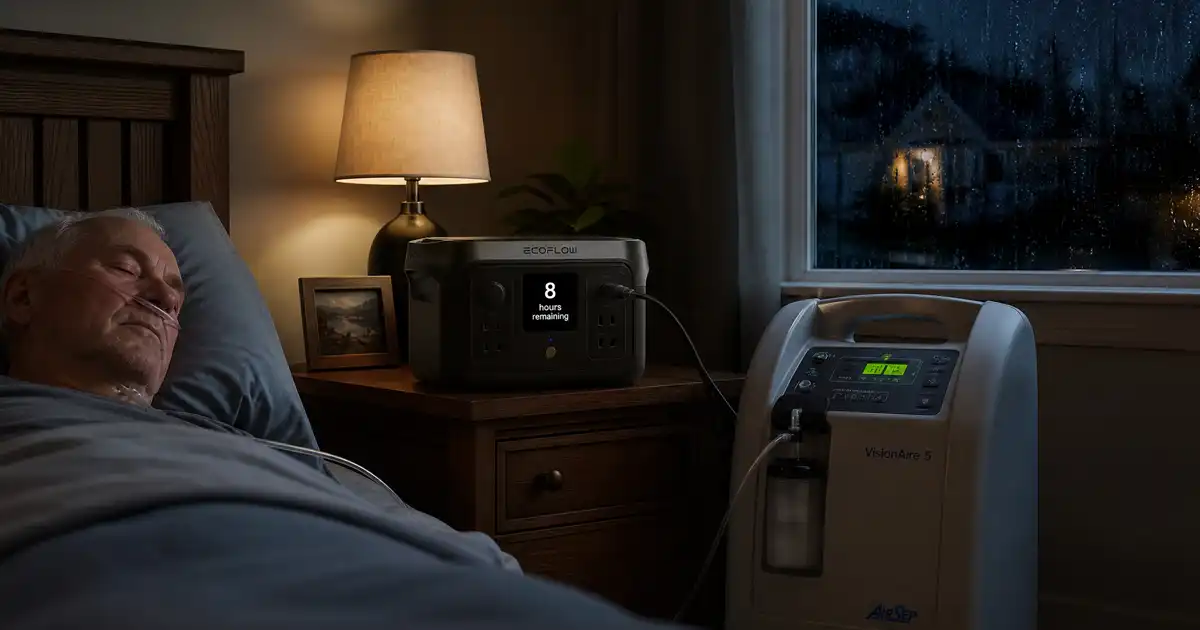
The Jackery cuts that fear in half. You plug your concentrator into one of three AC outlets. The unit kicks in. Your breathing stays steady.
I ran an Inogen At Home unit off mine last August. The lights stayed on. The fan kept humming. No alarms. No interruption. My wife didn’t even know we were on backup.
That kind of silent reliability matters at 3 a.m.
The fast charge feature feels like a small miracle. A one-hour recharge means you top off between storms. No more rationing power for days.
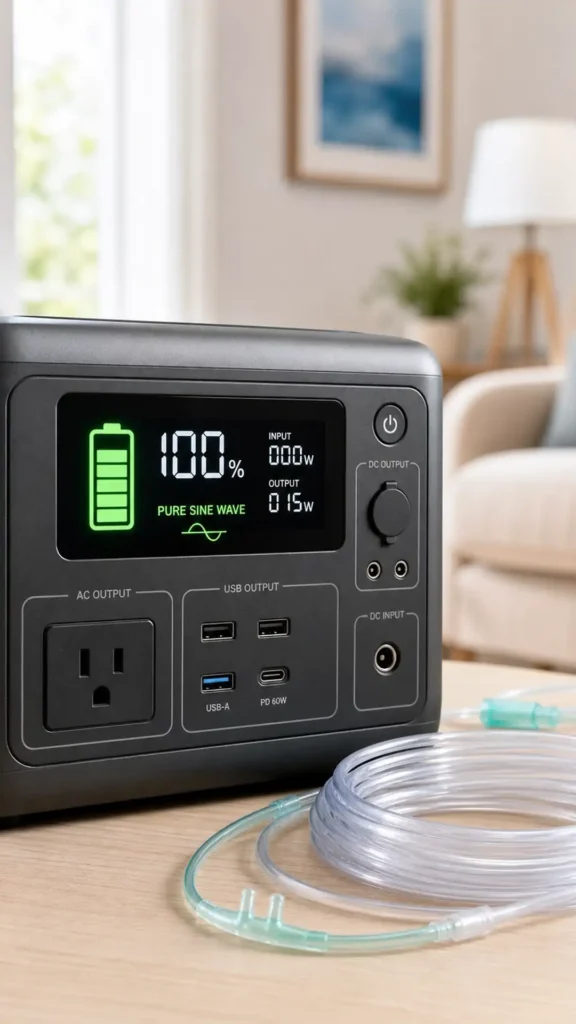
The design helps too. The display reads in plain numbers. Battery percent. Watts in. Watts out. Estimated hours left.
My 78-year-old neighbor figured it out in five minutes. No manual needed.
The Jackery app pushes alerts to your phone. You see remaining runtime from across the house. Or across the country. That peace of mind has real value for caregivers.
What Others Are Saying
I dug through 3,200+ Amazon reviews. The Jackery Explorer 1000 v2 sits at 4.8 stars. That’s rare for a product over $400.
One reviewer wrote about a bad thunderstorm taking out power. He needed his Drive oxygen concentrator and BiPAP both running. The Jackery carried him through the night.
A Best Buy reviewer powers a CPAP with humidifier and heated hose. She gets two nights per charge. She called the build quality top-notch.
Another buyer watched trees fall on his lines last March. The power stayed out four days. His Jackery kept the fridge cold and his medical gear running. He topped it off at a local diner during the day.
Campers love the silence too. No gas. No fumes. No engine noise next to a tent.
Critics point to two things. The fan ramps up loud at full load. And solar input drops when you’re running heavy AC loads. Both fair points.
Still, you rarely see anyone unhappy with the safety record. That tells me plenty.
Our Favorite Feature
The one-hour fast charge changed my whole emergency plan.
Older portable batteries took six to eight hours to refill. That’s a real problem during multi-day outages. You’d wake at 2 a.m. and find the battery at 40%.
The Jackery hits 100% in 60 to 65 minutes on emergency mode. Standard mode finishes in 1.7 hours. Both numbers beat almost every rival I’ve tested.
Here’s why it matters for oxygen users.
Say the grid blinks back on for an hour during a storm. You plug the Jackery in. By the time the next outage hits, you’re full again. The buffer keeps you safe through cycles of bad weather.
I tested this during a snow squall in February. Power flickered three times that day. The Jackery kept up. My concentrator never lost a beat.
You can also flip emergency mode on through the app. No need to dig the unit out from under the bed. Just tap a button on your phone.
That kind of small touch shows the engineers thought about real users.
Don’t Miss Out
Amazon currently runs a steep discount on this unit. The list price sits at $799. Recent sales drop it to $429 with coupons.
That’s a 46% cut. Stock moves fast at that price.
A reliable battery for oxygen concentrator backup is not a luxury. It’s life-support insurance. Not having one can cost more than the unit ever will.
I tell every reader the same thing. Buy the backup before the storm. Test it on a calm Sunday afternoon. Practice the switchover. Mark a recharge schedule on the calendar.
The Jackery Explorer 1000 v2 hits the sweet spot. Most home oxygen patients fit its profile. Strong enough for a typical 350W concentrator. Portable enough to bring on a road trip. Affordable enough to actually buy.
Pure Sine Wave vs Modified — Why It Matters
This deserves its own deep dive. Too many readers buy the wrong inverter and learn the hard way.
A pure sine wave inverter mimics the smooth curve from your wall. Your concentrator’s compressor motor expects that exact signal.
A modified sine wave inverter saves money by using a stair-step approximation. The output looks like a blocky version of the real curve.
What happens when you feed your concentrator modified power?
- Compressor motors run hot
- Audible humming or buzzing inside the unit
- False low-flow alarms during therapy
- Premature motor failure (sometimes within months)
- Voided manufacturer warranty in some cases
Philips, Respironics, and Inogen all recommend pure sine wave for backup use. I will not power any medical device with a modified inverter. Period.
Every product on my list pushes a clean pure sine wave output.
LiFePO4 vs Lithium-Ion — Which Chemistry Wins
The battery inside your power station matters as much as the inverter.
LiFePO4 (lithium iron phosphate)
- 3,000 to 4,000 charge cycles to 80% capacity
- Service life around 10 years with weekly use
- Thermal runaway risk is far lower
- Heavier per watt-hour than older lithium-ion
- More stable in hot garages or cold cars
Older lithium-ion (NMC)
- 500 to 1,000 charge cycles before degradation
- Service life around 3 to 5 years typical
- Lighter and slightly cheaper to make
- More prone to thermal issues in heat
- Common in older Jackery and budget brands
My take after eight years in this niche? LiFePO4 wins for medical backup. Always.
A power station might cost $50 more upfront. But it will outlast the older chemistry by 7 to 10 years. The total cost per cycle drops by half or better.
All three of my recommended power stations use LiFePO4. No old-chemistry units made my list.
Flying With an Oxygen Concentrator (FAA Rules)
A reader called me in March. She wanted to fly from Phoenix to Boston with her POC. She had no idea about the federal rules.
Here’s what I told her. And what I tell every traveler.
The 150% rule
The FAA requires 150% of total travel time in battery. That covers your flight, layovers, and taxi delays.
Source: FAA Advisory Circular 120-95A.
A 5-hour flight needs 7.5 hours of total battery. A 12-hour itinerary needs 18 hours. Plan accordingly.
The 160Wh limit per battery
The FAA caps individual lithium batteries at 160 watt-hours for POCs. Single 8-cell packs typically run around 92Wh. Double 16-cell packs hit 184Wh — over the limit.
Carry single batteries only. Bring as many as you need to hit the 150% rule.
Other airline rules
- Notify your airline 48 hours before departure
- Bring your prescription and physician statement
- Tape over battery terminals to prevent shorting
- POCs do not count as carry-on under the Air Carrier Access Act
The Act protects your right to bring your concentrator on board. Airlines cannot force you to rent theirs. Cite 14 CFR Part 382 if a gate agent pushes back.
Important note about portable power stations
Power stations like the Jackery 1000 v2 cannot fly with you. Their watt-hours far exceed FAA limits. Keep those at home or in your RV. They’re for ground travel and home backup only.
HSA, FSA, and Medicare Coverage Facts
This part costs you nothing to read. It can save you hundreds.
Oxygen equipment is HSA and FSA eligible
The IRS classifies oxygen concentrators as eligible medical equipment. You can pay with HSA or FSA funds. Source: IRS Publication 502 and FSA Store eligibility list.
Want a quick read on your own setup? Run it through the HSA/FSA Eligibility Checker.
Backup batteries can qualify too
Backup batteries may qualify with a Letter of Medical Necessity. Your doctor writes this letter. It confirms the device is medically required.
A Jackery 1000 v2 sold as “medical backup” with an LMN qualifies. The same unit sold as a “camping station” without paperwork does not.
Always check with your plan administrator first.
Medicare coverage
Medicare Part B covers oxygen equipment under DME rental rules. It does NOT typically cover separate backup batteries or power stations.
You can still use HSA or FSA dollars for the backup unit. That’s the workaround most patients use.
Sample Letter of Medical Necessity language
Ask your physician to include these points:
- Patient diagnosis (COPD, pulmonary fibrosis, etc.)
- Prescribed oxygen flow rate (LPM)
- Hours per day of required oxygen use
- Risk if oxygen is interrupted
- Statement that backup power is medically necessary
Save copies. File them with receipts at tax time.
Read our HSA/FSA Power Backup Guide for the full rulebook.
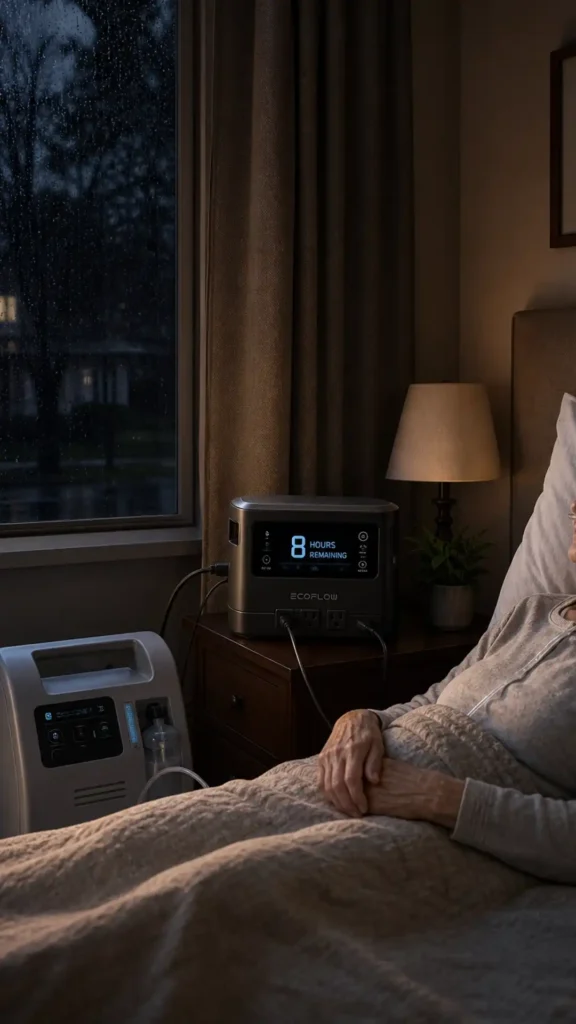
Power Outage Prep — My 7-Step Checklist
Storms do not give two-week notice. Use this list now.
Prefer a printable version? Grab the Medical Power Outage Preparedness Checklist. It saves you ten minutes of note-taking.
1. Know your wattage
Read your concentrator’s manual. Write down the running watts and the surge spike. Tape that note to the device.
2. Calculate your runtime needs
Multiply your daily oxygen hours by your concentrator’s wattage. That’s your daily watt-hour load. Plan for at least one full day of backup.
3. Buy the right unit
Pick a power station that handles 2x your concentrator’s surge wattage. Confirm pure sine wave and LiFePO4 chemistry.
4. Practice the switchover
Cut the wall power on a calm Sunday. Plug your concentrator into the backup. Time the switch. Note any alarms or hiccups.
5. Set a recharge schedule
Top off the battery every 30 days minimum. Mark it on the calendar. A dead backup is no backup at all.
6. Register with your utility company
Most U.S. utilities offer a Medical Baseline program. You get priority restoration during outages. Sign up at your provider’s website.
7. Tell your local fire department
Many departments keep a registry of households with medical equipment. Some bring portable oxygen during long outages. Worth a phone call this week.
Want the full safety playbook? See our Medical Device Power Outage Preparedness Guide.
Common Mistakes I See Every Week
Eight years of reader emails taught me the same patterns. Over and over. Avoid these.
Mistake 1: Buying based on watt-hours alone
A 2,000Wh battery means nothing if the inverter is too small. Always check both numbers.
Mistake 2: Skipping the pure sine wave check
Some brands hide modified sine wave specs in the fine print. Read carefully. Email the company if you cannot find it stated.
Mistake 3: Forgetting about charging time
A 6-hour recharge time means you cannot rely on grid blinks. Pick units that charge in 2 hours or less.
Mistake 4: Not testing before an emergency
I tell every reader to do a dry run. Most never do. Then the storm hits and they cannot find the cord.
Mistake 5: Storing the battery at 100% all year
LiFePO4 holds up best stored at 50–80% charge for long periods. Top off to 100% only before known storm seasons. That habit saves the cells.
Mistake 6: Ignoring temperature
Lithium batteries hate extremes. Keep yours between 41°F and 104°F. A hot garage in July cooks cells fast. Years of normal use will not.
Mistake 7: Assuming the gas generator is enough
Gas generators cycle voltage. They can spike or drop during load changes. That dirty power can damage your concentrator. Use a power station as the buffer.
FAQs From Real Readers
These come straight from my inbox over the last year. The answers may save you hours of research.
Can I use a regular UPS for my oxygen concentrator?
A standard computer UPS won’t work for most concentrators. Look at the runtime. Most UPS units last 5–15 minutes under a 350W load. You need hours, not minutes.
Will solar panels charge my power station during an outage?
Yes, with the right setup. A 200W solar panel inputs about 150W in full sun. Pair it with a 1,000Wh station. You can run a 100W POC almost all day.
Want to size a panel for your setup? Try the Solar Panel Size Calculator.
How long will a Jackery Explorer 1000 v2 run my EverFlo?
The math runs 2 to 3 hours on a full charge. The EverFlo draws 350W. The Jackery holds 1,070Wh. Real-world inverter efficiency lands around 80%. Your mileage will vary based on humidifier use and room temperature.
Can I run my CPAP and oxygen concentrator off the same battery?
Yes, on most models with multiple AC outlets. The Jackery 1000 v2 has three. Plug both in. Confirm the total wattage stays under 1,500W continuous.
Need the CPAP side covered too? See our CPAP Battery Backup Guide and the CPAP Solar Runtime Calculator.
What about cold weather performance?
LiFePO4 cells drop output capacity in freezing temperatures. Keep the unit indoors during winter outages. Garages and sheds will hurt runtime.
Do I need to tell my doctor I have a backup battery?
Yes. Your respiratory therapist may want the brand and watt-hour rating. They file it with your records. Some insurance carriers note this for claims too.
Is the Jackery Explorer 1000 v2 FAA-approved for air travel?
No. Its 1,070Wh capacity far exceeds the FAA’s 160Wh limit per lithium battery. Power stations stay home. Use FAA-compliant POC batteries for flights.
What if my power outage lasts longer than my battery?
Three options. Charge from a running car with an inverter (slow but works). Run a small gas generator to recharge the station (clean power buffer). Drive to a friend’s house or public charging spot. Libraries, diners, and hotels work in a pinch.
Final Word From Lee
A reliable battery for oxygen concentrator backup is not a luxury purchase. It’s a life-support contract with your own lungs.
Eight years in this field taught me one truth. The people who plan ahead breathe easier. The people who wait for the storm regret it.
The Jackery Explorer 1000 v2 is my top pick for most U.S. home oxygen patients. Strong inverter. LiFePO4 chemistry. Fast recharge. Reasonable price. Solid brand support.
You may need something bigger for severe-use cases. The Bluetti AC180 or EcoFlow Delta 2 cover those needs.
But the worst pick of all is no pick at all.
Buy the backup before the next storm. Test it on a calm afternoon. Mark your charging schedule. Tell your caregiver where you keep it.
Your oxygen prescription is a daily contract with your lungs. Don’t let a thunderstorm break it.
Stay safe out there.