Battery Powered CPAP: 3 Setup Options That Work (2026)
 By Lee Arnold
Medical Solar Power Backup Specialist | 8+ years in the field
Quick Answer:
Three approaches power a CPAP from battery. One: a small travel CPAP running on a power bank. Two: a dedicated CPAP battery pack connecting directly to your home machine. Three: a portable power station running through its AC outlet. Each approach suits a different need and budget.
Table of Contents
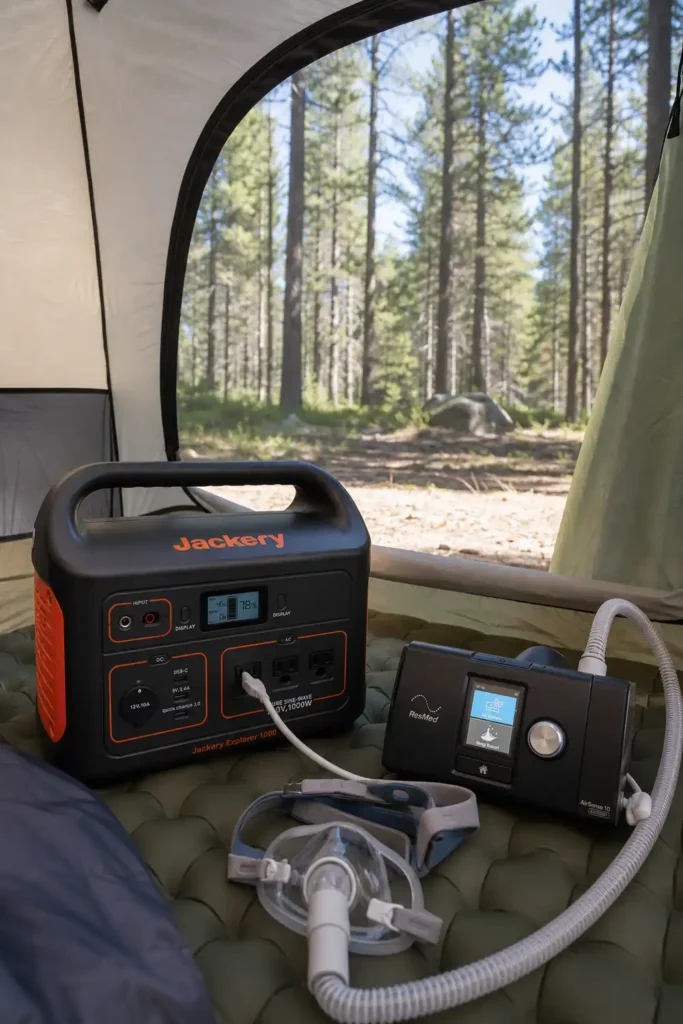
A CPAP patient called me last September. He’d bought a portable power station for hurricane season. He tried to run his AirSense 11 through it. The machine threw an error code and shut down.
He’d bought a modified sine wave inverter. CPAP machines need pure sine wave.
That mistake cost him $200 and weeks of frustration. Most “battery powered CPAP” search results don’t explain the difference.
This guide covers the three real approaches to battery-powered CPAP therapy. The right pick depends on your machine, travel habits, and budget.
Why You Might Want a Battery-Powered CPAP
Three situations push CPAP patients toward battery power.
Travel: Hotel rooms, camping sites, airplanes, and international travel all create power access problems. A battery-powered setup gives you therapy without depending on an outlet.
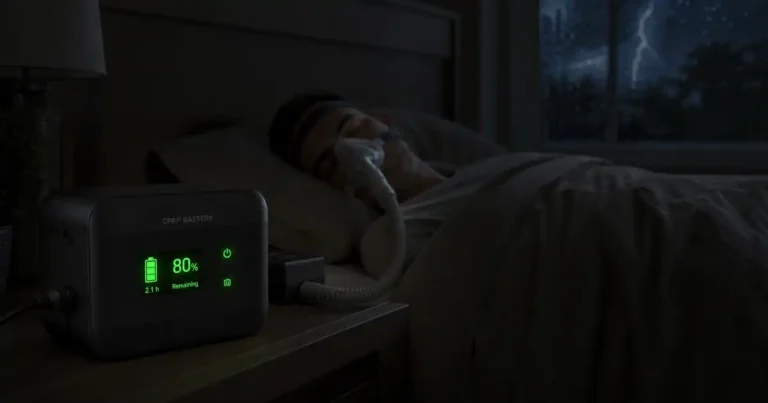
Power outages: Grid failures from storms, hurricanes, or utility failures interrupt therapy for millions of CPAP patients. A battery backup keeps the machine running.
Off-grid lifestyle: RV travel, remote work, and outdoor recreation increasingly require medical equipment to go where outlets don’t.
Each situation calls for a different battery approach.
Approach 1: Small Travel CPAPs Designed for Battery Use
The lowest-draw CPAP machines run on standard phone power banks. No special adapter. No inverter. Just USB or DC power.
These machines draw 6-25W without humidifier. That puts them far below standard home CPAPs at 30-105W. The difference is massive for battery sizing.
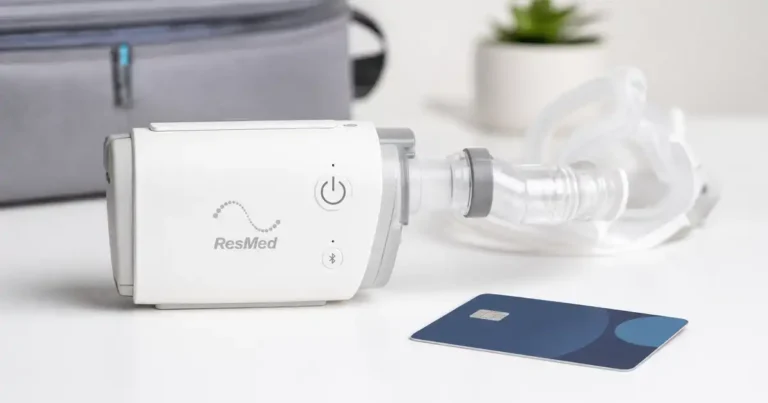
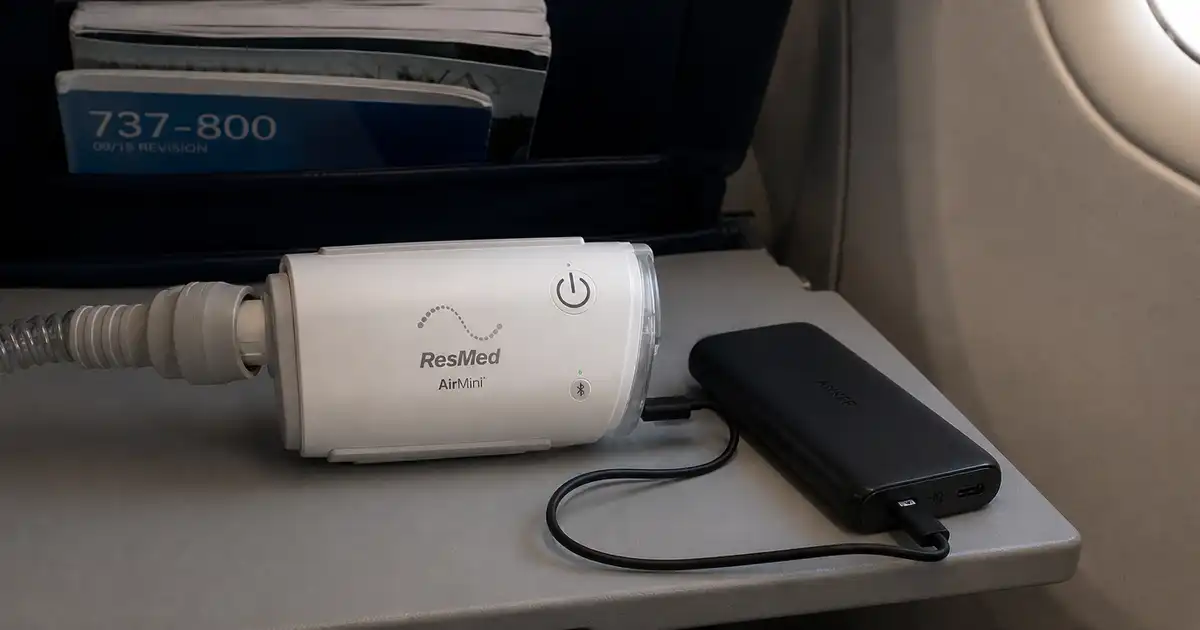
ResMed AirMini
The smallest full-featured CPAP on the market. Weighs 0.66 pounds. About the size of a can of soda.
- Power draw: 6.3W typical, 27W peak
- Power input: USB-C or proprietary adapter
- Humidification: Waterless HumidX disc (no power draw)
- FAA approved for in-flight use
- App control via AirMini app (iOS and Android)
A 10,000mAh power bank runs the AirMini for 2+ nights without humidifier. No inverter. No conversion. Pure DC from bank to machine.
The AirMini requires a prescription. Purchase through authorized CPAP retailers, not Amazon.
Breas Z2 Auto
The Z2 Auto is a close competitor. Slightly larger than the AirMini. Compatible with the PowerShell snap-on battery that clips directly to the device.
- Power draw: 18W typical
- PowerShell battery adds 8+ hours without increasing pack size significantly
- Runs on 12V DC (car power compatible)
- Z-Breathe algorithm reduces pressure on exhale
- FAA approved
The PowerShell system is the cleanest battery integration available. The battery snaps onto the bottom of the Z2. No cables. No separate bag.
Transcend Micro Auto / Transcend 3
The Transcend Micro fits in a shirt pocket. Compatible with the PowerAway battery pack (Transcend’s proprietary snap-on battery).
- Power draw: 15-25W
- PowerAway battery: 8+ hours
- Universal adapter works on any voltage globally (100-240V)
- FAA approved
The Transcend 3 adds a drying mode and improved humidification.
Best for: Frequent travelers, campers, international travelers, patients who want the smallest possible setup.
Approach 2: Dedicated CPAP Battery Packs
Dedicated CPAP batteries connect directly to your existing home CPAP. No inverter. No conversion loss. They output the machine’s exact native DC voltage. Typically 24V for ResMed, 12V for Philips.
These are the most efficient battery approach for home CPAP users. The machine plugs into the battery. The battery plugs into the wall. Fully inline. The battery charges continuously. When power fails, the CPAP draws from battery without any interruption.
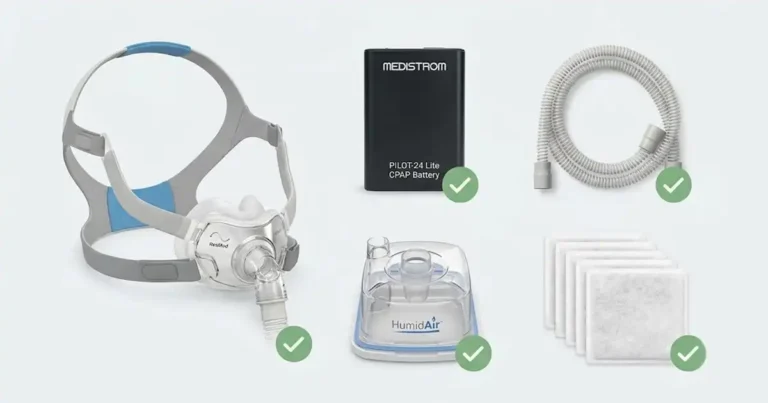
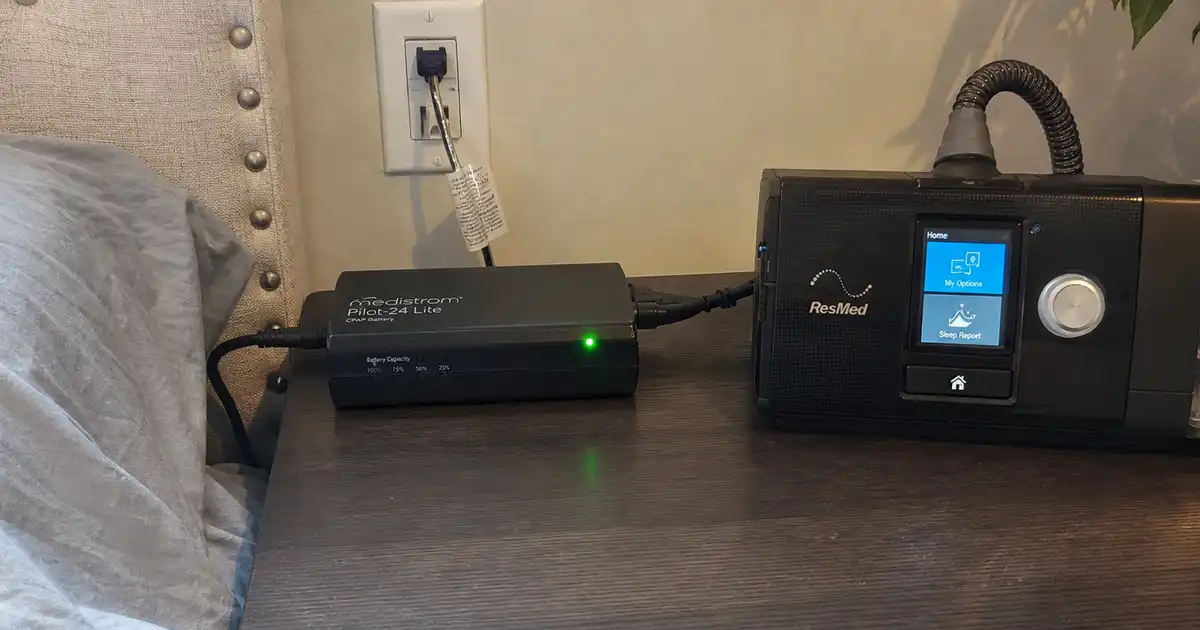
Medistrom Pilot-24 Lite — Best for ResMed Users
The Pilot-24 Lite is the most trusted 24V dedicated CPAP battery. That covers the AirSense 10, AirSense 11, AirMini, and AirCurve series.
Check the Medistrom Pilot-24 Lite on Amazon.
- Capacity: 95Wh
- Compatible: ResMed AirSense 10, AirMini, AirCurve 10, S9
- FAA compliant (under 100Wh carry-on limit)
- Runtime: 1-2 nights without humidifier
- UPS function: seamless switchover when power fails
- Weight: 1.1 lbs
- Built-in USB port for charging phones and tablets
The AirSense 10 / AirMini bundle saves a separate cable purchase.
Check the Medistrom Pilot-24 Lite Bundle on Amazon.
Important: The Pilot-24 Lite is native 24V. It works with ResMed machines directly. For DreamStation and other 12V machines, use the Pilot-12 Plus instead.
Voltage must match your machine. Using the wrong voltage battery can damage your CPAP.
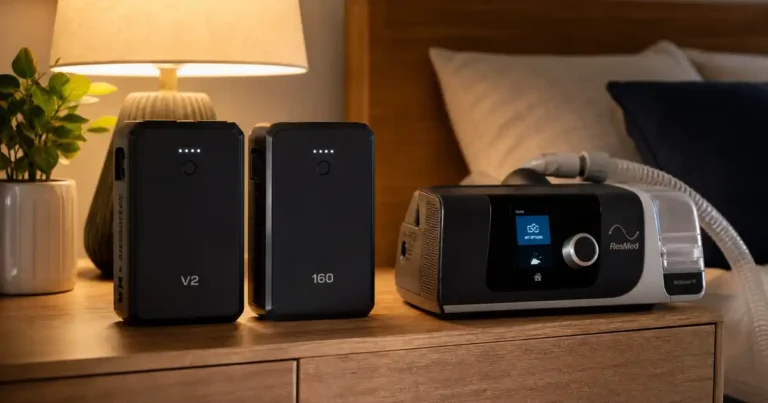
Freedom CPAP Battery (V2 and 160)
The Freedom CPAP Battery series is the main competitor to Medistrom. The Freedom 160 holds 160Wh — nearly double the Pilot-24 Lite’s 95Wh.
The Freedom 160 runs an AirSense 11 for up to 24 hours. That covers multiple consecutive nights of outage.
A dedicated Freedom CPAP Battery review is coming to MedicSolar soon.
Best for: Home CPAP users who want seamless outage protection with their existing machine. The inline UPS function requires zero behavior change — just plug in and forget.
Approach 3: Portable Power Stations (Most Flexible)
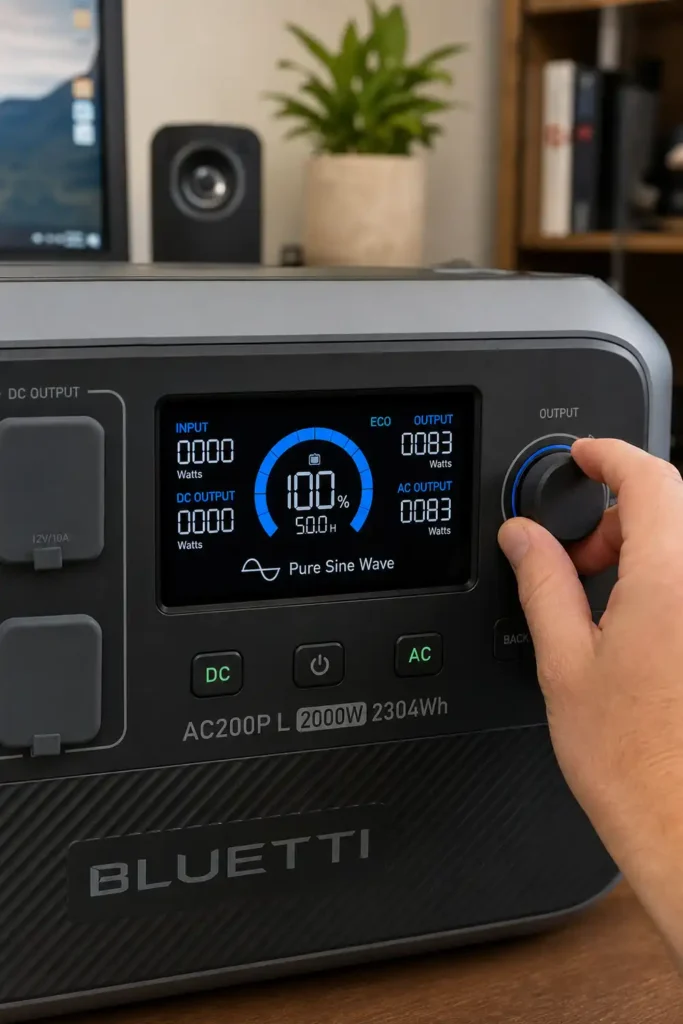
A portable power station runs your CPAP through its AC outlet. The machine plugs in normally. No adapters. No compatibility concerns.
This is the most flexible approach. One power station can run a CPAP, phone, and laptop simultaneously. It works with any CPAP model without voltage matching.
The trade-off: the AC path involves two conversions. Station DC → AC → then adapter converts back to DC. That costs 10-20% efficiency versus a dedicated CPAP battery. The runtime math requires a larger station to cover one night.
What to look for in a CPAP power station
Pure sine wave output: This is non-negotiable. Modified sine wave damages CPAP motors and electronics over time. Every power station on my recommended list outputs pure sine wave. Never buy a CPAP power station without confirming pure sine wave output.
1,000Wh minimum for a standard home CPAP: A CPAP drawing 60W for 8 hours needs 480Wh at minimum. A 1,000Wh station provides about 1.5 nights with humidifier and margin for inefficiency.
LiFePO4 battery chemistry: Safer, longer-lasting, and more stable than lithium-ion in power stations. Rated for 3,000-4,000 charge cycles versus 500 for older li-ion.
Runtime estimates by station size
| Station Size | CPAP (no HH, 8 hrs) | CPAP (humidifier on, 8 hrs) |
|---|---|---|
| 300Wh | 1 night | Less than 1 night |
| 500Wh | 1.5 nights | 1 night |
| 1,000Wh | 3 nights | 1.5 nights |
| 2,000Wh | 6 nights | 3 nights |
For station picks sized for CPAP, see my cpap battery backup guide. For solar generator pairings, see my cpap generator guide.
Which Approach Is Right for You?
Match your situation to the right approach.
| Your Situation | Best Approach |
|---|---|
| Frequent air travel | Small travel CPAP (AirMini, Z2, Transcend) |
| Camping and off-grid | Small travel CPAP + power bank or dedicated battery |
| Hurricane / storm outage | Dedicated CPAP battery OR power station |
| Multi-device household | Portable power station (runs everything) |
| AirSense 10 or 11 user wanting UPS backup | Medistrom Pilot-24 Lite |
| Long-term off-grid use | Portable power station + solar panels |
Critical Rules for Battery-Powered CPAP
Follow these before buying anything.
Rule 1: Pure sine wave only. Your CPAP requires pure sine wave power. Modified sine wave inverters cause motor noise, erratic therapy, and long-term component damage.
Rule 2: Match voltage for dedicated batteries. 24V batteries for ResMed. 12V batteries for Philips DreamStation. Confirm your machine’s voltage before buying a dedicated pack.
Rule 3: Turn off the humidifier. The humidifier more than doubles your draw. Cut it during battery operation. Use a HumidX passive humidifier or nothing at all. This single change doubles your runtime.
Rule 4: Use DC when possible. A DC cord bypasses the AC adapter conversion. DC path runtime improves 20-30% over AC path. For AirSense 11 DC cord options, see my airsense 11 power cord guide.
Rule 5: Test before you need it. Run your full setup overnight before storm season. Find problems on a calm night, not during an emergency. The testing protocol is in my test cpap backup battery guide.
FAQs on Battery-Powered CPAP
Can any CPAP run on battery?
Yes. Every CPAP can run on a battery with the right setup. Travel CPAPs need smaller batteries. Full-size home CPAPs need larger power stations or dedicated battery packs. The key variables are wattage, battery capacity, and power conversion method.
How many hours does a CPAP battery last?
It depends on the machine, settings, and battery size. The Medistrom Pilot-24 Lite (95Wh) runs an AirSense 10 for 1-2 nights. A 300Wh station runs a CPAP for roughly one night with humidifier.
Do I need a special battery for my CPAP?
Not necessarily. A portable power station works with any CPAP through its AC outlet. Dedicated CPAP batteries connect via DC and are more efficient. They must match your machine’s voltage.
Is the AirMini worth it just for battery use?
Yes, for frequent travelers. The AirMini draws 6.3W — far less than any humidified home CPAP. A 10,000mAh phone power bank runs it for 2+ nights. The efficiency difference is dramatic.
Can I use a car battery for CPAP?
Yes. A 12V DC car adapter connects directly to many CPAP machines. Most car batteries hold 40-80Ah, enough for multiple CPAP nights via DC. Do not run the car in a closed space.
Does using a battery damage my CPAP?
No, if you use the correct voltage and pure sine wave output. Dedicated CPAP batteries are designed for this. Modified sine wave stations cause long-term motor damage. Always confirm pure sine wave.
Will my CPAP battery work on an airplane?
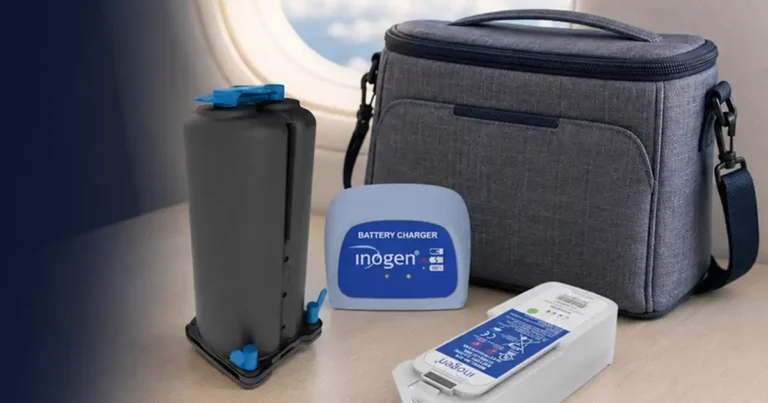
Dedicated CPAP batteries under 100Wh are FAA carry-on compliant. The Medistrom Pilot-24 Lite at 95Wh qualifies. The Freedom CPAP Battery 160 at 160Wh is FAA approved. Airline notification required. Power stations over 100Wh require airline approval.
Bottom Line
Three approaches work for battery-powered CPAP. Small travel CPAPs (AirMini, Z2, Transcend) for extreme portability. Dedicated CPAP batteries (Medistrom Pilot-24 Lite, Freedom 160) for seamless home UPS. Portable power stations for the most flexible multi-use setup.
The Medistrom Pilot-24 Lite is the best first pick for AirSense users. On Amazon, FAA approved, inline setup, no routine change required.
For full power station reviews, see my cpap battery backup guide. For the full outage action plan, see my cpap power outage guide.