Insulin Pump Temperature Safety: Heat & Cold Limits
 By Lee Arnold
Medical Solar Power Backup Specialist | 8+ years in the field
Quick Answer:
Insulin pumps actually have three different temperature numbers, and most guides collapse them into one vague “keep it moderate” warning. Tandem’s t:slim X2 stops delivering insulin entirely at an internal temperature below 35°F or above 113°F, but the company’s own recommended range for protecting the insulin inside is a tighter 41°F to 99°F. Medtronic’s MiniMed 780G specifies an even narrower 41°F to 98.6°F operating range. The pattern across every brand we checked: the insulin is almost always the fragile part, not the electronics. A pump can physically survive conditions that already ruined the dose inside it — FDA guidance flags insulin exposed above 86°F for replacement, well before any pump alarm would trigger.
Most articles on this topic repeat some version of “keep your pump between 36°F and 86°F” without saying where that number came from or which part of the system it’s actually protecting. Pulled directly from the manufacturers’ own documentation, the real numbers are more specific — and more useful — than that.
Table of Contents
Why “Operating Temperature” Isn’t One Number
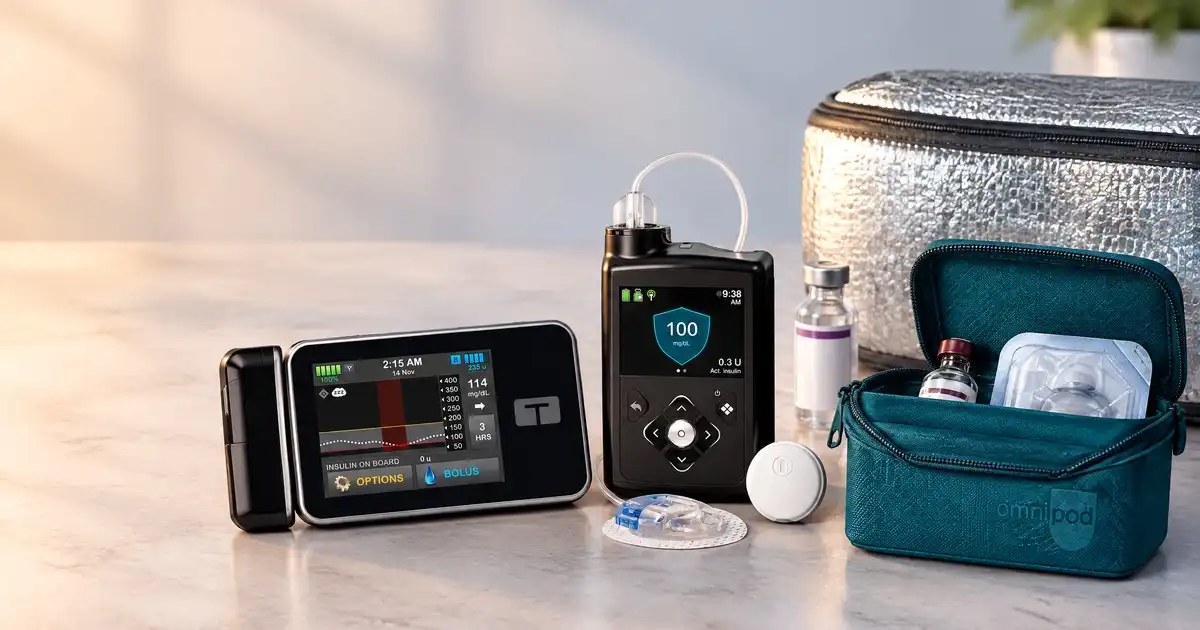
Every insulin pump manufacturer publishes some version of a temperature spec, but a close read of Tandem’s own support documentation shows it’s actually three different numbers doing three different jobs:
A recommended range, narrower and insulin-focused — Tandem tells users to avoid exposing the t:slim X2 to anything below 41°F (5°C) or above 99°F (37°C), specifically because “insulin is very sensitive to heat and cold and can spoil even if exposed for a short period of time.”
An alarm/delivery-stop threshold, wider — the pump’s own alarms (10, 11, and 15) only trigger at an internal temperature below 35°F (2°C) or above 113°F (45°C), at which point the device halts insulin delivery entirely until it’s moved back into range and manually resumed.
A hardware storage range, wider still — Medtronic’s MiniMed 780G specs list a storage temperature range of -4°F to 122°F (-20°C to 50°C) for the disconnected pump, well beyond either the recommended-use or alarm range, because there’s no insulin inside to protect at that point.
The gap between the first number and the last one is the part most guides skip. The electronics can survive conditions the insulin never could — which is exactly why the tighter, insulin-focused number is the one that actually matters day to day, not the one that sounds the alarm.
What Each Major Pump Actually Specifies
| Tandem t:slim X2 | Medtronic MiniMed 780G | Omnipod DASH (PDM) | |
|---|---|---|---|
| Recommended operating range | 41°F–99°F (5°C–37°C) | 41°F–98.6°F (5°C–37°C) | 41°F–104°F (5°C–40°C) |
| Alarm / delivery-stop threshold | Below 35°F or above 113°F (2°C–45°C) | Not published as a separate threshold in the documentation we could confirm | Not published as a separate delivery-stop threshold — Omnipod’s own warning is that “extreme operating temperatures can affect the PDM’s battery and interfere with… operation” |
| Storage range (disconnected, no insulin) | Not published in the sources we could confirm | -4°F–122°F (-20°C–50°C) | Not published in the sources we could confirm |
Figures pulled directly from Tandem’s t:slim X2 temperature alarm documentation, Medtronic’s MiniMed 780G technical specifications, and Omnipod’s safety documentation. Where a manufacturer’s public documentation didn’t state a figure clearly, we’re flagging that as unconfirmed rather than estimating one.
One gap worth calling out directly: Omnipod 5 controls run through either a dedicated Insulet controller or the patient’s own smartphone rather than a standalone PDM, and Omnipod’s documentation doesn’t publish a separate operating-temperature spec for the Pod itself. In practice, that means your phone’s own temperature limits — most smartphones throttle or shut down well before 113°F — often become the real constraint on the system before the Pod’s insulin does, a detail that’s easy to miss if you’re only thinking about the Pod.
What Actually Happens to Insulin at the Wrong Temperature
The pump alarms are downstream of the real issue: insulin itself has documented, FDA-published temperature limits that have nothing to do with which pump you use.
Refrigerated storage: Unopened insulin stored at 36°F to 46°F stays effective until its printed expiration date, per FDA guidance.
Room-temperature/in-use storage: Insulin — opened or unopened — can be kept unrefrigerated between 59°F and 86°F for up to 28 days while remaining effective. This is the range that governs the insulin sitting in your pump’s reservoir or cartridge day to day.
Opened or diluted insulin: Insulin that’s been altered for dilution, or removed from its original manufacturer vial, should be discarded within two weeks regardless of temperature.
Never freeze it. The FDA is explicit that frozen insulin should be discarded outright — freezing isn’t a slow degradation like heat exposure, it’s an immediate disqualifier.
Infusion sets specifically: Discard the infusion set after 48 hours of use, or immediately if it’s been exposed to temperatures above 98.6°F — a lower bar than the pump’s own alarm threshold, and one that’s easy to miss since it’s a supply-level rule, not a pump-level one.
The practical trigger: insulin exposed above 86°F should be replaced with a properly-stored dose as soon as possible — well before Tandem’s 113°F alarm or Medtronic’s 98.6°F operating ceiling would ever fire. If you’re waiting for your pump to tell you something’s wrong, you’ve likely already missed the point where the insulin itself needed replacing.
Real-World Heat: The Scenarios That Actually Get People
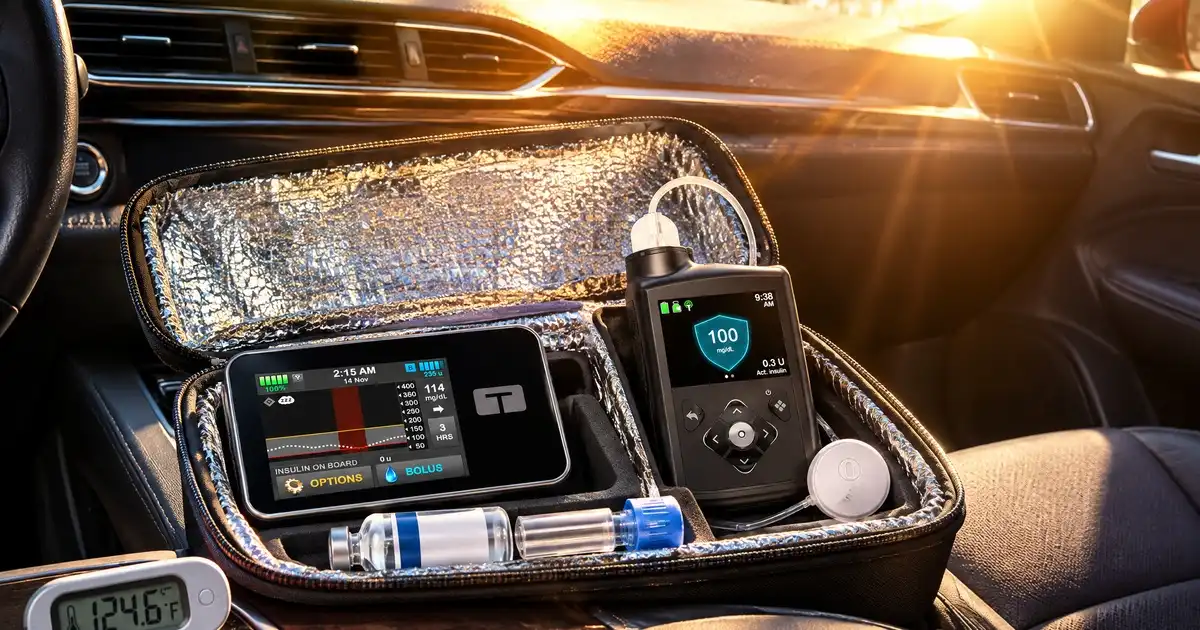
The parked car is the single biggest risk, and it’s faster than most people expect. A widely-cited Jan Null / San Francisco State University study on enclosed-vehicle heat found interior temperatures climbing an average of 3.2°F every five minutes, with 80% of the total rise happening in the first 30 minutes. Across outdoor temperatures ranging from a mild 72°F to 96°F, interiors still rose by roughly 40°F on average — meaning even a “cool” 75°F day can put a dashboard or center console well past both the insulin’s 86°F replacement threshold and a pump’s alarm range within half an hour. A pump or insulin left in a car during a grocery run is a more realistic risk than a heat wave itself.
Beach days and direct sun exposure put the pump at risk even while worn, not just when set down — direct sunlight on dark clothing or a pump case can push local temperature well above ambient air temperature. A light-colored, insulated pump case matters more than people assume.
Exercise and sweat create a secondary problem beyond ambient heat: infusion site adhesive failure. Heavy sweating loosens the adhesive holding an infusion set in place well before core body heat becomes a pump-temperature issue — worth planning for separately from the temperature question itself.
Real-World Cold: The Less-Discussed Half
Cold gets less attention than heat in most insulin guidance, but the numbers are just as specific. Insulin exposed to freezing temperatures is ruined immediately and permanently — there’s no “warm it back up and it’s fine” recovery the way there sometimes is with mild heat exposure.
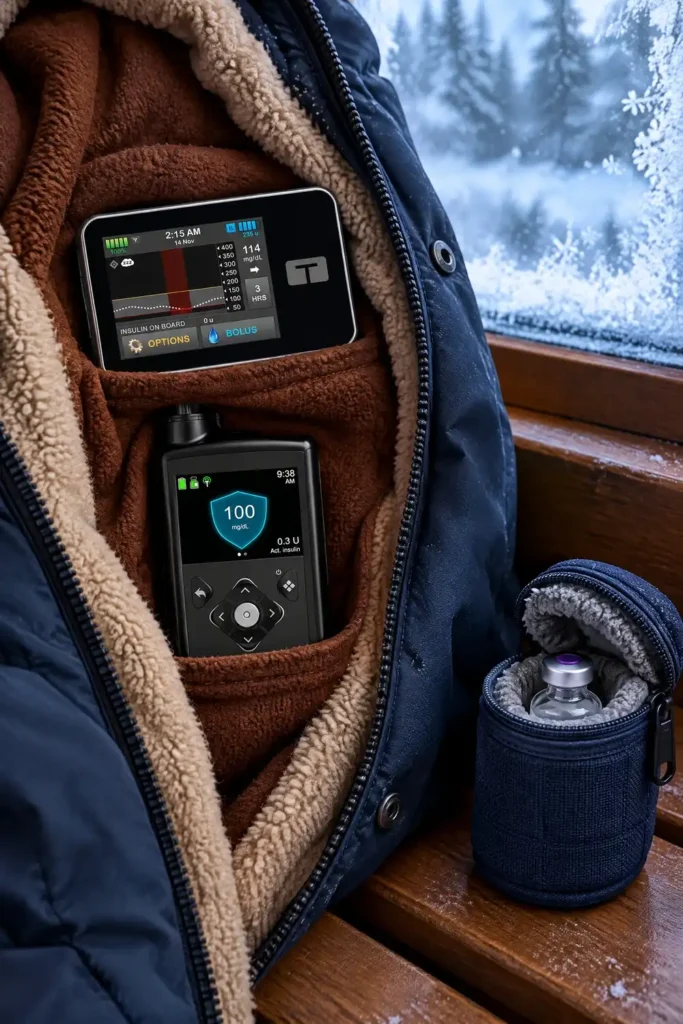
Winter outdoor activity — skiing, shoveling, a cold commute — is the main real-world risk. A pump worn under a base layer, close to body heat, generally stays well within range; one left in a coat pocket, a car, or exposed to wind chill on an exterior layer is a different story.
Cold cars are the mirror image of hot ones. A vehicle interior in freezing weather can sit well below 35°F for hours, especially overnight — the same “don’t leave it in the car” rule that applies in summer applies just as directly in winter, for the opposite reason.
Wind chill matters more than air temperature alone for anything worn externally, since it accelerates heat loss from the pump and its insulin reservoir faster than still air at the same thermometer reading would.
How to Actually Protect the Pump and the Insulin Inside It
Keep it against your body, not in an outer layer, during cold-weather exposure. Body heat is a more reliable buffer than any case in genuinely cold conditions.
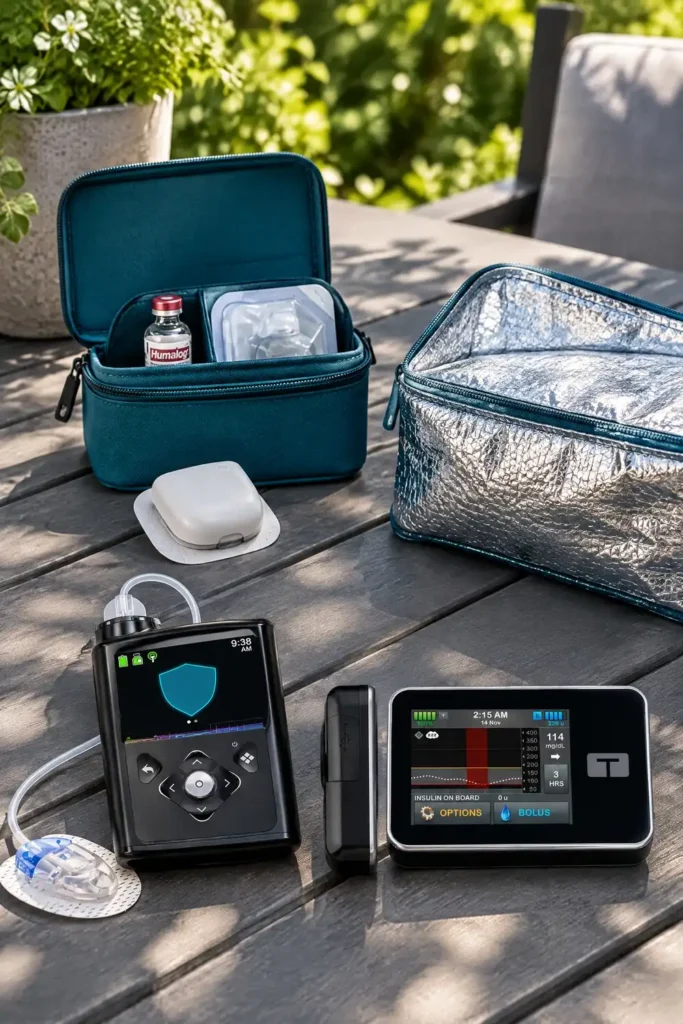
Use an insulated, reflective case in heat rather than trusting a pump case’s fabric alone — a case that reflects sunlight does more than one that simply covers the device. If you’re looking for a specific tested option, our solar-powered insulin cooler guide reviews cooling cases built for exactly this, separate from the power-backup focus of this site’s other guides.
Never leave the pump, a spare pod, or reservoir insulin in a parked car, in either season — the numbers above apply whether the car is baking in July or sitting in a January parking lot overnight.
Check infusion sites more often in heat and heavy sweat, independent of the temperature question — adhesive failure is a mechanical problem, not a thermal one, and it happens on its own schedule.
Rotate reservoir insulin on the FDA’s 28-day room-temperature window, not on a “looks fine” basis — insulin doesn’t visibly change when it’s lost potency, which is part of why the printed guidance exists in the first place. Our own Insulin Temperature Safety Timer tracks that window against real exposure conditions if you’d rather not do the math by hand.
This Is a Different Problem Than Cold-Chain Storage During an Outage
Worth being direct about the distinction, since it’s easy to conflate: this guide covers the pump and in-use insulin you’re wearing day to day, through ordinary heat, cold, exercise, and weather. It’s a different scenario from keeping a refrigerated insulin supply safe during a multi-day power outage, which our insulin cold-chain guide covers in depth, including the 72-hour planning window that scenario calls for. If you’re specifically weighing UPS versus solar generator backup for refrigerated insulin storage, that comparison is covered separately in our UPS vs. solar generator guide.
FAQs
What temperature will actually damage insulin in my pump?
FDA guidance flags insulin exposed above 86°F for replacement — a lower bar than any pump manufacturer’s alarm threshold. Treat 86°F as the practical trigger point, not the temperature at which your pump starts alarming.
Will my pump alarm before my insulin is actually ruined?
Not necessarily. Tandem’s t:slim X2 alarm doesn’t trigger until 113°F, well above the FDA’s 86°F insulin-replacement guidance. The alarm is a hardware safeguard, not a real-time insulin-quality monitor — don’t treat “no alarm” as confirmation the insulin is still good.
Can I wear my pump in cold weather if I keep it under my clothes?
Generally yes — body heat is usually enough to keep a pump worn close to the skin within its recommended range even in genuinely cold outdoor conditions. The risk is mainly for a pump left in an outer layer, a bag, or a vehicle rather than one worn against the body.
Is it safe to leave my pump or insulin in a hot car for “just a few minutes”?
No — a widely-cited vehicle-heat study found interior temperatures rising an average of 3.2°F every five minutes, with most of the total rise happening in the first half hour. A few minutes on a moderate day is enough to meaningfully raise interior temperature, and repeated short exposures add up.
Does the same temperature rule apply to insulin pens and vials, not just pump reservoirs?
The FDA’s room-temperature window (59°F to 86°F for up to 28 days) applies to insulin generally, not just what’s loaded into a pump. Pens and vials carried in a bag or pocket are subject to the same real-world heat and cold risks described here.
Bottom Line
The number that actually matters for day-to-day insulin pump use isn’t your pump’s alarm threshold — it’s the FDA’s 86°F insulin-replacement guidance, which triggers well before any manufacturer’s hardware alarm does. Tandem, Medtronic, and Omnipod each publish a tighter recommended operating range specifically to protect the insulin, separate from the wider alarm or storage specs that protect the electronics. Treat the pump’s alarm as a last-resort hardware safeguard, not a real-time signal that your insulin is still good — by the time it fires, the dose may already need replacing.
For refrigerated insulin backup during an extended power outage, see our insulin cold-chain guide; for cooling cases built specifically for daily heat protection, see our solar-powered insulin cooler guide.
HSA/FSA Note
Insulin pump accessories purchased to maintain a prescribed device’s safe operation — including insulated carrying cases and cooling accessories — can potentially qualify as a deductible medical expense under IRS Publication 502, typically with a prescription for the underlying device and supporting documentation of medical necessity. Requirements vary by plan administrator, so confirm before purchasing.
This article reflects manufacturer specifications and FDA guidance current as of October 2026 . Insulin pump temperature specifications vary by model and can change with firmware or hardware updates — always verify against your specific pump’s current documentation and your care team’s guidance before relying on any temperature threshold.