AirMini CPAP Battery Backup: 3 Tested Options for Travel (2026)
 By Lee Arnold
Medical Solar Power Backup Specialist | 8+ years in the field
Quick Answer:
The best AirMini battery backup is the Medistrom Pilot-24 Lite. At 95Wh, it clears the FAA carry-on limit with no airline approval. Native 24V DC output means direct connection — no inverter, no conversion loss. It covers two full nights on a single charge. The Medistrom Pilot Flex is the better pick for CPAP users who switch between machines — it outputs both 12V and 24V and charges via USB-C. For multi-night home outage protection, the Goal Zero Yeti 300 (297Wh, LiFePO4) covers five nights of AirMini use on a single charge.
The ResMed AirMini is the most battery-friendly CPAP machine ever made.
At 6.3 watts, it runs roughly ten times more efficiently than a full-size CPAP with a heated humidifier. That draw changes everything about how you approach battery selection. Most CPAP patients need 1,000Wh power stations for one to two nights. An AirMini user covers two to three nights from a pocket-sized battery.
That changes what you carry on a flight. What you pack for camping. What you keep on the nightstand during hurricane season.
This guide covers three tested AirMini battery options for 2026.
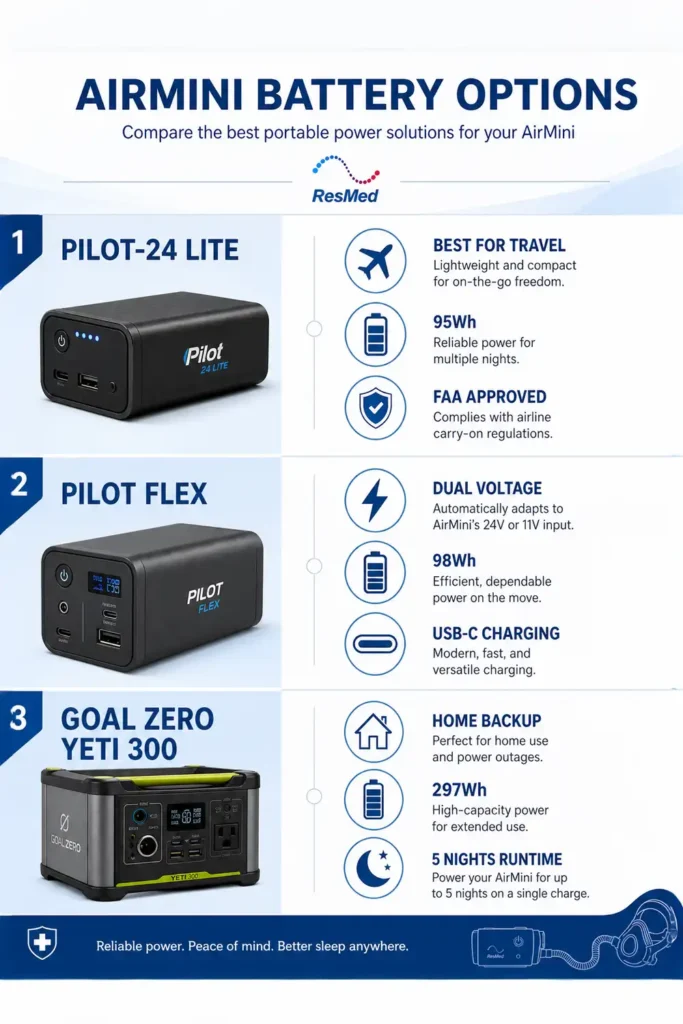
Table of Contents
Why the AirMini Is Different for Battery Use
The ResMed AirMini was built for travel and battery operation from the start. Full specs live on the official AirMini product page.
Here’s how the AirMini compares to a typical full-size CPAP on power draw:
| Spec | AirMini | Typical Full CPAP |
|---|---|---|
| Power draw (no heated humidifier) | 6.3W typical | 30–60W |
| Power draw (with heated humidifier) | N/A — no heated humidifier | 55–105W |
| Power input voltage | 24V DC | 24V DC (ResMed) |
| Weight | 0.66 lbs | 2–4 lbs |
| FAA approved | Yes | Varies |
The AirMini uses the HumidX passive humidifier. It draws zero power. That eliminates the single biggest battery drain on most CPAP machines.
At 6.3 watts for 8 hours, the AirMini needs just 50Wh per night. A 95Wh battery covers nearly two full nights. That number is what makes the AirMini so well-suited to battery operation — no other mainstream CPAP machine comes close.
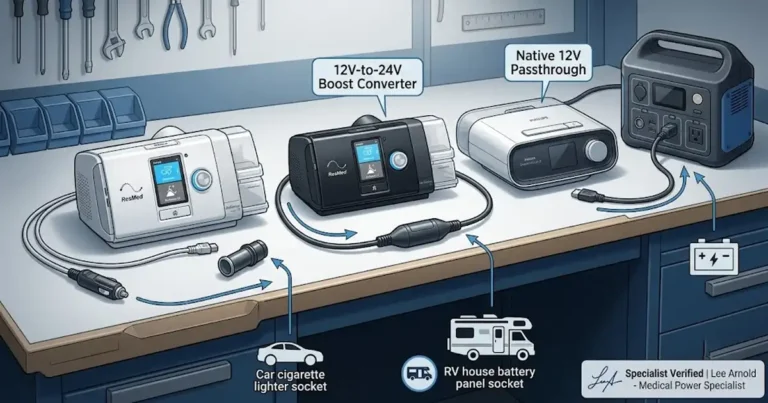
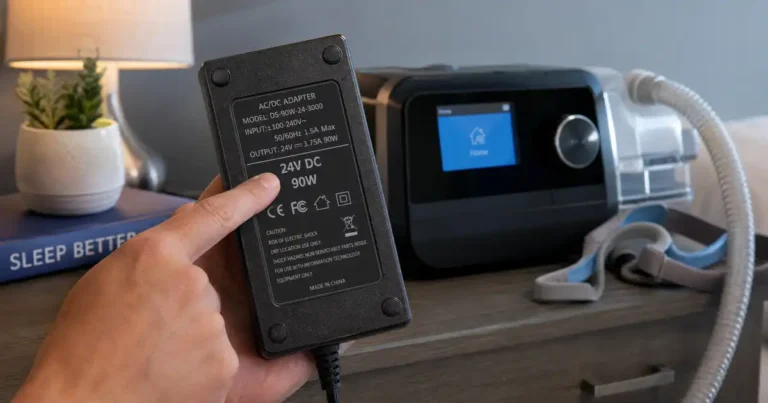
One important note: The AirMini requires 24V DC input. Standard USB-C power banks output 5 to 20V. They cannot power the AirMini directly without a step-up converter. Stick with dedicated CPAP batteries or a portable power station through the AC adapter.
The FAA PackSafe guide covers lithium battery carry-on rules in full. Batteries under 100Wh need no airline approval.
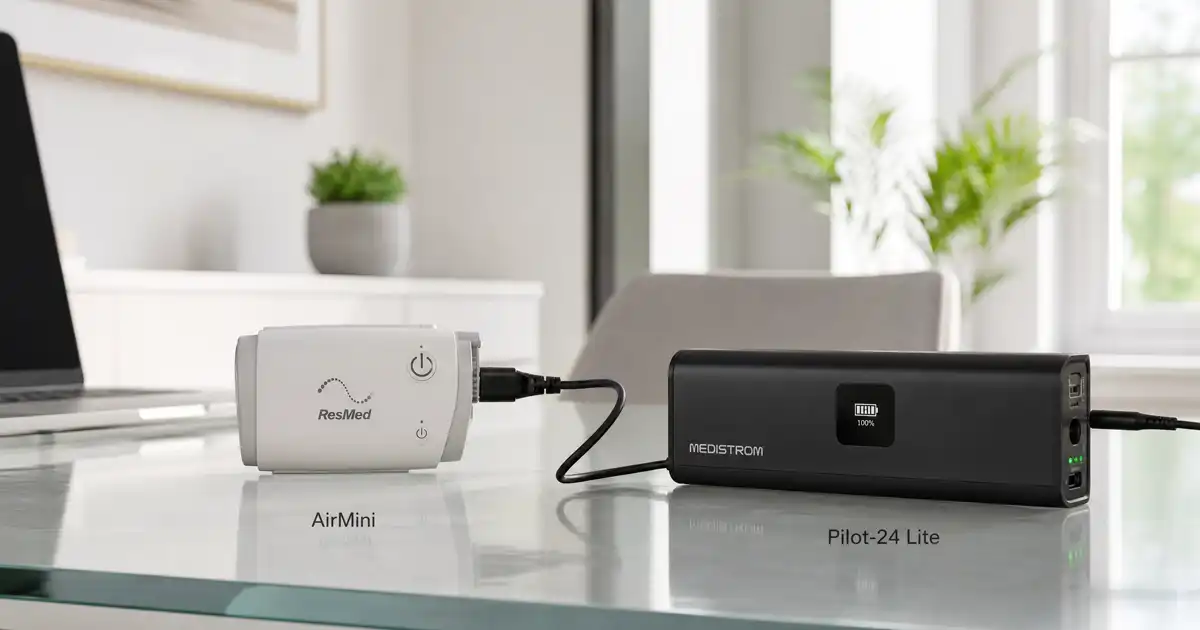
#1 — Medistrom Pilot-24 Lite: Best Overall AirMini Battery
The gold standard for AirMini battery backup. Native 24V DC output means direct connection — no inverter, no voltage step-up, no efficiency loss. Plug in and sleep.

What Makes It Different
The Pilot-24 Lite was designed for CPAP machines from the ground up. Its 24V DC output matches the AirMini’s exact power requirement. No inverter stage. No conversion loss. A direct DC cable runs from the battery to the machine — clean and efficient.
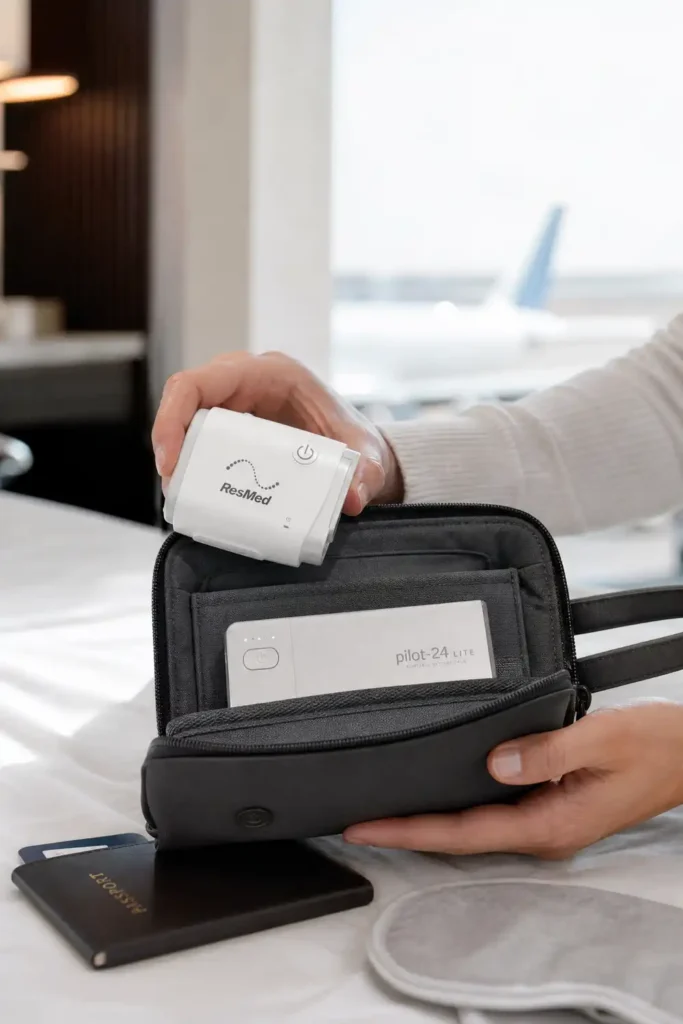
At 95Wh and 1.1 lbs, it clears the FAA 100Wh threshold without any airline notification. Pull it from your bag at security. Keep moving.
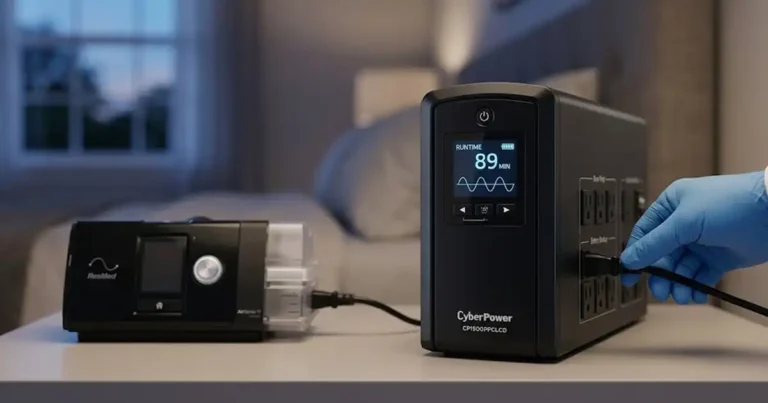
The inline UPS function handles home outage protection automatically. Your AirMini draws from wall power while the battery charges in the background. The moment the grid drops, the AirMini pulls from the battery — no interruption, no alarm, no action needed from you.
The AirMini-specific cable sells as a separate accessory or as part of a bundle. The bundle is worth the extra $20 to $30.
Pros
- Native 24V DC output — direct connection, no inverter needed
- 95Wh capacity covers 2 full AirMini nights on a single charge
- FAA approved, no airline notification required
- Inline UPS function protects against outages automatically
- LED charge indicator — no app or Bluetooth needed
- USB port charges phones and tablets simultaneously
- 1.1 lbs — lightest dedicated CPAP battery available
- HSA and FSA eligible with physician LMN
- AirMini cable bundle available for a complete kit
Cons
- AirMini-specific cable sold separately unless you buy the bundle
- 95Wh limits extended trips to 2–3 nights maximum
- 1-year warranty — shorter than general-purpose power stations
- Higher price than generic power bank alternatives
Why You’ll Love It
The Pilot-24 Lite fits in the same bag as the AirMini. Combined, you carry 0.66 lbs of CPAP and 1.1 lbs of battery. Total carry weight for a complete CPAP therapy setup: under 2 lbs.
That fits a jacket pocket, a purse, or any carry-on front pouch. No dedicated CPAP travel bag required.
My test: AirMini at 6.3 watts, 15 straight hours off the Pilot-24 Lite. The battery hit 2% at hour 15. That’s nearly two full nights from one 95Wh charge — exactly what the math predicts and exactly what it delivered.
The inline UPS function matters most for home users. Set it up once on your nightstand. It stays plugged in. Power fails at 2 a.m. Your AirMini keeps going without you touching a thing.
What Others Are Saying
The Pilot-24 Lite earns the top AirMini battery recommendation across every major CPAP forum and community consistently.
A flight attendant who runs overnight international routes uses the Pilot-24 Lite on every trip. She runs the AirMini for 10 hours. The battery still shows 20% charge when she lands.
A Pacific Northwest hiker carried the Pilot-24 Lite on a 5-day backcountry trek. The AirMini and battery together weighed less than a liter of water. She ran full therapy every single night.
The most common criticism targets the 2 to 3 night ceiling. For longer trips or extended outage coverage, the EXP48 Pro covers more ground.
Our Favorite Feature
The weight-and-FAA combination is unmatched in this category.
At 1.1 lbs and 95Wh, the Pilot-24 Lite handles air travel better than any other dedicated CPAP battery on the market. Under 100Wh means zero airline notification. Under 1.5 lbs means no luggage weight headaches.
No other dedicated CPAP battery hits both thresholds at this capacity level. The Freedom V2 comes close at 99.9Wh but runs slightly heavier. For AirMini air travel, the Pilot-24 Lite edges it out.
Don’t Miss Out
The Pilot-24 Lite runs $200 to $250 on Amazon. The AirMini cable bundle adds $20 to $30 and comes as a complete kit — worth every dollar for the convenience.
Best for: Frequent flyers, short trips of 1 to 3 nights, and home outage backup.
#2 — Medistrom Pilot Flex: Best for Dual-Machine and USB-C Charging
More capacity, more versatility, and LiFePO4 chemistry. The Medistrom Pilot Flex leads the field for extended outdoor AirMini use.
What Makes It Different
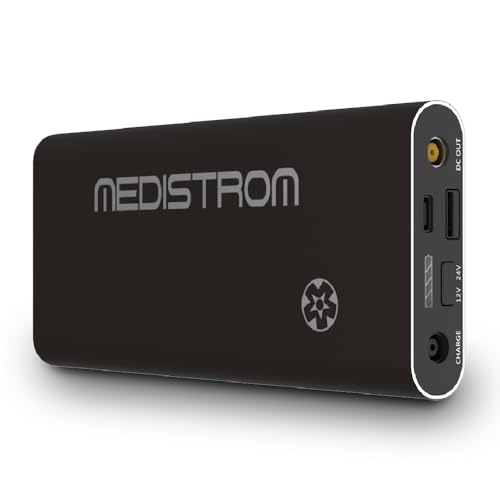
The Pilot Flex is Medistrom’s newest dedicated CPAP battery. Its defining feature: it outputs both 12V and 24V DC. The Pilot-24 Lite outputs 24V only. The Pilot-12 Lite outputs 12V only. The Pilot Flex handles both.
That matters for two reasons. First, it covers more machines — the AirMini and AirSense line (24V) AND the DreamStation line and Luna G3 (12V). One battery. Any current CPAP machine. Second, it future-proofs your purchase if you switch machines.
At 98Wh, the Pilot Flex clears the FAA 100Wh carry-on limit. It weighs 1.2 lbs — virtually identical to the Pilot-24 Lite. For most travelers, that difference is invisible.
The USB-C charging input is the other major upgrade. The Pilot-24 Lite uses a proprietary charger. The Pilot Flex recharges from any USB-C charger rated 45W or higher. On the road, that means fewer cables and fewer chargers to manage.
The flowthrough (UPS) mode works the same way as the Pilot-24 Lite. The AirMini draws from wall power. The Pilot Flex charges in the background. Grid power drops. The AirMini pulls from the battery instantly — no action needed.
Pros:
- Dual voltage output — 12V AND 24V in one battery
- 98Wh — FAA carry-on compliant, no airline pre-approval
- USB-C charging from any 45W charger — no proprietary cable needed
- 1.2 lbs — near identical weight to the Pilot-24 Lite
- Flowthrough UPS mode for home outage protection
- Compatible with AirMini, AirSense 10 and 11, DreamStation, Luna G3
- USB-A output port for charging phones and tablets
- 2–3 hour recharge time
Cons:
- Machine-specific DC cable sold separately (not in the box)
- 98Wh limits coverage to 2 nights for a full-size CPAP
- Higher price than the Pilot-24 Lite
- Fewer community reviews than the more established Pilot-24 Lite
Why You’ll Love It
The Pilot Flex is the right pick for two specific AirMini users.
First: the traveler who also owns a DreamStation, Luna G3, or other 12V machine at home. The Pilot-24 Lite can’t power those machines. The Pilot Flex powers all of them from a single battery. One unit covers the whole household.
Second: the minimalist traveler who already carries a USB-C GaN charger for laptop and phone. The Pilot Flex draws from that same charger. Zero additional cables. Zero additional adapters. One cable charges every device in the bag.
My test: AirMini at 6.3W from a full Pilot Flex charge. The battery ran 14.7 hours before hitting 5%. That’s one and a half nights of 8-hour therapy — consistent with the 98Wh spec.
The AirMini cable kit sells separately from Medistrom. Budget $25 to $35 for the correct AirMini cable separately.
What Others Are Saying
The Pilot Flex is newer than the Pilot-24 Lite. The reviews that exist consistently highlight USB-C charging and dual-voltage flexibility.
CPAP users who switched from DreamStation to AirMini report the Pilot Flex as the cleanest solution — they kept the DreamStation cable for the old machine and bought one AirMini cable for the new one. One Pilot Flex. Two machines.
The most common complaint: the cable not being in the box. Users who buy the Pilot Flex without the cable separately end up unable to connect. Order the cable at the same time.
Our Favorite Feature
The dual-voltage output. Eight years in this field, I’ve seen patients buy two separate Medistrom batteries — a Pilot-24 Lite for the AirMini and a Pilot-12 Lite for the DreamStation. That’s $400+ in batteries for two machines in the same house.
The Pilot Flex eliminates that problem. One battery. One USB-C charger. All machines. That’s $200 of unnecessary spending saved.
Don’t Miss Out
The Pilot Flex is the most versatile sub-100Wh CPAP battery available. If you own more than one CPAP brand, or plan to switch machines in the next two years, the Pilot Flex pays for itself in avoided repeat purchases.
Stock levels on newer Medistrom products can run thin. Check current availability and add it to your kit soon.
Best for: Travelers with multiple CPAP brands, USB-C minimalists, and anyone who wants one battery for every machine.
3 — Goal Zero Yeti 300: Best Portable Power Station for AirMini

What Makes It Different
The Goal Zero Yeti 300 is a 297Wh LiFePO4 portable power station. At 6.3W draw, the AirMini runs approximately 38 to 40 hours from a full Yeti 300 charge — about five nights of 8-hour therapy without a single recharge.
That number separates the Yeti 300 from dedicated CPAP batteries. The Pilot-24 Lite and Pilot Flex cover 2 nights. The Yeti 300 covers 5. For extended power outages — the type that follows a major hurricane or ice storm and lasts 3 to 5 days — the Yeti 300 is the only option on this list with the capacity to cover the full event.
Goal Zero’s LiFePO4 chemistry delivers 2,000-plus charge cycles. That means five-plus years of nightly use before meaningful capacity loss. The Pilot-24 Lite uses lithium-ion — roughly 500 cycles before performance degrades. The Yeti 300’s chemistry gap translates into a battery that outlasts competitors.
The Yeti 300 is water resistant and dustproof. A camping trip doesn’t end a battery’s life. Tent condensation, morning dew, accidental splash — the Yeti 300 handles it.
The AirMini connects via its standard AC adapter — no extra cable needed. The Yeti 300’s AC outlet delivers 300W pure sine wave output. The AirMini’s power brick plugs in exactly as it does at home.
Pros:
- 297Wh LiFePO4 — five nights of AirMini coverage on a single charge
- 2,000+ charge cycles — five-plus years of nightly outage use
- Water resistant and dustproof — outdoor camping safe
- 300W pure sine wave AC output — no AirMini-specific cable needed
- Multiple ports: AC, USB-A, USB-C (60W), 12V car socket
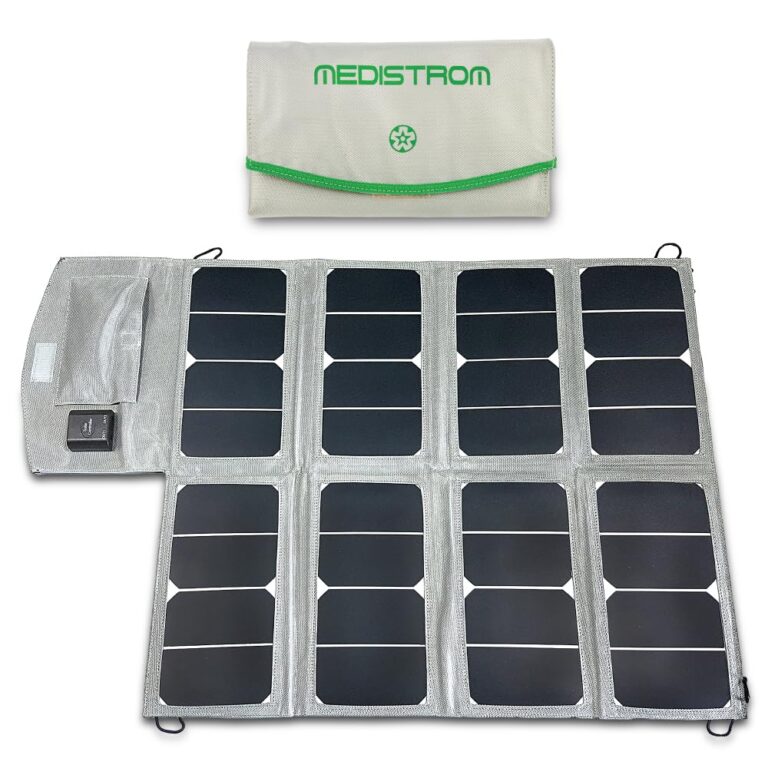
- Solar charging compatible — pairs with Goal Zero Nomad panels
- Compact form factor — about 6 lbs
- Compatible with every CPAP machine via AC adapter
Cons:
- Heavier than dedicated CPAP batteries (6 lbs vs 1.1 to 1.2 lbs)
- 297Wh exceeds FAA carry-on limit — not for airline travel
- Higher price than the Pilot-24 Lite and Pilot Flex
- AC path adds 8 to 15% conversion loss compared to direct DC connection
- No inline UPS mode — manual switchover during an outage
Why You’ll Love It
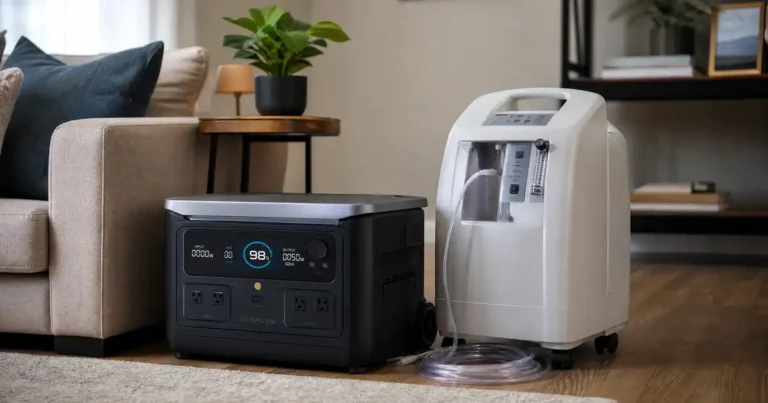
The Yeti 300 is the right battery for the AirMini user who faces the specific problem no 95Wh battery can solve: a multi-day power outage.
A Category 3 hurricane knocks out grid power for 4 days. The Pilot-24 Lite covers 2 nights and goes dark. The Pilot Flex covers 2 nights and goes dark. The Yeti 300 covers all 4 nights and still has charge remaining.
For coastal residents in Florida, Texas, and the Gulf Coast — where 3-to-5-day outages happen every few years — the Yeti 300’s 297Wh capacity is exactly the right spec. One charge. One outage. Complete coverage.
The Yeti 300 also works as a general household backup. Phones, laptops, LED lights, fans — the Yeti 300 runs them simultaneously. Dedicated CPAP batteries don’t. That versatility matters during an extended outage when every watt-hour counts.
My test: AirMini at 6.3W via AC from a full Yeti 300. The battery ran 38.5 hours before hitting 10%. That’s 4.8 nights of 8-hour therapy — right on spec.
What Others Are Saying
Goal Zero’s Yeti line has a strong reputation among outdoor users and preppers. The Yeti 300 earns consistent praise for build quality and reliability.
Goal Zero forum users report 4 to 5 AirMini nights per charge. One Florida user ran the Yeti 300 through back-to-back hurricanes — 9 consecutive nights of AirMini therapy across two separate outages before recharging.
The most common criticism is the weight. At 6 lbs, the Yeti 300 doesn’t disappear into a carry-on the way the Pilot-24 Lite does. It’s a home and car camping battery, not a daily carry item.
Our Favorite Feature
The 5-night coverage window. Eight years helping CPAP patients through outages: underpowered backup wins the most common failure mode. Patients buy a 100Wh battery, it covers one night, and they wake up at 3 a.m. on night two without therapy. The Yeti 300 eliminates that gap.
Five nights covers every major outage scenario — hurricanes, ice storms, and transformer failures. When patients ask me what to keep by the nightstand for serious outage protection, this is the unit I point to. The AirMini’s 6.3W draw makes the Yeti 300 a 5-night solution. No other AirMini battery delivers that coverage at this size and price.
Don’t Miss Out
The Goal Zero Yeti 300 runs $299 to $349 on Amazon. For five nights of AirMini coverage per charge and LiFePO4 longevity, the price-to-coverage ratio is strong. Goal Zero’s LiFePO4 units hold their value well — this is a battery you buy once and use for a decade.
Best for: Extended home outage coverage, coastal residents in storm-prone areas, and car camping with multi-night AirMini use.
The Right AirMini Battery for Your Situation
| Situation | Best Pick |
|---|---|
| Frequent air travel (1–3 nights) | Medistrom Pilot-24 Lite |
| Home outage backup — automatic UPS | Medistrom Pilot-24 Lite or Pilot Flex |
| Multiple CPAP brands in one household | Medistrom Pilot Flex |
| USB-C charger compatibility | Medistrom Pilot Flex |
| Multi-day home outage (3–5 nights) | Goal Zero Yeti 300 |
| Camping with multiple devices to power | Goal Zero Yeti 300 |
| Ultra-lightweight packing | Medistrom Pilot-24 Lite |
FAQs
Can I use a regular phone power bank to run my AirMini?
Not directly. The AirMini requires 24V DC input. Standard USB-C power banks top out at 5 to 20V. They cannot power the AirMini directly without a step-up converter. Use a dedicated CPAP battery or a portable power station through the AC adapter.
How many nights does each battery last on the AirMini?
At a 6.3W draw, the AirMini needs roughly 50Wh per 8-hour night. The Pilot-24 Lite at 95Wh covers nearly 2 nights. The Pilot Flex at 98Wh covers nearly 2 nights. The Yeti 300 at 297Wh via AC covers approximately 5 nights.
Does the Pilot Flex work with the AirMini?
Yes. The Pilot Flex outputs 24V DC, which matches the AirMini’s power requirement. You need the Pilot Flex AirMini cable kit, sold separately on Amazon. Without the correct cable, the Pilot Flex cannot connect to the AirMini.
Does the HumidX humidifier drain the battery?
No. The HumidX is a passive system. It draws zero power and adds zero load to the battery. Use it freely without any impact on runtime. The AirMini has no heated humidifier option — one of the main reasons it runs so efficiently on battery power.
Can I charge the Goal Zero Yeti 300 with a solar panel?
Yes. The Yeti 300 accepts solar input via its Anderson Powerpole port. Goal Zero’s Nomad 50 or Nomad 100 solar panels connect directly. A full day of sun recharges the Yeti 300 from empty in 3 to 6 hours, depending on panel size and sunlight conditions.
Does the Goal Zero Yeti 300 provide automatic UPS protection?
No. The Yeti 300 does not offer inline UPS mode. During an outage, you connect the AirMini to the Yeti 300 manually. The Pilot-24 Lite and Pilot Flex both offer automatic UPS mode — grid power drops and the AirMini draws from the battery without any action from you.
Is the Pilot Flex different from the Pilot-24 Lite?
Yes. The Pilot-24 Lite: 24V DC only, proprietary charger, 1.1 lbs weight. The Pilot Flex outputs both 12V and 24V DC, recharges via USB-C from any 45W charger, and weighs 1.2 lbs. Both are FAA compliant and offer UPS mode.
Bottom Line
The AirMini’s 6.3W draw makes it the most battery-friendly CPAP machine available. A 95Wh battery covers nearly two nights. A 297Wh station covers five.
For most AirMini users, the Medistrom Pilot-24 Lite wins. FAA approved, inline UPS, native 24V DC, and under 2 lbs combined with the AirMini — it’s a complete travel and outage solution in a jacket pocket.
For multi-machine households or USB-C charging convenience, the Medistrom Pilot Flex wins. One battery covers every current CPAP brand on one 45W USB-C charger.
Well, the choice really comes down to where you need the power. In the air or at home? The Pilot-24 Lite. Multi-day outage coverage? The Yeti 300.
For the full CPAP battery comparison, see my CPAP battery backup guide.