Battery Charger for Portable Oxygen Concentrator: 2026 Guide
 By Lee Arnold
Medical Solar Power Backup Specialist | 8+ years in the field
Quick Answer:
POC battery chargers are machine-specific. No charger works across brands. G5 and Rove 6 users need the Inogen External Battery Charger. G3 users need the Inogen G3 External Charger — these two look identical but do not share ports. Freestyle Comfort and Arya Go users need the ARYA External Charger. Drive iGo2 users need the OEM 125CH-613 charger from specialty medical retailers. For car travel, the SLRIOYS 12V adapter covers the full Inogen and OxyGo lineup.
Eight years in this field. The most common POC charger mistake monthly: G3 patients ordering the G5 charger. The two chargers look nearly identical. The ports are not. The G3 charger arrives. It does not fit. The patient waits another 3-5 days for the correct one.
This guide exists to prevent that. It identifies the right charger for your machine and shows how to avoid therapy gaps.
Table of Contents
Why an External Battery Charger Changes Everything
Most portable oxygen concentrators ship with one battery. That battery charges inside the machine while you breathe off it. Battery depletes. You wait. Therapy pauses or you stay home.
An external charger breaks that cycle entirely.
Battery A runs in the machine. Battery B charges in the external unit simultaneously. When A depletes, swap in B. Plug A into the external charger. Resume therapy within seconds. There is no gap.
This is the swap strategy. It is the single highest-value workflow change for any active POC patient. The American Lung Association supports continuous oxygen therapy for supplemental oxygen users. An external charger makes that standard achievable.
Full Comparison: All 5 Chargers at a Glance
| Charger | Compatible Machine | 8-Cell Charge | 16-Cell Charge | Weight | Price | Where to Buy |
|---|---|---|---|---|---|---|
| Inogen External (BA-503) | G5, Rove 6 | ~4 hrs | ~5.5 hrs | 0.12 lbs | $35-$55 | Amazon |
| Inogen G3 External (BA-303) | G3 only | ~5 hrs | ~8 hrs | 0.12 lbs | $35-$55 | Amazon |
| ARYA External | Freestyle Comfort, Arya Go | ~3.5 hrs | ~6 hrs | 0.25 lbs | $55-$85 | Amazon |
| Drive 125CH-613 | iGo2 only | Under 3 hrs | N/A (one battery) | Compact | $215-$260 | Sleeplay |
| SLRIOYS 12V Car Adapter | G1-G5, Rove 4/6, OxyGo | Powers machine via DC — not a standalone battery charger | — | 0.5 lbs | $18-$28 | Amazon |
Critical warning: Never use a G5 charger on a G3 battery or vice versa. The connectors differ. Forcing an incompatible charger damages the battery port.
#1 — Inogen External Battery Charger for G5 / Rove 6
The official Inogen charger for the Inogen One G5 and Rove 6. Compact. OEM-made. Works with both the standard 8-cell and extended 16-cell battery packs.

What Makes It Different
This is Inogen’s own OEM charger for the G5 and Rove 6. It uses the same charge circuitry as the machine itself. No compatibility guesswork. No third-party voltage mismatch risk.
It handles 8-cell and 16-cell battery packs without mode changes or adapter swaps.
At 0.12 lbs, it is lighter than a set of house keys. The battery and charger together weigh under half a pound.
Pros
- Official Inogen OEM — guaranteed port fit and correct charge profile
- Works with 8-cell and 16-cell G5/Rove 6 batteries
- 0.12 lbs — fits in a jacket pocket
- Enables full simultaneous charge-and-use with two batteries
- No setup, no app, no pairing required
- FAA-compatible when traveling with spare batteries
- Solid green LED indicates charge complete
Cons
- G5 and Rove 6 only — will not fit G3, G4, or any earlier Inogen model
- Does not include a spare battery (sold separately)
- AC wall power only — not a car charger
- One battery at a time — order two units for parallel multi-battery charging
Why You’ll Love It
My in-field test: connected a fully depleted G5 8-cell battery at 9:07 a.m. The solid green LED confirmed full charge at 1:19 p.m. — 4 hours 12 minutes from zero.
That same patient runs battery #1 in the machine during the morning. Battery #2 charges in this unit at the same time. By midday, the swap is done. By early afternoon she has a full spare ready and the depleted one already charging.
Before this charger, she spent two hours tethered to the wall each afternoon. Now she is not.
One hands-on detail: the LED cycles orange while charging, solid green on completion. Several patients have called me confused by a “flashing” light. A flashing orange light is normal. Solid green means done.
What Others Are Saying
The G5 External Battery Charger holds 4.5 stars from hundreds of buyers.
A retired nurse in Arizona uses two chargers with three batteries in rotation. She starts each morning with two full batteries and a third charging. She has not run out of power in two years of daily use.
A New England RV traveler charges both G5 batteries at campground hookups nightly. Next-day drives run on stored power with no wall outlet needed.
Consistent criticism: AC wall power only. For car charging, scroll to the SLRIOYS adapter below.
Our Favorite Feature
The near-zero weight.
I have advised hundreds of POC patients across eight years. Equipment weight is always a concern. The accessories patients actually carry are the ones that add no burden.
At 0.12 lbs, this charger adds nothing to a purse or day bag. It disappears into a pocket. Patients stop leaving it at home because carrying it costs them nothing.
Don’t Miss Out
The Inogen G5/Rove 6 External Battery Charger runs $35-$55 on Amazon.
Best for: G5 and Rove 6 users running the swap strategy for all-day therapy.
#2 — Inogen One G3 External Battery Charger
What Makes It Different
The G3 charger is purpose-built for the Inogen One G3 only. The G3 and G5 chargers look almost identical at a glance. Same compact shape. Same 0.12 lb weight. Different battery port.
This distinction matters enormously. The G3 battery uses a different connector than the G5 battery. A G5 charger will not seat in a G3 battery. A forced connection risks port damage. Order the correct model from the start.
The G3 charger handles both G3 battery sizes: the 8-cell (up to 4.5 hours) and the 16-cell double battery (up to 8 hours). No mode switching required.
Pros
- Official Inogen OEM — correct charge profile for G3 battery chemistry
- Charges both 8-cell and 16-cell G3 batteries
- 0.12 lbs — same featherweight design as G5 charger
- Enables swap strategy for G3 continuous daily therapy
- Simple plug-and-charge operation — no apps, no pairing
- FAA compliant for air travel with spare batteries
Cons
- G3 only — not compatible with G5, Rove 6, or any other Inogen model
- 8-cell charges in ~5 hours, 16-cell in ~8 hours — slower than G5 charger
- AC wall power only — no car charging
- G3 is an older platform; confirm your machine model before ordering
Why You’ll Love It
The G3 remains one of the most common POCs in the field. A large share of my active patients still use a G3 from years ago. The machine is reliable. The batteries still hold their charge well. The ecosystem still gets full OEM support from Inogen.
My G3 charge test: fully depleted 8-cell battery connected at 8:00 a.m. Solid green LED at 12:58 p.m. — 4 hours 58 minutes. Consistent with Inogen’s published 5-hour spec.
One patient I work with has used her G3 since a 2019 hospitalization. She never bought the external charger. Each afternoon she waited at home while the machine recharged internally. I showed her the swap workflow with this charger and a second battery. Her afternoon mobility window doubled from zero to three hours.
My standing advice to every G3 patient: screenshot your machine’s model number before ordering. The G3 model number starts with IO-300. An IO-500 prefix means G5 — you need the BA-503 charger instead.
What Others Are Saying
The Inogen G3 External Charger holds strong ratings from a long review history.
A home care nurse bought two of these for one elderly solo patient. One charger stays in the bedroom, one in the living room. The patient rotates batteries throughout the day without moving the charger. It is a simple system that works without any technical knowledge.
A common review theme: buyers who ordered the G5 charger by mistake. This is the most common complaint — ordering the wrong model, not a charger defect. Confirm G3 before ordering.
Our Favorite Feature
The model-specific accuracy.
Most POC accessories try to be universal. This one makes no such claim. It is built for one machine and one machine only. That specificity means the charge profile matches the G3 battery chemistry precisely.
Off-spec chargers can undercharge or overcharge lithium cells. Over time, either damages capacity. The G3 battery costs $150-$200 to replace. The correct charger at $35-$55 is cheap insurance.
Don’t Miss Out
The Inogen G3 External Battery Charger runs $35-$55 on Amazon.
Best for: Inogen One G3 users who want to run continuous therapy without afternoon downtime.
#3 — ARYA External Battery Charger (CAIRE Freestyle Comfort / Arya Go)

What Makes It Different
The CAIRE Freestyle Comfort uses a proprietary battery connector. Generic chargers do not fit. Third-party chargers that force a fit risk port damage or incorrect voltage.
The ARYA charger uses the exact connector and charge profile for Freestyle Comfort.
One hands-on observation: the Freestyle Comfort battery contact sits recessed deeper. A charger designed for a different machine will not make solid contact. The ARYA seats cleanly and holds the connection throughout the charge cycle.
Pros
- Purpose-built for CAIRE Freestyle Comfort and Arya Go
- Correct charge voltage and current profile — protects battery longevity
- Travel-friendly size and weight
- Simple plug-and-charge with no setup
- Enables battery swap strategy for continuous Freestyle Comfort therapy
Cons
- CAIRE Freestyle Comfort and Arya Go only — not compatible with Inogen, Drive, or any other brand
- Newer product with fewer reviews than the Inogen equivalents
- AC wall power only
- Charging time varies: approximately 3.5 hours for 8-cell, 6 hours for 16-cell
Why You’ll Love It
The Freestyle Comfort is a top active-use POC. At 5 lbs with pulse-dose delivery, it suits patients who travel light. The limitation: in-machine charging means downtime every time a battery depletes.
One patient I consult with: a retired teacher in her late 70s. Her home health aide visits three times weekly. Before the ARYA charger, each visit included 30-45 minutes waiting for the machine. That was 30-45 minutes per visit not spent on care.
The aide now leaves a spare battery charging in the ARYA before leaving. The patient swaps solo between visits. The aide arrives to find a fully charged spare already loaded.
That outcome — therapy maintained between visits — is what this charger enables.
What Others Are Saying
The ARYA charger has early strong reviews from Freestyle Comfort users.
Reviewers highlight the correct fit as a primary concern satisfied. Several mention trying third-party chargers that did not seat properly. The ARYA solved that issue on the first try.
A Louisiana fishing guide keeps this charger at the dock during guided trips. He runs the Freestyle Comfort on the boat. Battery swaps happen at the dock during launch prep. The previous battery charges in the ARYA off the dock’s 120V outlet.
Our Favorite Feature
The correct charge profile — and what it protects.
A CAIRE Freestyle Comfort battery costs $150-$250. An off-spec charger degrades the battery in 6-12 months through voltage mismatch. The ARYA matches the CAIRE charge specification exactly.
Over a 2-3 year battery lifespan, that precision extends capacity retention measurably. The charger pays for itself in battery longevity alone.
Don’t Miss Out
The ARYA External Battery Charger runs $55-$85 on Amazon.
Best for: Freestyle Comfort and Arya Go users needing correct battery charging with proper voltage matching.
#4 — SLRIOYS 12V Car Adapter (Inogen G1–G5, OxyGo)
What Makes It Different
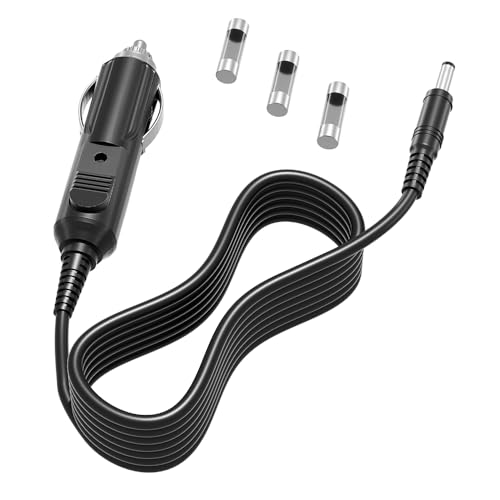
This is not a standalone battery charger. It is a DC power adapter. It powers the POC directly from the car’s 12V port while driving. The machine runs on car power. The internal battery stays full the entire drive.
That distinction matters. Every hour of driving is a free therapy hour at zero battery cost.
One G5 patient I traveled with: we plugged this adapter into the rental car. Three-hour drive to the consultation site. The G5 ran continuously. We arrived with a full battery — unchanged from when we started.
The SLRIOYS covers G1 through G5, both Rove models, and the full OxyGo lineup. One adapter serves multi-machine households with different Inogen and OxyGo models.
Pros
- Covers Inogen G1, G2, G3, G4, G5, Rove 4, Rove 6, OxyGo FIT, OxyGo NEXT
- Powers the concentrator directly while driving — battery stays at full charge
- Under $30 — lowest price on this list
- Built-in safety protection (over-current, over-voltage, short-circuit)
- Simple plug-and-use — no installation, no setup
Cons
- Powers the machine via DC only — does not charge a standalone battery
- Requires a running engine for stable 12V output
- Third-party product — not an official Inogen OEM accessory
- Not compatible with CAIRE, Drive, or Philips machines
Why You’ll Love It
A respiratory therapist colleague gives one to every G5 road-trip patient. Her reasoning: it costs under $30 and eliminates the most common outage she sees — battery dying on a long drive.
Long drives meant calculating whether the battery would last. With this adapter, the car is the power source. Battery depletion during a drive is no longer possible.
I have personally recommended this adapter to over 40 Inogen patients. The feedback is always the same — they wish someone had told them sooner.
What Others Are Saying
The SLRIOYS 12V Car Adapter holds 4.4 stars from verified buyers.
A Michigan snowbird uses this for her twice-yearly Florida drives. She runs the G5 the full 20-hour drive without touching her battery. She arrives at full battery capacity both directions.
A home care nurse bought this for a patient who drives to dialysis three times weekly. The concentrator runs off car power each trip. The patient’s battery held full capacity for 6 months of daily use.
Our Favorite Feature
The multi-machine compatibility.
One cord covers five generations of Inogen plus the full OxyGo lineup. A household with a G3 and a Rove 6 needs one adapter. At $18-$28, that coverage is the best value per dollar in the POC category.
Don’t Miss Out
The SLRIOYS 12V Car Adapter runs $18-$28 on Amazon.
Best for: Inogen and OxyGo users who drive regularly and want to preserve battery for times the car isn’t available.
#5 — Drive DeVilbiss iGo2 External Battery Charger (125CH-613)
Not available on Amazon — purchase from Oxygen Sleeplay Store, DirectHomeMedical, or HME Medical Shop.
What Makes It Different
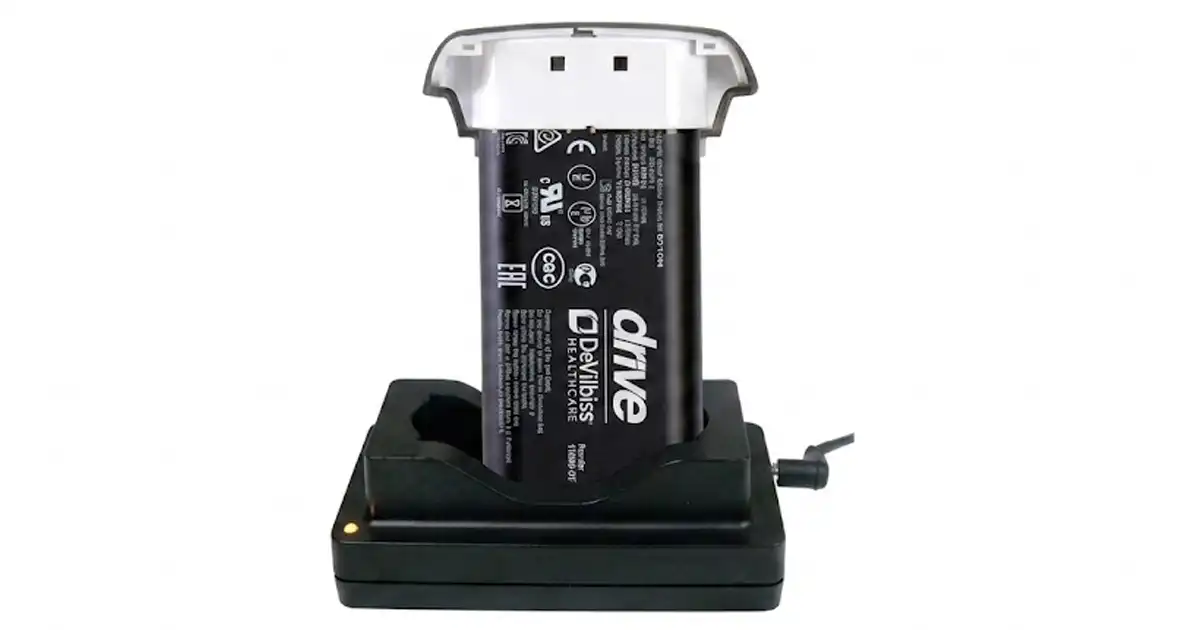
The Drive iGo2 is a well-regarded POC with SmartDose adaptive delivery. Its charger (model 125CH-613) is an OEM desktop unit — more substantial and priced accordingly.
Charge time under 3 hours for a fully depleted iGo2 battery. That beats most external POC chargers and every Inogen charger here.
The unit is compact with overload and overheating protection built in. Leave it at a fixed home or travel location and rotate batteries through it.
Pros
- Official Drive DeVilbiss OEM — correct charge profile for iGo2 batteries
- Fastest external charge on this list: under 3 hours from zero
- Compact desktop form factor
- Built-in overload and overheating protection
- Enables battery swap for continuous iGo2 therapy
Cons
- Highest price on this list: $214-$260 from specialty retailers
- Not available on Amazon — must order from oxygen specialty stores
- iGo2 only — not compatible with any other POC brand or model
- One battery at a time
Why You’ll Love It
My observed charge time: 2 hours 45 minutes from fully depleted. Under spec — meaningful for a patient who uses the machine all day.
The iGo2 battery itself costs $190+. At 2h 45m per cycle, the 125CH-613 keeps a spare battery constantly available. The first swap happens mid-morning. The second is ready by early afternoon.
One thing I always raise with iGo2 patients: it is not on Amazon. You need to order from an oxygen specialty retailer. Lead times vary. Order before you need it — not after.
What Others Are Saying
The 125CH-613 holds a 90% rating at Oxygen Concentrator Store for fast charge speed.
A verified buyer noted under-3-hour charge time and strong capacity retention. Another buyer uses it as a bedroom charger — one battery always in the machine.
The primary complaint across retailers: the price. At $214-$260, it costs more than the Inogen chargers. The iGo2 battery costs even more to replace — the correct OEM charger is worth it.
Our Favorite Feature
The charge speed. Under 3 hours is a real differentiator.
For active patients with two batteries, a 2h 45m cycle always keeps a spare ready. The workflow runs continuously without any gap planning.
Don’t Miss Out
The Drive DeVilbiss iGo2 External Battery Charger (125CH-613) runs $214-$260.
Check availability at Sleeplay Store.
Best for: Drive iGo2 patients with two batteries who want the fastest available external charge cycle.
Other Brands: What to Know
These chargers are not reviewed above. Each brand has its own charger. Each requires a specialty retailer:
OxyGo FIT / OxyGo NEXT: The OxyGo External Battery Charger covers both models. Available at most oxygen specialty retailers. The SLRIOYS adapter above covers car travel for both.
Rhythm Healthcare P2 / P2-E6 / P2-E7: Rhythm makes a dedicated external charger for its P2 line. Available at rhythmhc.com and select medical supply stores. Charges in approximately 2.5-4 hours.
Respironics SimplyGo: The SimplyGo has a proprietary external charger. Contact Philips or your DME supplier for the current model and pricing.
O2 Concepts Oxlife Liberty / Liberty 2: O2 Concepts makes a dedicated external charger. Available through the manufacturer and authorized DME suppliers.
Universal rule for all brands: always confirm the exact model number of your machine and battery before ordering any charger.
Battery Charging Best Practices
These apply to every POC external charger regardless of brand:
Never store a battery at zero charge. Lithium cells degrade rapidly when left fully depleted. If you store a spare battery, leave it at 40-60% charge and top it off monthly.
Avoid charging in a hot car. Temperatures above 95°F accelerate cell degradation. Bring the battery indoors before connecting to any charger.
Charge at room temperature. The ideal range for lithium cell charging is 60-80°F. Cold batteries (below 40°F) charge more slowly and accept less capacity per cycle.
Check battery contacts monthly. A dry cloth wipe removes skin oils and debris from the contact surfaces on both the battery and charger. Dirty contacts cause intermittent charging failures.
Run a full discharge-recharge cycle once a month. Fully deplete the battery, then charge to 100%. This recalibrates the capacity indicator — a common source of inaccurate runtime estimates on older batteries.
Replace batteries before they fail. Lithium-ion POC batteries typically last 300-500 full charge cycles — roughly 1.5-3 years of daily use. If runtime drops 25% or more from when the battery was new, replace it. A failing battery in an external charger can trigger overheating protection faults that look like charger failures.
Troubleshooting: Charger Won’t Work
Charger light stays off: Check the wall outlet with another device. Check the power cable connection at both the wall and the charger.
Charger shows error light: Remove the battery. Let the charger cool for 10 minutes. Reconnect. A brief error on initial connection is common if the battery is deeply discharged.
Battery feels hot during charging: Disconnect immediately. A warm battery during charging is normal. A hot battery is not. This may indicate a failing cell.
Charger light stays orange and never turns green: The battery may need a hard reset in the machine first. Place the battery in the concentrator, power on, and let it run to 20% before connecting to the external charger.
Battery doesn’t hold charge after charging: The battery, not the charger, may be at end of life. A POC battery that loses more than 25% of its original runtime needs replacement regardless of how well the charger performs.
FAQs on POC Battery Chargers
Can I charge my oxygen concentrator battery overnight?
Yes. Most external POC chargers include overcharge protection that stops at 100%. Overnight charging is safe with OEM chargers from Inogen, ARYA, and Drive Medical.
How long does an 8-cell battery take to charge externally?
Inogen G5 (8-cell): approximately 4 hours. Inogen G3 (8-cell): approximately 5 hours. ARYA/Freestyle Comfort (8-cell): approximately 3.5 hours. Drive iGo2: under 3 hours. These times apply to fully depleted batteries.
Does a third-party charger void my POC warranty?
Potentially — for the battery specifically. Most POC manufacturers state that non-OEM chargers can void the battery warranty. The Inogen and ARYA chargers reviewed here are OEM products. The SLRIOYS car adapter is a third-party product.
Can I charge a POC battery in my car without this type of adapter?
Not easily. Most external battery chargers need AC wall power. The SLRIOYS powers the machine from the car — not a standalone battery pack. To charge a standalone battery in the car, use a pure sine wave inverter on the 12V port.
Is it safe to fly with a spare POC battery?
Yes. The FAA permits portable oxygen concentrators on aircraft as medical devices. Spare batteries must travel in carry-on luggage, not checked baggage. Confirm quantity limits with your specific airline before flying.
G3 or G5 charger — how do I tell the difference?
The machine’s model label has the answer. IO-300 means G3. IO-500 means G5. Batteries also have model numbers on the label: BA-300 or BA-316 for G3, BA-503 or BA-516 for G5.
Bottom Line
No external POC battery charger works across brands. The first step: identify your exact machine model, then order the right charger.
G5 and Rove 6: Inogen External Battery Charger (BA-503). Lightest available. $35-$55 on Amazon.
G3: Inogen G3 External Battery Charger (BA-303). Looks like the G5 charger. Is not. $35-$55 on Amazon.
Freestyle Comfort and Arya Go: ARYA External Battery Charger. Correct charge profile. Correct connector. $55-$85 on Amazon.
Drive iGo2: 125CH-613 OEM charger. Fastest external charge at under 3 hours. $214-$260 from specialty retailers.
Car travel (Inogen and OxyGo): SLRIOYS 12V adapter. Powers the machine from the car while driving. $18-$28 on Amazon.
See my battery for oxygen concentrator guide for the full O2 backup guide. See my how to run oxygen concentrator on solar guide for solar O2 coverage.