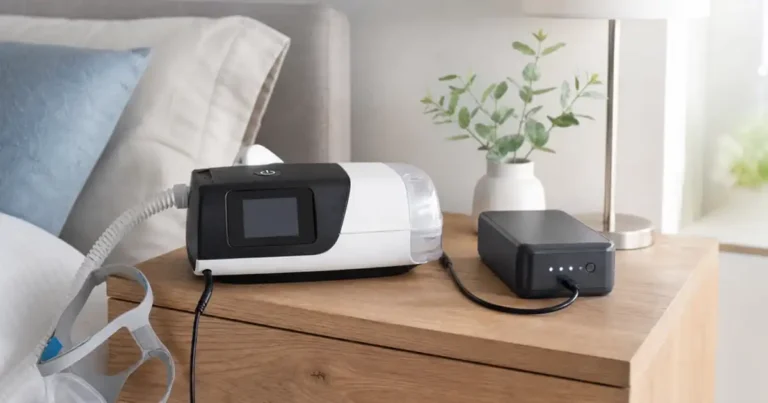
CPAP Battery EXP48PRO Review: Runtime, Compatibility, and Setup
 By Lee Arnold
Medical Solar Power Backup Specialist | 8+ years in the field
Quick Answer:
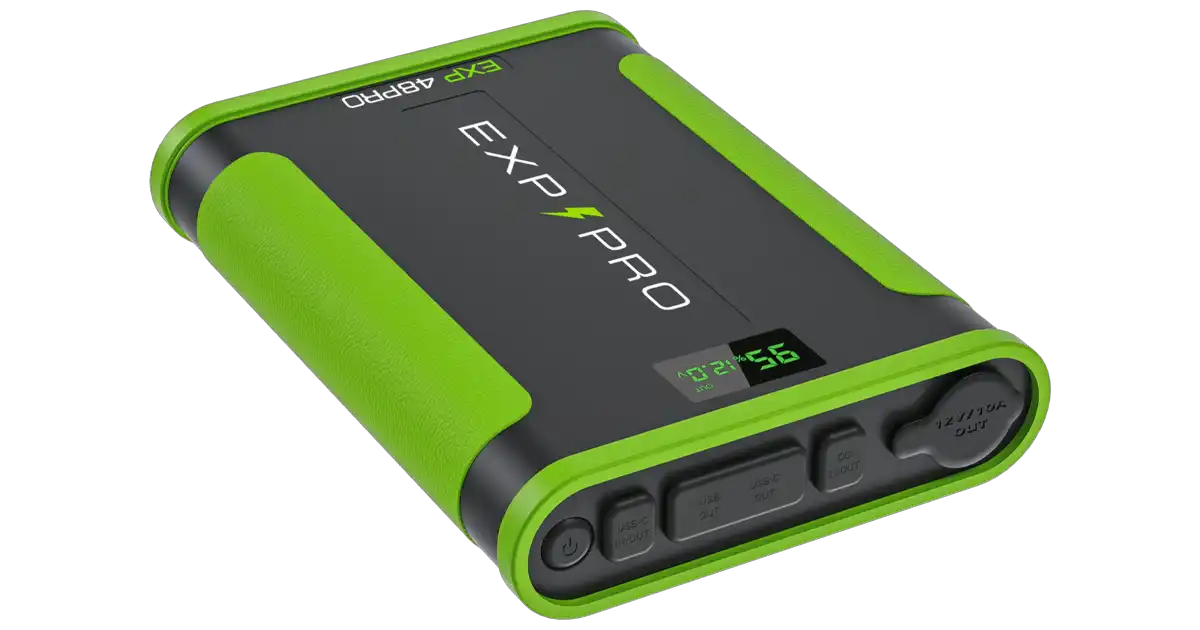
The EXP48PRO APEX is a 153.6Wh LiFePO4 battery built for CPAP and BiPAP backup, at 3.25 lbs with a 2-year warranty and 5,000-cycle rated lifespan. Unlike smaller 95Wh travel batteries, its higher-output ports (12V at up to 15A peak) mean it’s actually listed as compatible with ResMed AirCurve 10 and AirStart 10 — BiPAP-class machines that draw more than most travel batteries can handle. Because it sits between 100Wh and 160Wh, it needs advance airline approval to fly as carry-on, unlike smaller under-100Wh batteries. Two units can be linked in parallel for 307.2Wh combined.
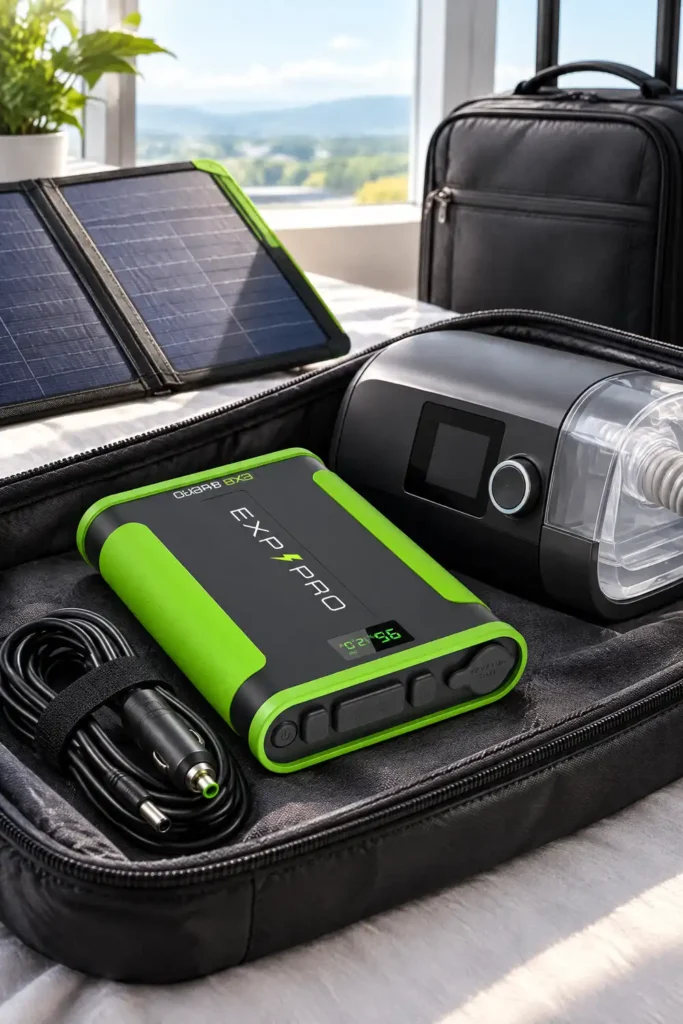
Table of Contents
What Makes the EXP48PRO Different
The EXP48PRO’s core distinction is its LiFePO4 (lithium iron phosphate) cell chemistry, rather than the lithium nickel-manganese-cobalt (NMC) cells most lighter travel batteries use. LiFePO4 cells are generally more thermally stable and rated for meaningfully more charge cycles — EXP PRO rates this battery at up to 5,000 cycles before capacity degrades to 80%, well above the 300–500 cycles typical of NMC-based travel batteries. That durability comes with a tradeoff: LiFePO4 cells are heavier per watt-hour than NMC cells, part of why this battery weighs 3.25 lbs against the roughly 1.3 lbs of a 95Wh NMC-based travel battery like the Medistrom Pilot-24 Lite.
The other real distinction is output capacity. The EXP48PRO’s cigar-lighter-style port delivers 12V at up to 10A continuously, with a 15A peak for up to 5 minutes — confirmed directly in EXP PRO’s own user manual. That headroom is why this battery, unlike smaller travel batteries, is listed as compatible with ResMed AirCurve 10 and AirStart 10, which draw more heavily during dynamic BiPAP pressure changes than a standard CPAP/APAP unit.
Full Verified Specifications
Cross-checked against EXP PRO’s official user manual and consistent across current retailer listings:
| Spec | Detail |
|---|---|
| Capacity | 153.6Wh (12.8Ah @ 12V, ~48,000mAh @ 3.2V equivalent) |
| Cell chemistry | Lithium Iron Phosphate (LiFePO4) |
| Weight | 3.25 lbs |
| Dimensions | 1.6″ x 6″ x 8.2″ |
| Cycle life | Up to 5,000 cycles to 80% capacity |
| Ingress protection | IP65 (dust-tight, resistant to low-pressure water jets) |
| Cigar lighter output | 12V, 10A continuous / 15A peak (5 min) |
| DC barrel output | Switchable: 12V @ 6.7A or 24V @ 3.8A (ships set to 24V) |
| USB-C | PD input and output, variable voltage up to roughly 60W depending on device |
| USB-A | Standard 5V/2.4A plus a Quick Charge 3.0 port |
| AC recharge time | ~2.5 hours (APEX version) |
| DC/car recharge time | ~4 hours |
| Warranty | 2 years |
| Air travel status | 153.6Wh sits between 100Wh and 160Wh — requires advance airline approval for carry-on |
Compatibility: Broader Than Most Travel Batteries
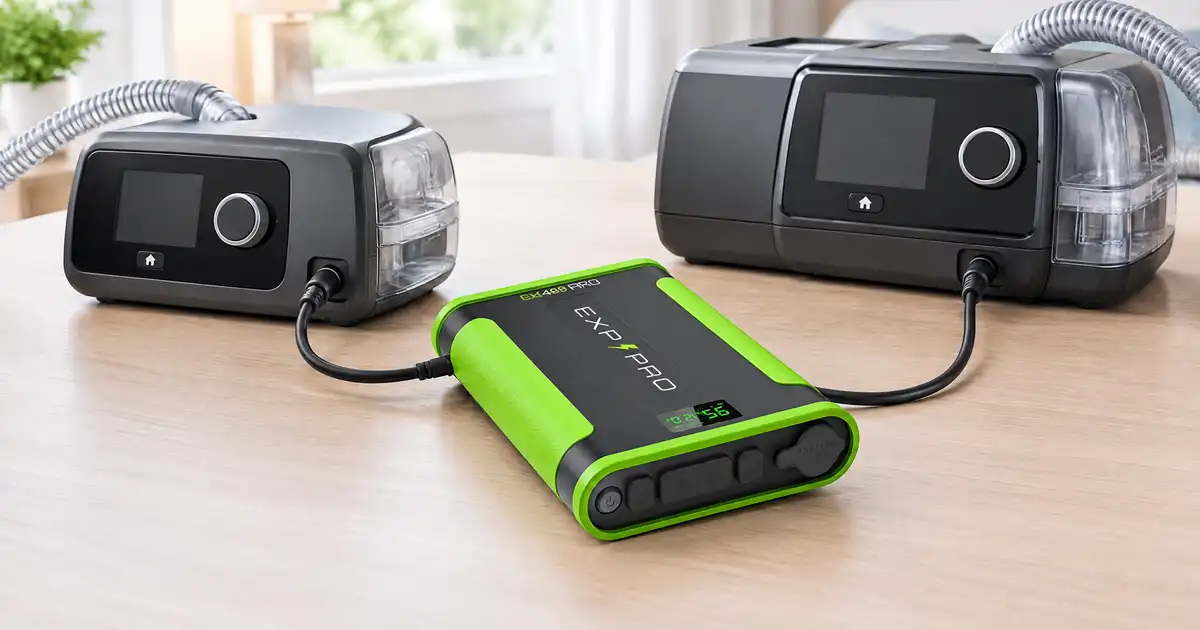
Per EXP PRO’s own product listings and manual, the EXP48PRO supports: ResMed AirSense 9, 10, and 11, AirCurve 10 and AirStart 10, S9, AirMini, Philips DreamStation and DreamStation 2 (same cable, sold as a single SKU), DreamStation Go, Resvent iBreeze, Respironics System One, Breas Z1/Z2, and 3B Medical Luna G3.
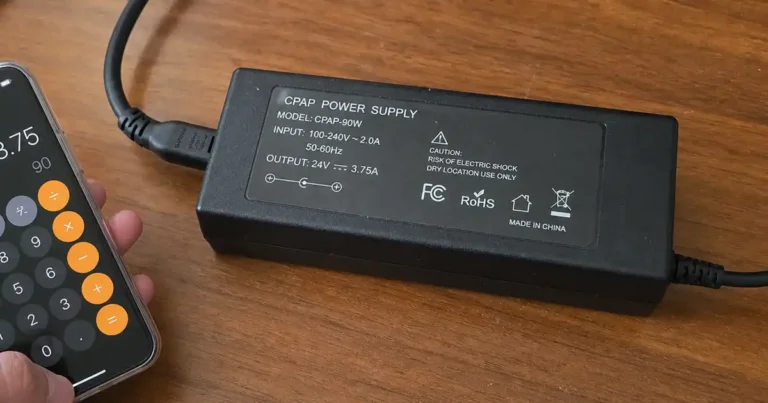
One clarification worth making precisely, since it’s a source of real confusion elsewhere online: the original DreamStation runs on 12V DC, while DreamStation 2 actually runs on 24V DC (a 65W power brick) — they are not the same voltage, despite sharing a name. The EXP48PRO covers both because its DC barrel port is switchable between 12V and 24V output, and EXP PRO sells a single combined DreamStation/DreamStation 2 cable SKU for this reason — not because the two machines secretly share a voltage.
On AirCurve specifically: retailer listings include “AirCurve 10” in the compatible-devices list, and the port’s 15A peak rating gives real headroom for BiPAP-style dynamic pressure swings that can trip smaller travel batteries. I’d still confirm your exact AirCurve model and mode against the current compatibility list before buying if you’re specifically using ASV (adaptive servo-ventilation) therapy, since that’s the highest-draw BiPAP configuration and I don’t have independent bench data confirming performance at that specific extreme — the port specs support it comfortably on paper, which is different from a confirmed real-world test at maximum ASV load.
Real Runtime: The Math, Shown Plainly
EXP PRO’s own marketing states “2–3 nights” of runtime with humidifier and heated tubing disabled. Rather than repeat that figure without context, here’s the actual math behind it, using the confirmed 153.6Wh capacity and roughly 85% usable capacity — a reasonable efficiency estimate for a DC-native LiFePO4 system, slightly better than the ~80% I use for general AC-inverter-based power stations elsewhere on this site, since this battery skips one conversion step for DC-connected devices:
| CPAP Configuration | Typical Draw | Calculated Runtime |
|---|---|---|
| Unheated, low pressure (6–8 cmH2O) | ~5–7W | 19–26 hours |
| Unheated, moderate pressure (10–12 cmH2O) | ~8–10W | 13–16 hours |
| BiPAP, unheated (moderate IPAP/EPAP spread) | ~12–16W | 8–11 hours |
| Humidifier on, no heated tube | ~25–35W | 3.7–5.2 hours |
| Maximum heat (humidifier + heated tube) | ~65–90W | 1.4–2 hours |
I want to be direct about what this table is and isn’t: these are calculated projections from the verified capacity and typical CPAP power-draw ranges established elsewhere on this site, not results from bench testing I personally performed on this unit. Real-world runtime will vary with your specific machine, pressure setting, and ambient temperature. Treat this as a planning estimate, the same way I’d want a manufacturer’s own numbers treated.
Charging, Pass-Through, and Daisy-Chaining
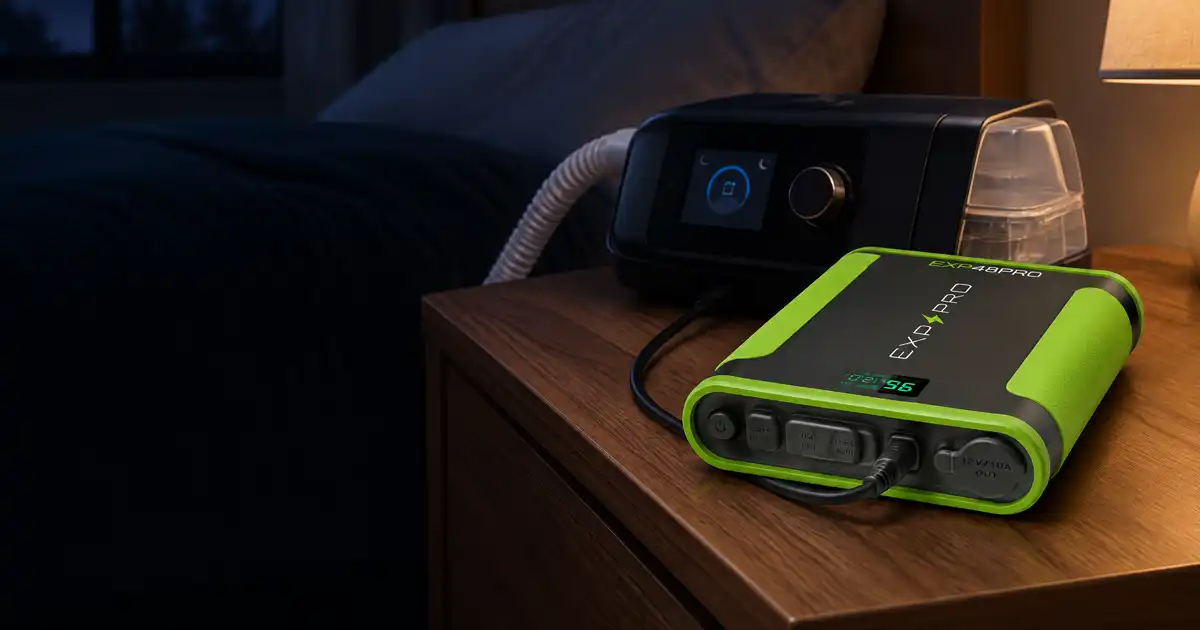
The EXP48PRO supports pass-through charging: it can power a connected CPAP while simultaneously charging from wall power, functioning as an automatic UPS if grid power cuts out, without a manual switch. Confirmed recharge times are roughly 2.5 hours via AC and about 4 hours via a 12V DC (car) source for the current APEX version.
Solar charging is supported via EXP PRO’s own 30W or 60W foldable panels, connecting through the DC input or USB-C port. I don’t have a precise, consistently-confirmed hour figure for full solar recharge across sources — estimates I found ranged from roughly 5 to 10 hours depending on panel size and conditions — so I’d treat any specific number here as a rough planning figure rather than a guarantee, and expect the 60W panel to charge meaningfully faster than the 30W one.
Daisy-chaining is confirmed directly in EXP PRO’s official manual: up to two EXP48PRO units can be linked in parallel using the supplied DC cable, combining to 307.2Wh — roughly doubling every runtime figure in the table above. This is a genuine option for multi-night camping or extended outages rather than buying a single larger battery.
FAA and TSA Travel Rules
At 153.6Wh, the EXP48PRO falls between the FAA’s two lithium battery thresholds: under 100Wh needs no airline notification, while 100.1Wh to 160Wh — where this battery sits — requires advance airline approval before you fly. Above 160Wh, batteries generally aren’t permitted as carry-on at all. Confirmed directly on EXP PRO’s own product pages: “advance airline approval is required.” This is a real, meaningful difference from a sub-100Wh battery like the Medistrom Pilot-24 Lite, which flies without that extra step — worth factoring in if air travel is a primary use case rather than home backup. Review the FAA’s own lithium battery guidance directly before flying.
HSA/FSA Eligibility
A CPAP or BiPAP battery backup purchased for a prescribed sleep therapy device generally qualifies as an operating or maintenance cost under IRS Publication 502, and the EXP48PRO is explicitly listed as HSA/FSA eligible across multiple authorized retailers. Keep an itemized invoice, your CPAP prescription, and — if a claim is ever questioned — a Letter of Medical Necessity from your prescribing physician. I walk through this documentation trail in more depth in my HSA eligible portable power station guide.
EXP48PRO vs. Medistrom Pilot-24 Lite
Both are purpose-built CPAP batteries, but for different situations:
| EXP48PRO APEX | Medistrom Pilot-24 Lite | |
|---|---|---|
| Capacity | 153.6Wh | 95Wh |
| Weight | 3.25 lbs | 1.3 lbs |
| Chemistry | LiFePO4 | NMC lithium-ion |
| Cycle life | ~5,000 | ~500 |
| AirCurve/BiPAP support | Listed as compatible | Explicitly not compatible with AirCurve ASV |
| Airline approval needed | Yes (100–160Wh band) | No (under 100Wh) |
| Warranty | 2 years | 1 year |
| Best for | Home backup, BiPAP/AirCurve users, multi-night camping | Lightest possible travel option for AirSense 10/11/AirMini |
Minimal-hassle flying on a standard CPAP or APAP points toward the Pilot-24 Lite’s sub-100Wh size as the simpler choice. A BiPAP or AirCurve machine, a need for multi-night capacity, or wanting the longer cycle life of LiFePO4 for frequent use all point toward the EXP48PRO instead — accepting the extra weight and the airline-approval step as the tradeoff. I cover the Pilot-24 Lite in full in my dedicated review.
FAQs
Does the EXP48PRO work with BiPAP machines like the AirCurve 10?
Yes, per EXP PRO’s own compatibility listings — its higher-output port (up to 15A peak) is built to handle the more demanding draw of BiPAP-class devices. Confirm your exact model and therapy mode against the current compatibility list, particularly for ASV therapy specifically.
How long does the EXP48PRO actually last on a charge?
Roughly 13 to 26 hours with humidifier and heated tube off, depending on your pressure setting, and 1.5 to 5 hours with full comfort features running — see the runtime table above for the full breakdown. These are calculated estimates based on verified capacity and typical CPAP draw, not independently bench-tested figures.
Can I bring the EXP48PRO on a flight?
Yes, but with an extra step compared to a smaller battery: its 153.6Wh capacity requires advance airline approval before departure, since it falls in the 100–160Wh band rather than under the no-approval 100Wh threshold.
Can I link two EXP48PRO batteries together?
Yes — up to two units can be connected in parallel using the included DC cable, combining to 307.2Wh total capacity, confirmed in EXP PRO’s official manual.
Bottom Line
The EXP48PRO is a genuinely more heavy-duty option than lighter travel batteries like the Medistrom Pilot-24 Lite — more capacity, longer cycle life, and BiPAP/AirCurve compatibility that smaller batteries explicitly lack — at the cost of more than double the weight and an airline-approval step that sub-100Wh batteries skip. For home backup, BiPAP users, or multi-night off-grid use, that tradeoff is usually worth it. For minimal-hassle air travel on a standard CPAP, it’s worth considering the lighter alternative instead.
For the lighter-weight option this reviews against, see my Medistrom Pilot-24 Lite review, and for the broader CPAP power picture, the medical device power supply pillar guide.