1000Wh Battery Oxygen Concentrator Runtime: The Real Numbers by Device
 By Lee Arnold
Medical Solar Power Backup Specialist | 8+ years in the field
Quick Answer:
A 1000Wh power station runs a portable pulse dose oxygen concentrator for roughly 6 to 20 hours, a portable continuous flow unit for roughly 2.5 to 7 hours, a stationary 5-liter unit for roughly 2 to 4 hours, and a stationary 10-liter unit for as little as 1 to 1.8 hours. The single most useful thing in those numbers: the same 1000Wh battery is oversized for a portable pulse dose unit and undersized for a stationary one — which one you have determines whether 1000Wh is more than enough or nowhere near enough.
Two other sites already do solid math on this exact question, so simply repeating “here’s the formula” wouldn’t add anything real. What’s missing from both: neither ties the runtime to an actual power station you can buy today, and neither states plainly that 1000Wh means something completely different depending on which type of concentrator you own. Both of those are covered below.
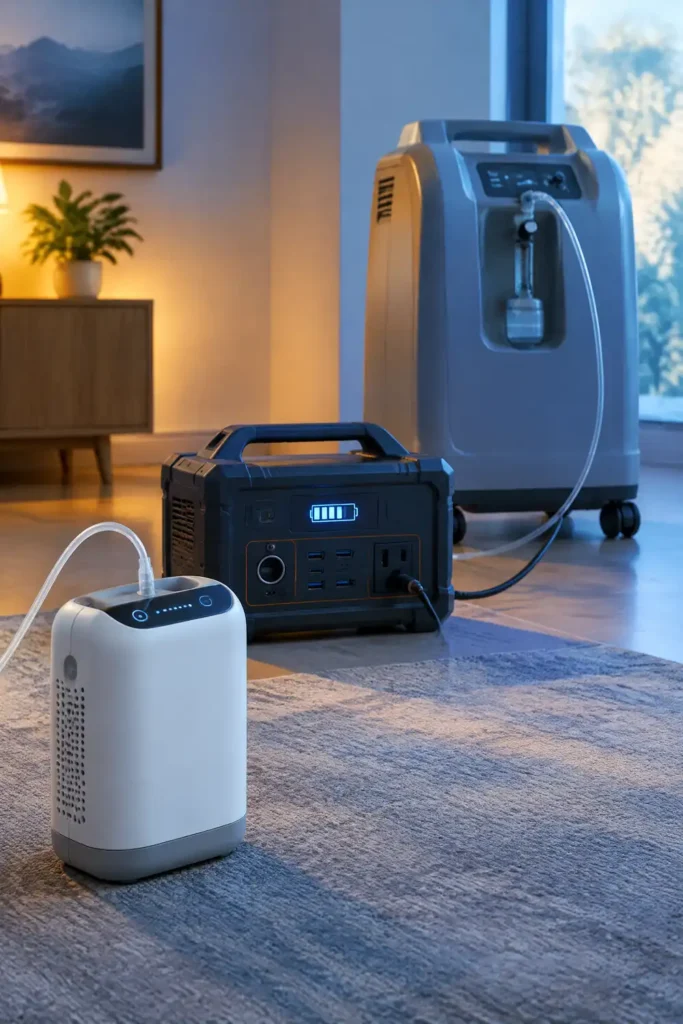
Table of Contents
Why 80% of the Rated Capacity, Not 100%
Every runtime estimate for a power station needs to start with a realistic usable-capacity number, not the rated Wh on the box. Two things eat into it:
DC-to-AC inverter conversion loss. Your concentrator runs on AC power, but the battery stores DC. That conversion isn’t free — it typically costs 10 to 15% of the stored energy as heat, before any of it reaches the device.
Battery management system reserve. Power stations don’t discharge to a literal 0% — the battery management system holds back a small reserve, typically another 5% or so, to protect the cells and keep voltage stable at the very end of a discharge cycle.
Combined, that puts realistically usable capacity at roughly 80% of the rated number — a 1000Wh battery gives you about 800Wh to actually work with. Some sources use 90%, some use 70%; 80% is a reasonable middle estimate, and I’d plan around it rather than the optimistic end if the runtime genuinely matters to you.
Runtime by Device Type
These figures apply the 800Wh of usable capacity from a 1000Wh-rated battery:
| Device Type | Running Watts | Runtime on 1000Wh |
|---|---|---|
| Portable, pulse dose | 40–130W | 6.2–20 hours |
| Portable, continuous flow | 120–300W | 2.7–6.7 hours |
| Stationary, 5-liter continuous | 200–350W | 2.3–4 hours |
| Stationary, 10-liter continuous | 450–800W | 1–1.8 hours |
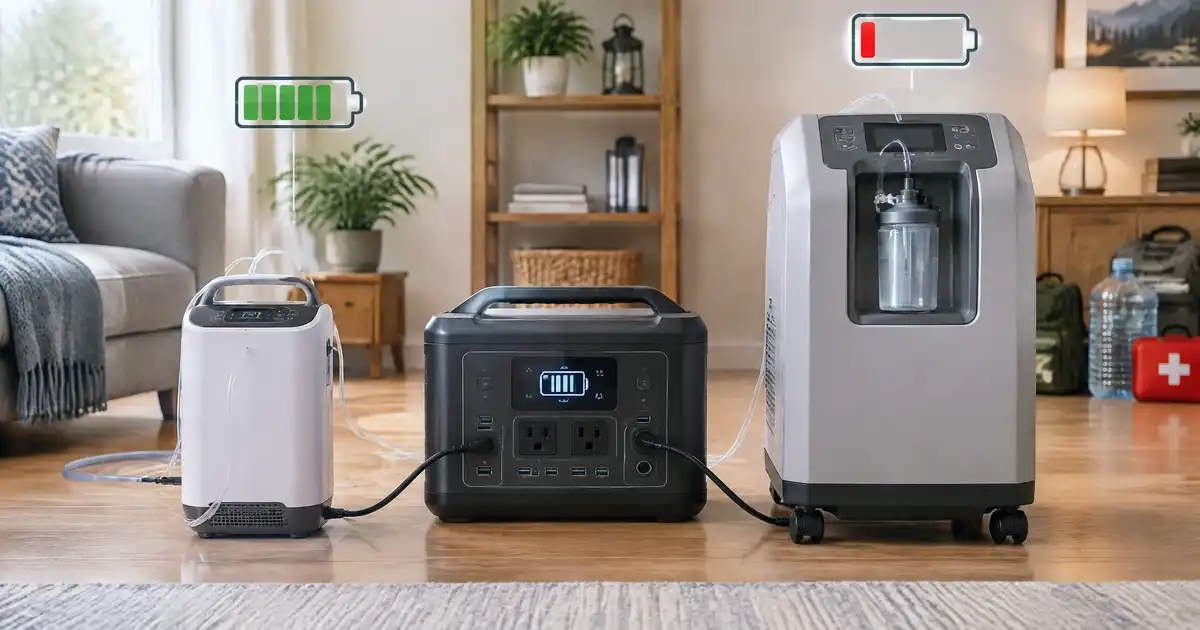
That range across the table is the point worth sitting with. For a portable pulse dose concentrator — the most common type by far — a 1000Wh power station is genuinely generous, likely more capacity than most people need for a single overnight outage. For a stationary 10-liter unit, that same 1000Wh barely clears an hour and a half. Not knowing which category your device falls into before shopping for backup power is exactly the mismatch that leads to either overspending on capacity you’ll never use, or badly underestimating what you need.
For the full wattage breakdown and why continuous flow draws so much more than pulse dose, see my continuous vs pulse dose power draw guide.
What a Real 1000Wh Power Station Looks Like
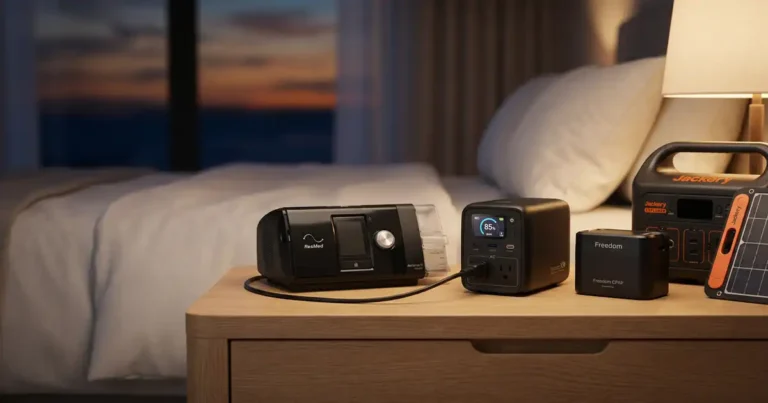
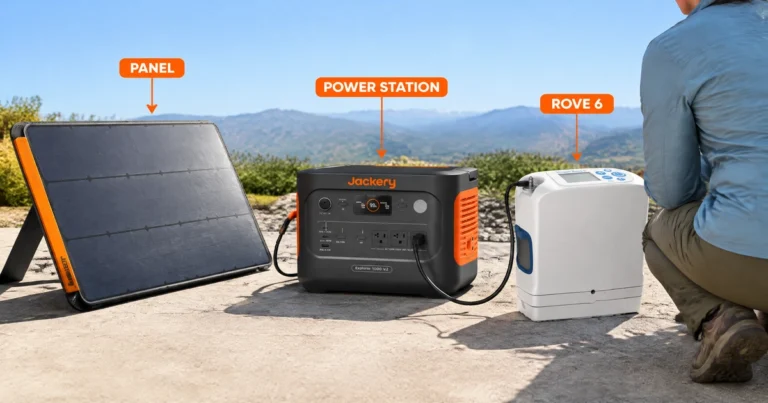
Rather than leave this abstract, here’s the math applied to an actual product: the Jackery Explorer 1000 v2, rated at 1070Wh with 1500W continuous pure sine wave output and a 3000W surge rating per Jackery’s own published specifications — slightly above the 1000Wh baseline used above, so real runtime on this specific unit lands a little past the high end of each range in the table. That 3000W surge rating clears the surge requirements of every device category above, including the 10-liter stationary units, which is worth checking on any power station you’re considering — a unit with plenty of Wh capacity but a low continuous rating can still fail to power a higher-draw concentrator at all. I cover this exact model in more depth, including verified compatibility and setup, in my Inogen Rove 6 solar charging guide.
Check Current Price for Jackery Explorer 1000 v2 on Amazon →
HSA/FSA Note: a power station sized and purchased specifically to run a prescribed oxygen concentrator generally qualifies as an operating cost under IRS Publication 502 — I walk through the documentation trail in my HSA eligible portable power station guide.
What Shortens Real-World Runtime Below These Numbers
Cold temperature. Battery capacity drops in the cold — expect a meaningful reduction below 40°F, on top of the 80% baseline already factored in above.
Battery age. A power station’s battery degrades with charge cycles like any lithium battery. A two-year-old unit used regularly may only deliver 85–90% of its original rated capacity, which compounds with the other losses here.
Running other devices simultaneously. These numbers assume the power station is running the concentrator alone. Add a CPAP, a phone charger, or a lamp on the same unit and usable runtime drops proportionally.
Higher flow settings than assumed. The wattage ranges above span a device’s full range of settings — your actual draw depends on your prescribed setting, which may sit anywhere in that range rather than at the low end.
Recharging a 1000Wh Battery on Solar
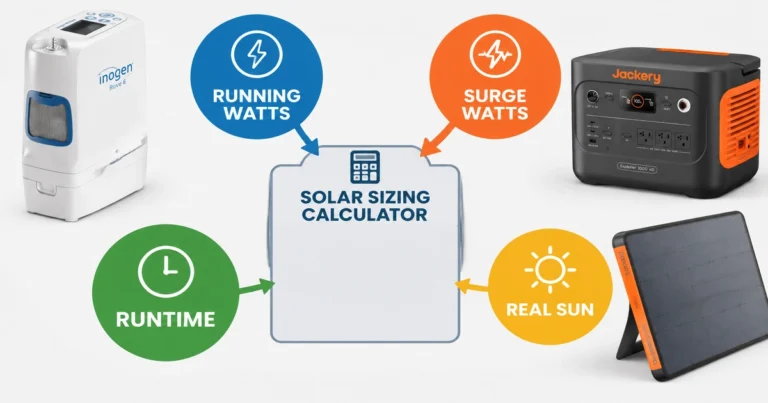
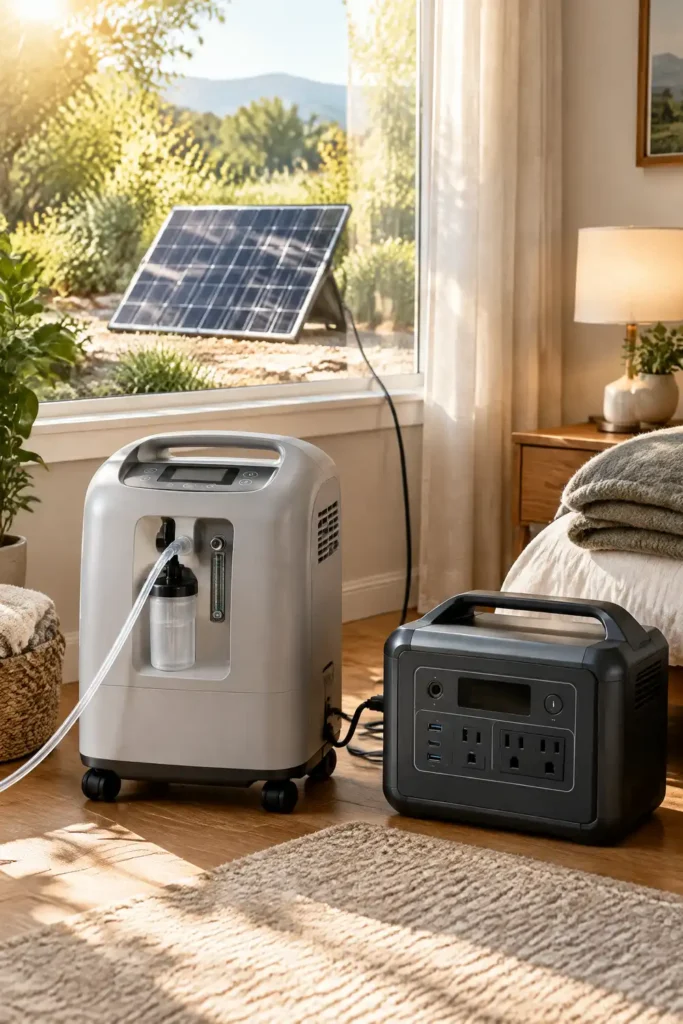
For anyone pairing this with solar rather than relying only on stored capacity, a single 100W panel generating a realistic 60–80W over 5 hours of good sun adds roughly 300–400Wh per day — meaning a full recharge from empty takes about 2 to 3 days on one panel, or roughly half that with a 200W panel. I cover the full sizing methodology, including how to apply it to your specific device, in my how to run an oxygen concentrator on solar guide.
For the complete picture on pairing any oxygen concentrator with backup power, see my battery for oxygen concentrator guide.
FAQs
Is 1000Wh enough for an oxygen concentrator during a power outage?
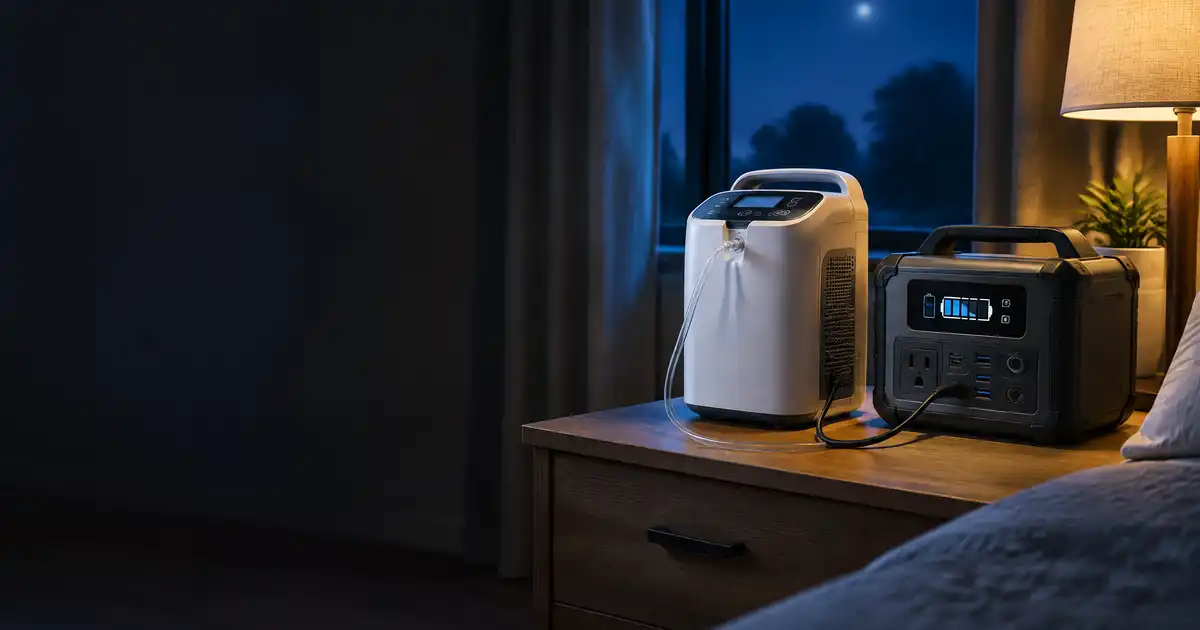
For a portable pulse dose unit, yes — typically 6 to 20 hours, which covers an overnight outage with room to spare. For a stationary unit, especially a 10-liter model, 1000Wh provides only 1 to 4 hours, which is not enough for reliable overnight backup on its own.
How many watt-hours do I need for an oxygen concentrator to run all night?
An 8-hour overnight target needs roughly 8 times your device’s running watts, divided by 0.8 to account for usable-capacity losses. For a 60W pulse dose unit, that’s about 600Wh minimum. For a 300W stationary unit, that’s closer to 3,000Wh.
Does a 1000Wh battery mean 1000 watts of power?
No — watt-hours (Wh) measure total stored energy, while watts (W) measure the rate of power draw at any given moment. A 1000Wh battery could deliver 1000W for one hour, 100W for ten hours, or any combination that adds up to roughly 800Wh of usable output, as covered above.
Why do different sources give different runtime estimates for the same battery?
Mostly because they use different assumed efficiency factors — some use 90%, others 70%. The real-world range genuinely varies with temperature, battery age, and inverter efficiency, so any single estimate is a planning figure, not a guarantee. Test your actual setup once rather than relying purely on the math.
Bottom Line
A 1000Wh power station gives a portable pulse dose oxygen concentrator 6 to 20 hours of runtime, but only 1 to 4 hours for a stationary unit — the same battery, radically different verdicts depending on your device. Know which category yours falls into before you buy, and plan around roughly 80% of the rated capacity rather than the number printed on the box.
For device-specific wattage data, see my continuous vs pulse dose power draw guide, and for the general solar-sizing math, my how to run an oxygen concentrator on solar guide.