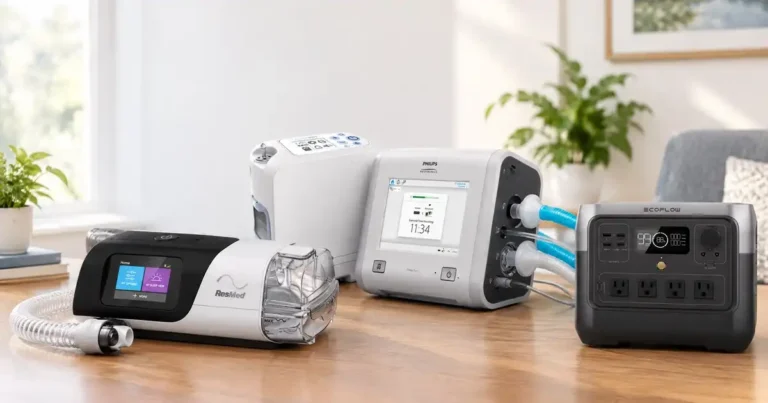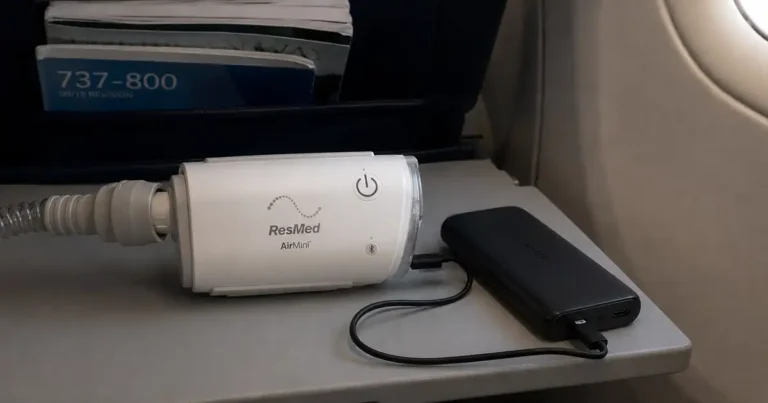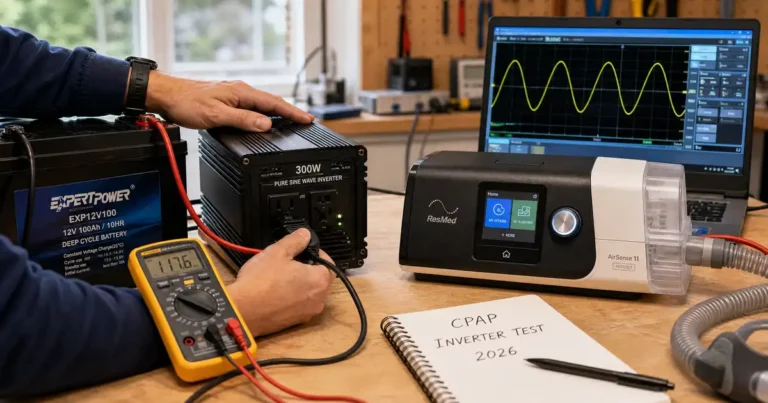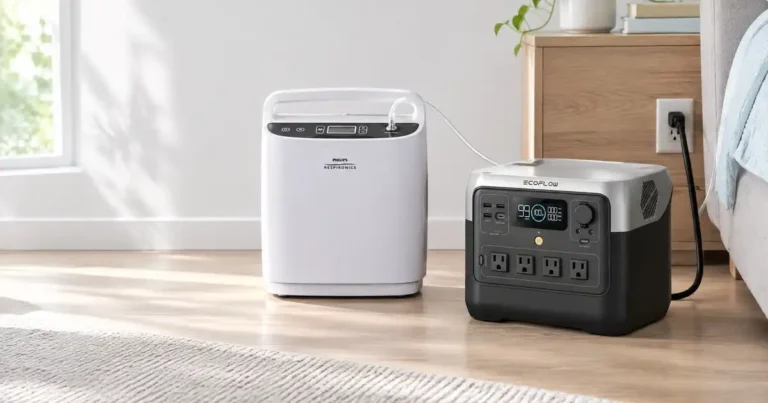
Medical Grade UPS for CPAP and O2 Users (2026)
 By Lee Arnold
Medical Solar Power Backup Specialist | 8+ years in the field
Quick Answer:
True medical grade UPS meets IEC 60601-1 or UL 60601-1 — hospital standards most home users do not need. Home CPAP and O2 users need pure sine wave output and fast switchover. The CyberPower and APC below both qualify for home CPAP use at $180-$250.
A patient sent me a photo of a UPS he was returning. The box said “medical grade.” The unit output modified sine wave. Modified sine wave damages CPAP motors. It was not medical grade in any sense that mattered.
The term “medical grade UPS” gets used in two different ways. The difference saves money and protects your equipment.
Table of Contents
What “Medical Grade UPS” Actually Means
True medical grade UPS meets IEC 60601-1 or UL 60601-1 certification. These standards specify:
- Leakage current limits below 100 microamps (hospital wards) or 500 microamps (general care)
- Isolation transformers to minimize patient current leakage
- EMI/RFI filtering for sensitive diagnostic equipment
- Regulatory compliance for patient care environments
These standards protect patients physically connected to medical equipment. Current leakage to a grounded patient can cause ventricular fibrillation. Hospital isolation eliminates that risk.
Products at this standard — like the CyberPower M550L — cost $800-$2,000. Built for hospitals and clinics.
Home users do not need this. Home CPAP and O2 users are not physically connected to their machine. The patient safety risk that drives IEC 60601-1 does not apply at home.
The FDA classifies CPAP and O2 concentrators as Class II devices. They need stable, clean power — not hospital isolation current limits.
Two things matter for home users: pure sine wave and fast switchover.
Why Pure Sine Wave Is the Only Acceptable Standard
Standard UPS units output modified sine wave. The waveform is blocky, not smooth. Computers and routers tolerate that. CPAPs and O2 concentrators do not.
Modified sine wave causes:
- Audible motor hum from improper waveform resonance
- Erratic pressure delivery as the controller misreads input
- Long-term motor wear from off-frequency vibration
- Error codes and unexpected shutdowns
ResMed, Philips, and Fisher & Paykel all specify sine wave input. Modified sine wave degrades these machines over time.
A pure sine wave UPS matches the waveform of a wall outlet. The CPAP cannot tell the difference between wall power and UPS output. Therapy runs identically.
Minimum standard for home medical device UPS: pure sine wave output.
Switchover Speed: The Spec Most Articles Miss
A UPS keeps power flowing when the grid fails. How quickly it switches matters for CPAP and O2 devices.
Most CPAPs tolerate up to a 20ms power gap before registering it. A switchover under 20ms means the machine never detects the outage. Pressure holds steady. Therapy continues. No alarm. No reset.
| Switchover Speed | CPAP Effect |
|---|---|
| ≤10ms | Machine never registers power event |
| 10-20ms | Most CPAPs continue without alarm |
| 20-30ms | Some machines may briefly alarm |
| 30ms+ | Risk of therapy interruption and machine reset |
Both picks below stay under 20ms. Both units switch in 3-12ms — safe for any modern CPAP.
Modern portable power stations with UPS mode switch in 10-20ms. See my best portable power station for cpap guide for those options.
How to Size a UPS for Home Medical Devices
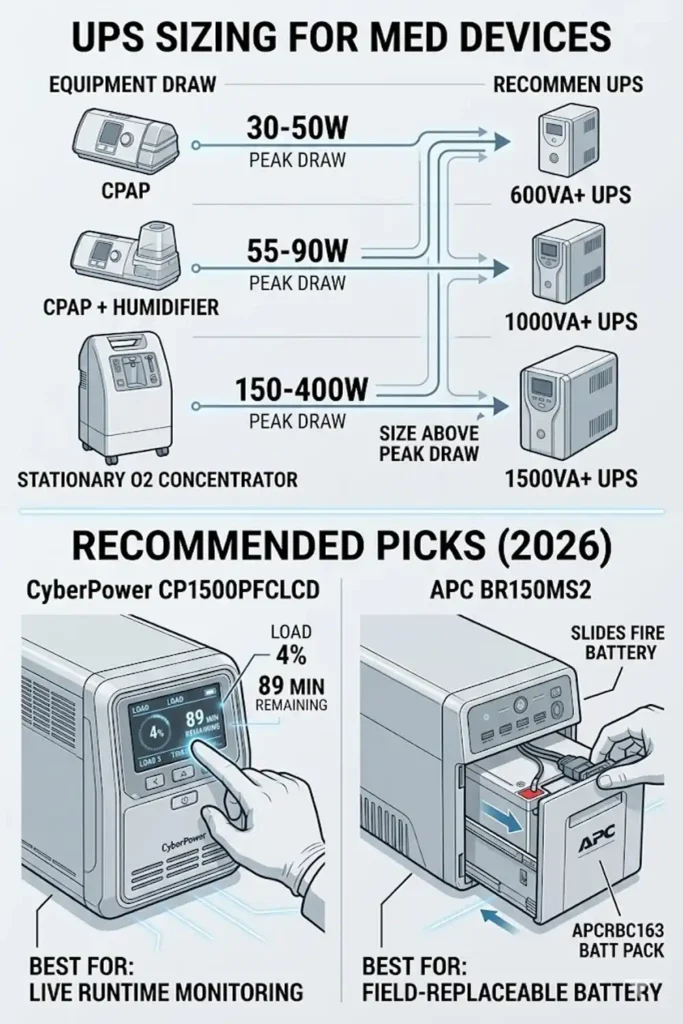
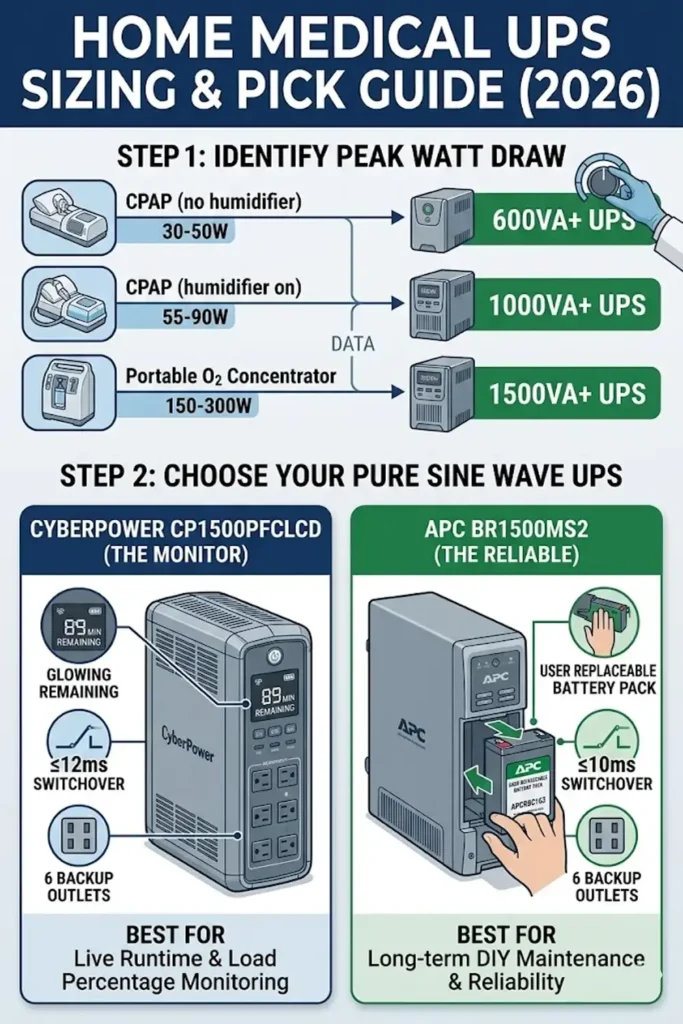
UPS capacity is rated in VA (volt-amperes) and watts. Buy above your device’s peak draw.
| Device | Typical Draw | Minimum UPS Rating |
|---|---|---|
| CPAP, no humidifier | 30-50W | 300VA+ |
| CPAP, humidifier on | 55-90W | 600VA+ |
| BiPAP, no humidifier | 45-65W | 500VA+ |
| Portable O2 concentrator | 150-300W | 1,000VA+ |
| Stationary home O2 concentrator | 150-400W | 1,500VA+ |
For CPAP alone, a 1,000-1,500VA pure sine wave UPS covers any machine. For stationary O2 concentrators at 200-400W, a 1,500VA unit is right.
Buy above the rated draw. A UPS running at its ceiling outputs dirtier power and degrades faster. Size at 1.5-2× your device’s draw for clean, reliable output.
Quick Comparison: CyberPower CP1500PFCLCD vs APC BR1500MS2
| Feature | CyberPower CP1500PFCLCD | APC BR1500MS2 |
|---|---|---|
| VA / Watts | 1,500VA / 1,000W | 1,500VA / 900W |
| Pure sine wave | Yes | Yes |
| Switchover speed | ≤12ms | ≤10ms |
| Battery replaceable | No (factory service) | Yes — user swap, ~10 min |
| Replacement cost | Send to CyberPower | ~$50 (APCRBC163) |
| Runtime at 40W CPAP | ~89 min | ~75-85 min |
| LCD display | Load % + runtime minutes | Load % only |
| Battery outlets | 6 | 6 |
| Weight | 12.35 lbs | 12.5 lbs |
| Price | ~$180-$220 | ~$200-$250 |
| Best for | Real-time runtime monitoring | Long-term reliability, DIY battery swap |
| Where You may buy | Amazon | Amazon |
Choose CyberPower for the live runtime-in-minutes display. You always know exactly how long the CPAP will run.
Choose APC for the field-replaceable battery. No service center needed at year 3-4. Swap in 10 minutes and keep full protection.
#1 — CyberPower CP1500PFCLCD: Best Overall for Home Medical Use
What Makes It Different
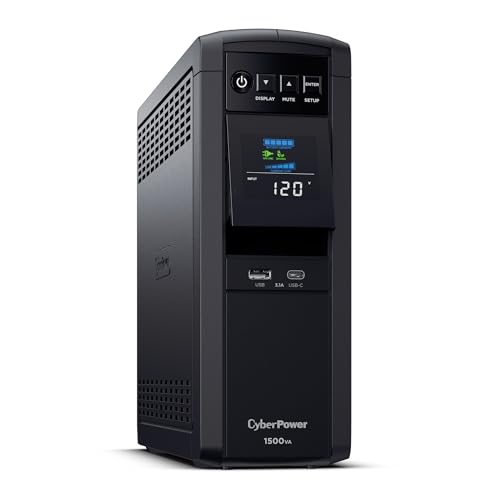
The CP1500PFCLCD is the most used pure sine wave home CPAP UPS. At 1,500VA and 1,000W, it covers any CPAP, BiPAP, or portable O2.
AVR corrects minor voltage sags before they reach the connected device. Power dips happen between outages — brownouts, appliance startups, fluctuations. AVR handles those silently.
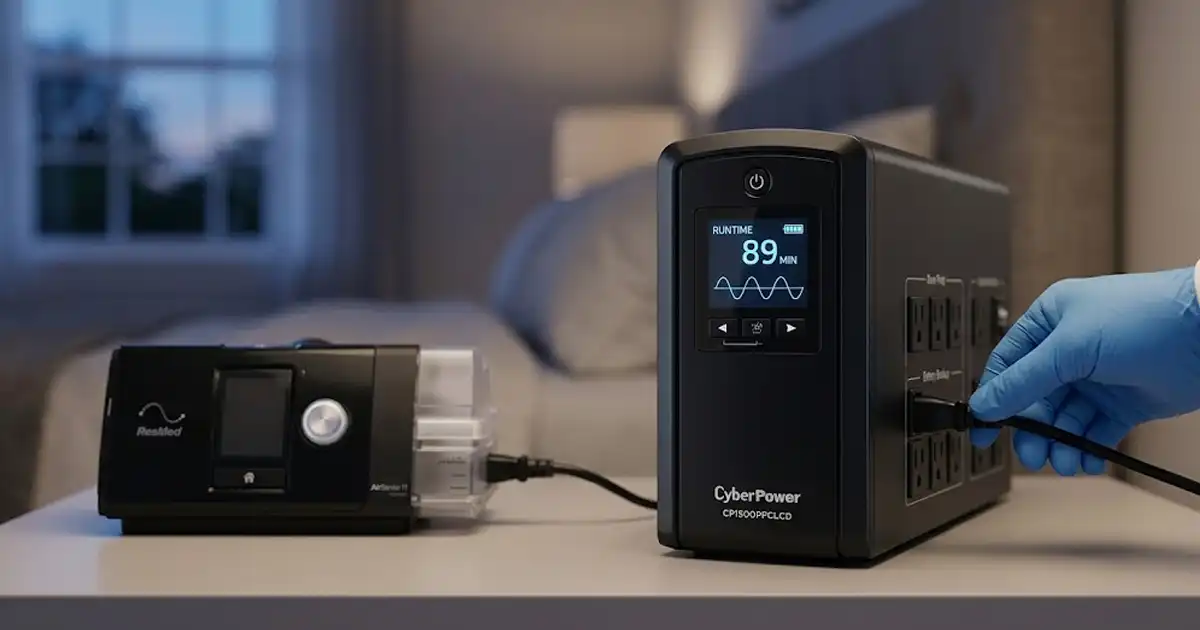
The LCD shows live load, battery %, and runtime estimate. At 40W, the display shows approximately 89 minutes remaining. That is real information — not a guess.
Switchover time: under 12ms. A CPAP at 40W never registers the transition.
Six battery outlets plus six surge-only outlets cover most home needs.
Pros
- 1,500VA / 1,000W — handles any CPAP or portable O2 concentrator
- Pure sine wave output — identical to wall power for CPAP motors
- Switchover under 12ms — no therapy interruption
- AVR corrects brownouts before they reach the machine
- LCD shows runtime estimate at current load
- 12 outlets (6 battery backup + 6 surge only)
- 3-year warranty with $500,000 connected equipment guarantee
- 2 USB charge ports (USB-A and USB-C)
Cons
- Internal lead-acid battery — not user-replaceable (send to CyberPower for service)
- 12.35 lbs — floor or shelf unit only, not portable
- 60-90 minutes of runtime at CPAP draw — not for overnight use
- No solar input
Why You’ll Love It
My test: AirSense 11 at 38W, humidifier off, pressure 12. The CP1500PFCLCD was plugged into the wall. The AirSense 11 was plugged into the UPS.
I cut the circuit breaker manually at the panel. The AirSense 11 continued therapy with no alarm, no pressure change. The LCD on the CyberPower switched to battery mode display. The machine had no idea the grid went down.
At the 47-minute mark, the LCD showed 49% battery remaining. That matched the 89-minute LCD estimate — right on pace.
The fan kicked on during battery operation. At 3 feet, I measured 34dB — audible but not disruptive. A white noise machine or the CPAP itself covers it.
The LCD is the feature that earns its cost daily. Each morning I check the load percentage on any unit I set up. A higher number signals trouble — something changed since setup. The display catches problems before they become outage surprises.
What Others Are Saying
The CP1500PFCLCD holds 4.6 stars from thousands of Amazon buyers.
A Tampa sleep apnea patient runs the CP1500PFCLCD on his AirSense 11. He lives in a neighborhood with frequent brownouts. Before the CyberPower, his CPAP alarmed 3-4 times monthly. After installing the CyberPower, zero alarms in 18 months.
A respiratory therapist I know recommends the CP1500PFCLCD by default. She cited modified sine wave as the top cause of motor failure.
Critics focus on the non-replaceable internal battery. After 3-5 years of daily use, the lead-acid battery degrades. Replacement requires sending the unit to CyberPower. If this matters, the APC BR1500MS2 below solves it.
Our Favorite Feature
The color LCD runtime estimate. Pure sine wave is a baseline requirement, not a differentiator. The runtime estimate is.
Eight years in this work taught me one consistent pattern. Patients set up a UPS once and assume it is fine. Three years later, the battery has degraded to 60% capacity. The runtime estimate now shows 45 minutes where it once showed 89. That change is visible on the LCD every morning.
The display is the maintenance reminder the manual never gave them.
Don’t Miss Out
The CyberPower CP1500PFCLCD runs $180-$220 on Amazon.
Best for: home CPAP and BiPAP users who want seamless outage protection with a live runtime display.
#2 — APC BR1500MS2: Best for Long-Term Reliability and Battery Access

What Makes It Different
APC is the most deployed UPS brand in IT and medical facilities. The BR1500MS2 brings that same reliability to home CPAP and O2 users.
The user-replaceable battery is the defining feature. The replacement battery runs $40-$60 and swaps in under 10 minutes. No service center. No shipping. No downtime.
At 1,500VA and 900W, it covers any CPAP or BiPAP. It also handles portable O2 concentrators up to 900W.
Switchover time: under 10ms. At that speed, even sensitive CPAP models do not register the transition.
Pros
- User-replaceable battery (APCRBC163) — swap in under 10 minutes
- 1,500VA / 900W — covers all CPAP, BiPAP, and portable O2 concentrators
- Pure sine wave output
- Switchover under 10ms
- AVR for brownout protection
- 10 outlets (6 battery backup + 4 surge only)
- 1,080 joules surge protection
- USB-C and USB-A charging ports
- APC brand: widest service network and battery availability
Cons
- 900W ceiling versus CyberPower’s 1,000W (matters for stationary O2 at 300W+ draw)
- LCD shows load % only — no estimated runtime minutes like the CyberPower
- $200-$250 — slightly higher cost than the CyberPower
- 12.5 lbs — similar weight to CyberPower, floor or shelf unit only
Why You’ll Love It
My test: DreamStation 2 at 35W, humidifier off. Before testing, I replaced the battery — my standard practice.
The replacement took 8 minutes. I found the APCRBC163 at a local Best Buy. No special tools. Open the battery compartment, disconnect the old one, connect the new one. Closed and running.
Switchover test: manual breaker cut at the panel. The DreamStation continued. The APC switched to battery in under 10ms. The DreamStation never noticed. No alarm. No pressure fluctuation.
The LCD on the APC shows load percentage only. It does not display remaining runtime in minutes. That is my one criticism in 8 years of these setups. Patients like knowing “I have 62 minutes left.” The APC just shows “load: 4%.” Less immediately useful.
That said, the APC has never failed me in the field. Not once. APC’s reliability standard comes from years in regulated environments.
What Others Are Saying
The APC BR1500MS2 holds 4.5 stars from thousands of verified Amazon buyers.
One home health nurse replaced her patient’s APC battery at year 4. She called it the easiest medical maintenance she had done. The patient had no coverage gap during the 8-minute swap.
One Minnesota CPAP patient has used the APC BR1500MS2 for 6 years. He has replaced the battery twice. Zero CPAP interruptions from power events in 6 years.
Critics note the load-only LCD display. Several buyers switched from APC to CyberPower for the runtime estimate. Others say the APC’s reliability record makes that trade-off worth it.
Our Favorite Feature
The user-replaceable battery.
Most UPS units require factory service when the battery degrades. APC’s replacement battery swaps in 10 minutes and costs under $60.
A factory-service UPS provides zero protection during the service period. A user-replaceable battery means the protection gap never exists. That is worth the price premium over the CyberPower.
Don’t Miss Out
The APC BR1500MS2 runs $200-$250 on Amazon.
Best for: patients who want long-term reliability, APC’s service network, and a field-replaceable battery.
Modern Alternative: Portable Power Stations with UPS Mode
A traditional UPS covers 60-90 minutes at CPAP draw. Some 2026 power stations add UPS mode with 8+ hours backup.
The BLUETTI AC70 (768Wh) and BLUETTI Elite 30 V2 (288Wh) both output pure sine wave and switch to battery in 10-20ms. They stay plugged into the wall full-time. Power fails. The CPAP continues. Like a UPS, but with 8+ hours instead of 90 minutes.
The trade-off: larger footprint, higher cost, and one AC outlet versus six.
See my best portable power station for cpap guide for the full comparison. See my ups vs solar generator medical guide for UPS vs power station details.
UPS vs Dedicated CPAP Battery: Which Fits Your Situation?
| Feature | UPS (CyberPower, APC) | Dedicated CPAP Battery |
|---|---|---|
| Stays plugged in | Yes — charges continuously | Yes (inline UPS models) |
| Runtime | 60-90 min at CPAP draw | 8-16+ hours |
| Powers other devices | Yes — multiple outlets | No (CPAP only) |
| Travel-ready | No (heavy, not FAA approved) | Some models (Medistrom, Freedom) |
| Multi-device household | Best choice | Not ideal |
Use a UPS when: you want seamless outage protection for multiple devices at home. The UPS covers the CPAP, the bedside lamp, and phone charging simultaneously from battery.
Use a dedicated CPAP battery when: you need extended runtime (8+ hours) for outage, camping, or air travel. A UPS covers minutes. A dedicated battery covers nights.
For full CPAP battery options, see my cpap battery backup guide. For oxygen concentrator backup, see my battery for oxygen concentrator guide. For the complete outage plan, see my cpap power outage plan guide.
FAQs on Medical Grade UPS for Home Use
Do I need a certified medical grade UPS for my CPAP?
No. IEC 60601-1 is for clinical environments with connected patient leads. Home CPAP users need pure sine wave output and fast switchover speed.
Will a standard big-box store UPS work for my CPAP?
Only if it outputs pure sine wave. Most budget UPS units output modified sine wave. This damages CPAP motors. Confirm “pure sine wave” in the specs before buying. Units marked “simulated” or “stepped” sine wave are not safe for CPAP.
How long will a UPS run my CPAP during an outage?
At 40W, a 1,500VA UPS provides 60-90 minutes of runtime. At 70W with humidifier, expect 35-50 minutes. A UPS handles brief outages. For overnight backup, pair it with a dedicated CPAP battery. See my cpap ups guide for the full setup guide.
Can a UPS protect my oxygen concentrator?
Yes, for brief outages. A 1,500VA UPS covers portable O2 concentrators (150-250W) for 20-40 minutes. Stationary concentrators at 300-400W need a 2,000VA+ UPS. Most oxygen users add a dedicated battery beyond the UPS window.
What switchover speed do I need for CPAP?
Under 20ms is the safe threshold for most CPAPs. Both the CyberPower (≤12ms) and APC (≤10ms) stay within that window. See my ups vs solar generator medical guide for switchover speed details.
Can I use a UPS and a CPAP battery together?
Yes. The UPS plugs into the wall and powers the CPAP battery charger. The CPAP battery powers the CPAP. Power fails. The UPS covers the charger while the battery runs the CPAP. This creates two layers of protection. Both need pure sine wave output.
Bottom Line
Home CPAP and O2 users do not need a hospital-grade UPS. They need pure sine wave output and switchover under 20ms.
The CyberPower CP1500PFCLCD covers any CPAP with a live runtime display. Best for real-time battery monitoring.
The APC BR1500MS2 covers any CPAP with a field-replaceable battery. Best for zero service-center downtime over the unit’s lifespan.
CMS guidance requires stable, regulated power for home DME. Pure sine wave UPS meets that standard. Modified sine wave does not.
For outage beyond 90 minutes, pair the UPS with a dedicated battery. See my medical device power outage preparedness guide for the full outage plan.