Travel CPAP with Battery: The Complete Setup Guide
 By Lee Arnold
Medical Solar Power Backup Specialist | 8+ years in the field
Quick Answer:
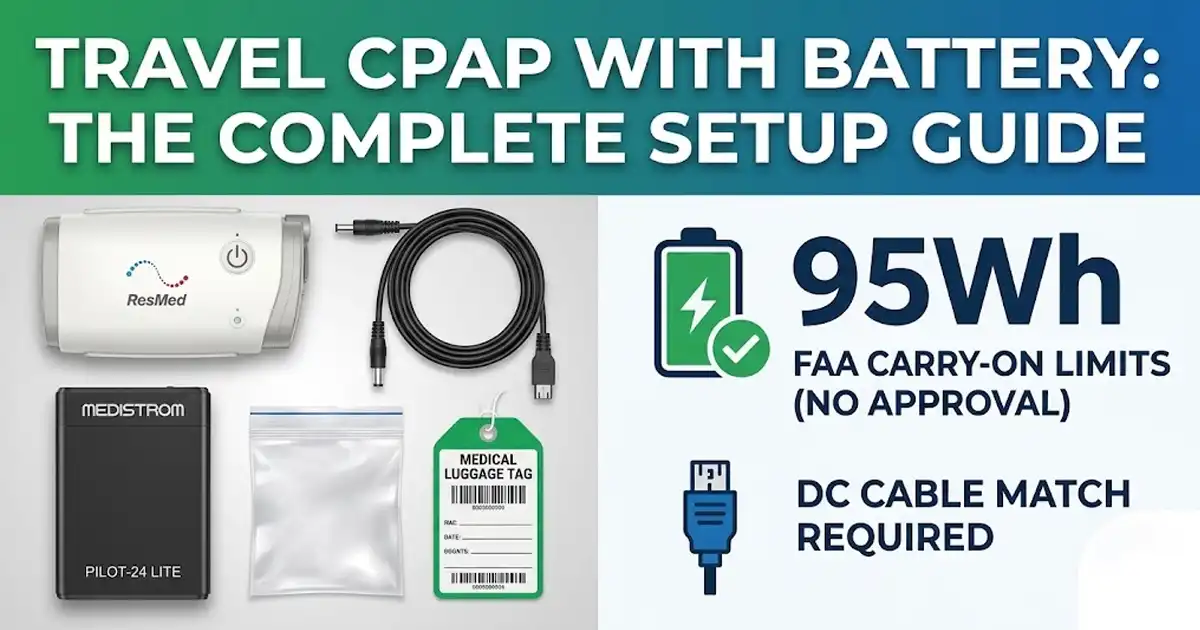
For most travelers: a sub-100Wh CPAP battery clears FAA carry-on rules with no approval needed. The Medistrom Pilot-24 Lite (95Wh), Medistrom Pilot Flex (98Wh), and EASYLONGER ES270 (99.9Wh) cover one to two nights and board any commercial flight. A 100-160Wh battery covers 2-3 nights with airline pre-approval.
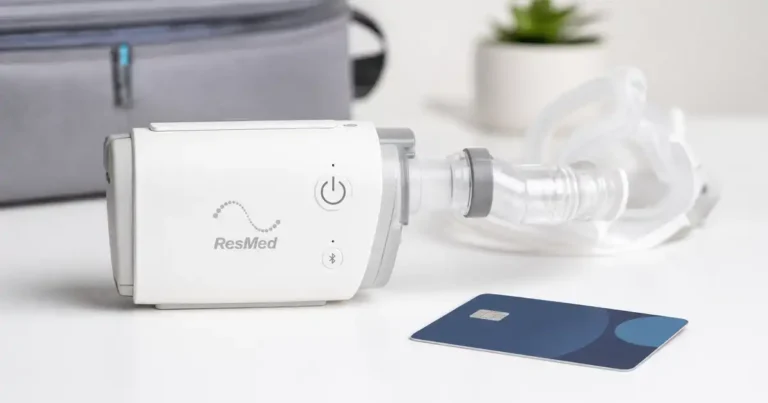
I travel with a ResMed AirMini and a Medistrom Pilot-24 Lite. That combination fits in a single carry-on pocket. I’ve taken it on 40+ flights across 3 continents over 8 years. The pattern is consistent. No pre-trip test, wrong cable, or battery over the FAA limit. All fixable. All preventable with a plan.
Table of Contents
Step 1 — Choose the Right Battery for Your Machine
Not every battery works with every CPAP. The right battery depends on your machine’s DC input.
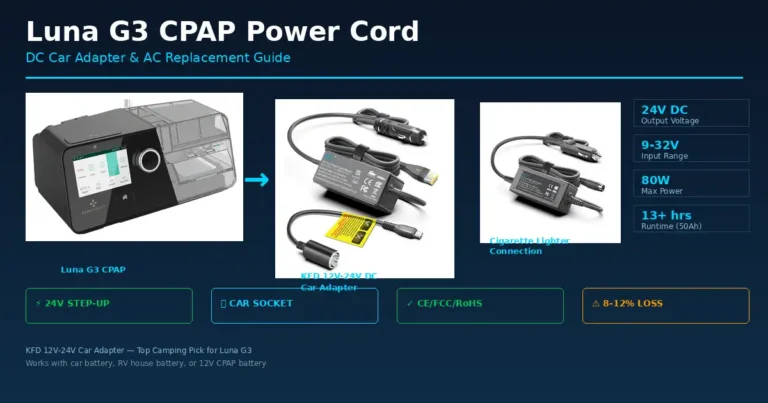
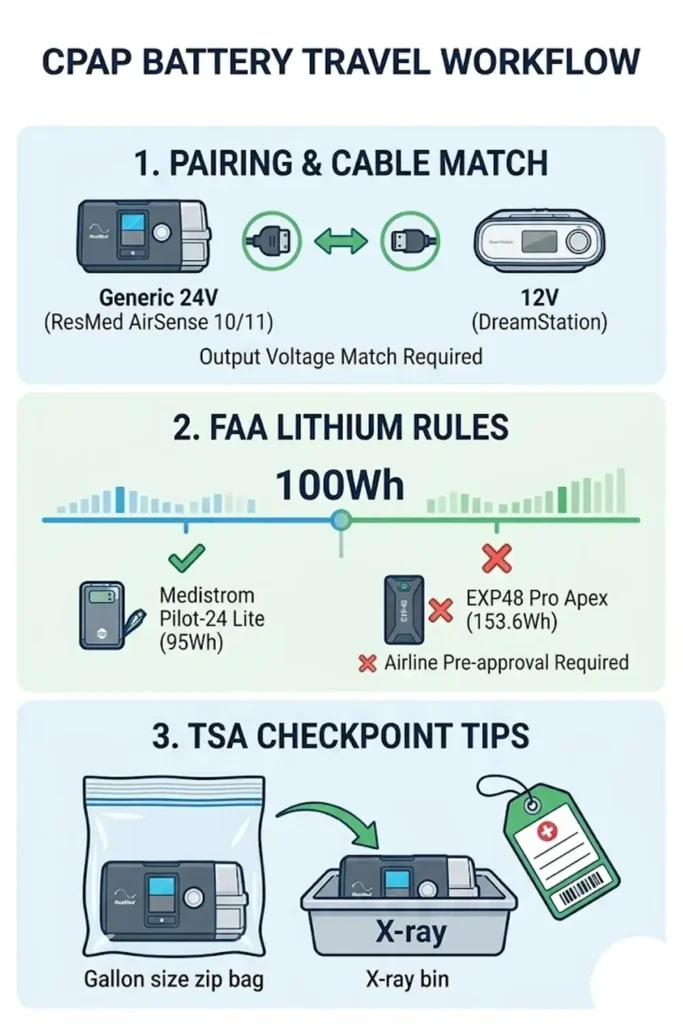
24V DC machines (ResMed AirSense 10, AirSense 11, AirMini, AirCurve): The Medistrom Pilot-24 Lite (95Wh), Medistrom Pilot Flex (98Wh), and EASYLONGER ES270 (99.9Wh) all output 24V DC. All include the correct ResMed cable. See my airsense 11 battery pack guide for AirSense 11-specific picks.
12V DC machines (Philips DreamStation 1 and 2): Use a battery with 12V DC output. The EASYLONGER ES270 outputs 12V DC and includes a DreamStation cable. Alternatively, run the machine’s AC adapter from a portable power station.
Travel CPAPs (ResMed AirMini, HDM Z1/Z2, Transcend): The AirMini uses 24V DC. Both Medistrom models are the top picks. The Z1 and Z2 use the HDM PowerShell proprietary battery. The Transcend Auto uses the P8 battery.
My personal pick: AirMini paired with the Pilot-24 Lite. At 0.66 lbs (AirMini) and 1.1 lbs (Pilot-24 Lite), the entire system weighs 1.76 lbs. The lightest CPAP travel kit available in 2026.
See my battery powered cpap guide for the full machine-battery pairing.
Step 2 — Know the FAA Battery Rules
Every lithium battery on a commercial flight falls under FAA carry-on rules:
| Battery Size | Carry-On Status |
|---|---|
| Under 100Wh | No airline approval needed |
| 100–160Wh | Airline pre-approval required |
| Over 160Wh | Not permitted on commercial flights |
Batteries that clear 100Wh with no approval:
- Medistrom Pilot-24 Lite: 95Wh
- Medistrom Pilot Flex: 98Wh
- EASYLONGER ES270: 99.9Wh
Batteries requiring airline pre-approval (100–160Wh):
- EASYLONGER ES400 AIR: 148Wh
- EXP48 Pro APEX: 153.6Wh
Never put lithium batteries in checked luggage. The FAA prohibits this due to fire risk. Pack the battery in carry-on regardless of flight length.
International flights: Many carriers (including Virgin Atlantic and Lufthansa) require enough battery power for 150% of your flight time for in-flight CPAP use. A 13-hour flight needs battery to cover 19.5 hours. Plan accordingly — bring two sub-100Wh batteries or one 100-160Wh battery with pre-approval.
Sub-100Wh batteries cleared security in London, Tokyo, and Sydney. No questions. No paperwork. No questions. The TSA and international equivalent agents see these batteries regularly now.
See my cpap tsa carry on rules guide for airport security procedures.
Step 3 — Know Your CPAP Travel Rights at the Airport
CPAP bag does not count as carry-on. The TSA and most airlines classify CPAP as medically necessary equipment. Your CPAP bag does not count against your carry-on or personal item allowance. Bring your roller bag, your laptop bag, and your CPAP bag — all three fly free.
At the TSA checkpoint: Remove the CPAP from its case and place it in a separate bin — the same as a laptop. Place the unit in a clear plastic bag first. It keeps the machine clean and makes the X-ray scan faster. One TSA officer told me: the clear bag speeds up processing every time.
A Medical Equipment tag tells TSA agents the bag holds sensitive gear. It is not required — but it helps.
Distilled water at the airport: Standard TSA liquid rules apply. Carry up to 3.4 oz (100ml) in your carry-on. Full bottles go in checked luggage. Many airport pharmacies inside security carry distilled water. Buy after clearing the checkpoint if you need it.
Critical: Empty the humidifier chamber before arriving at security — not at the gate. Water in the chamber triggers the liquid rules. TSA will make you drain it at the checkpoint, which adds time and stress. Drain at home the night before.
Step 4 — Build Your Travel Kit
A well-organized travel CPAP kit removes checkpoint stress and prevents forgotten cables.
Core items:
- CPAP machine in its travel case
- Standard AC power adapter (always carry it — hotels have outlets)
- CPAP battery charged to 100%
- DC cable for battery-to-CPAP connection
- Gallon-size clear zip bag for TSA checkpoint
Optional but useful:
- Universal travel plug adapter for international outlets
- Passive humidifier (HumidX for AirMini, or the heated chamber)
- Short 6-foot extension cord for nightstand outlet reach
- Extra DC cable as a spare
- Medical equipment luggage tag for the CPAP case
What to leave home:
- Distilled water bottles over 3.4 oz (buy after security)
- Batteries over 160Wh (not permitted on commercial flights)
Keep the clear zip bag permanently in your CPAP travel case. Pull out the CPAP, drop it in the clear bag, and bin it. One motion. No searching for the bag at the last second.
Before sleeping on a flight, mute mask-off and leak alerts. These alerts are designed for home therapy. On a plane, these alerts are not needed and disturb other passengers. Check your machine’s settings menu to silence them.
If possible, book a window seat for in-flight CPAP use. A window seat gives privacy and keeps the CPAP from the aisle. A pillow between you and the seat blocks the hose from pulling.
Step 5 — Test the Battery Before You Leave
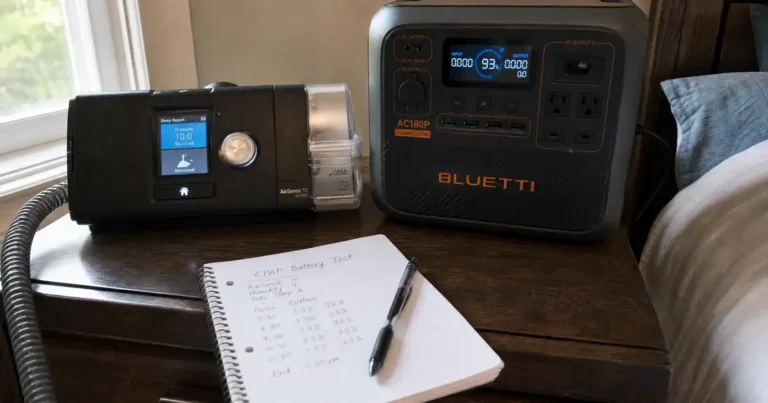
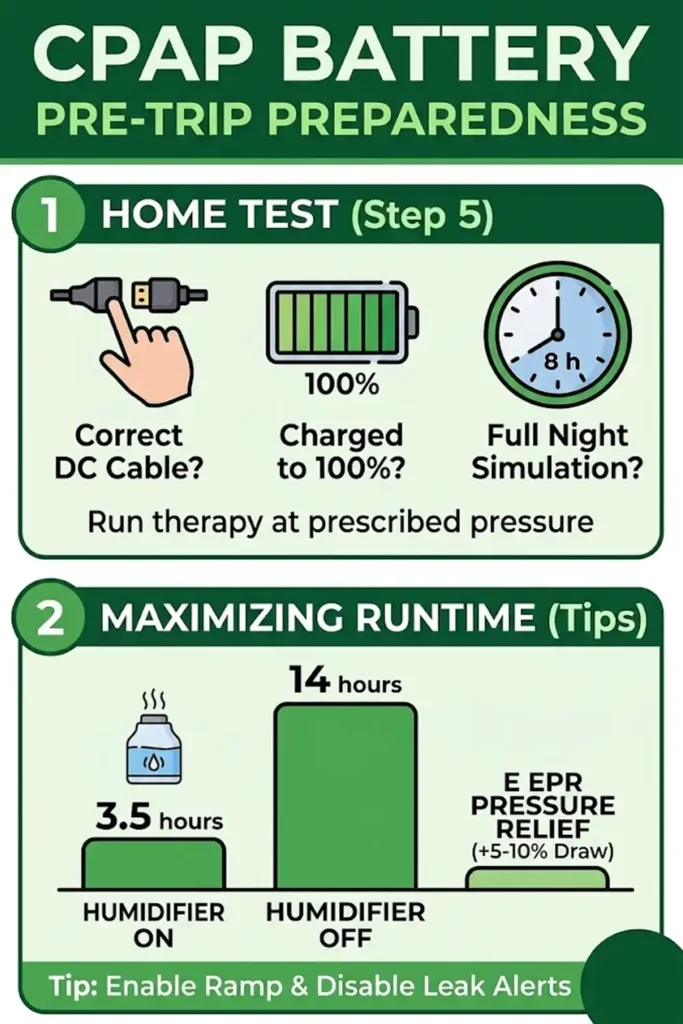
Run a full test at home before every trip. Charge the battery to 100%. Connect it to your CPAP machine. Run your therapy at your actual prescribed pressure for one full night.
This confirms:
- The cable is the correct one for your machine
- The battery capacity covers your nightly draw
- The connection holds throughout the session
I run this test with every new patient travel setup. The most common failure I find: wrong DC cable. Not a broken battery. Not a bad machine. A cable that looks right but does not match the machine’s port. That fix at home costs you nothing. That fix at a hotel costs you sleep.
Step 6 — Plan Your Charging Strategy
A 95Wh battery covers one to two nights for the AirMini. It covers one night for a full-size AirSense 10 at typical pressures. Your charging plan depends on trip type.
Hotel stays: Use the AC adapter every night at the hotel. The battery is your in-flight backup — not your primary hotel power. Charge the battery from a hotel outlet or USB-C during the day.
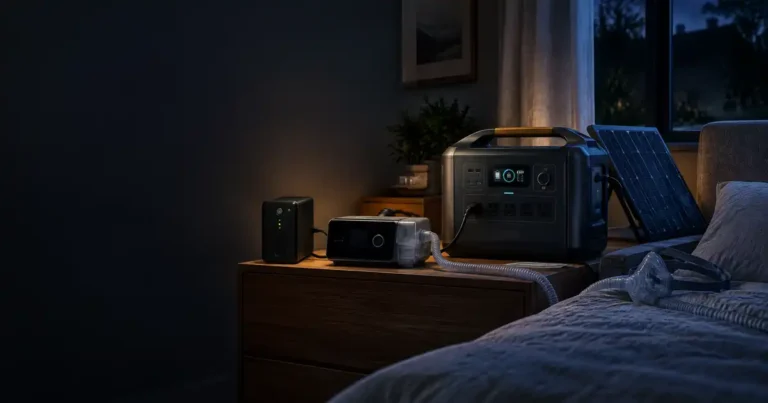
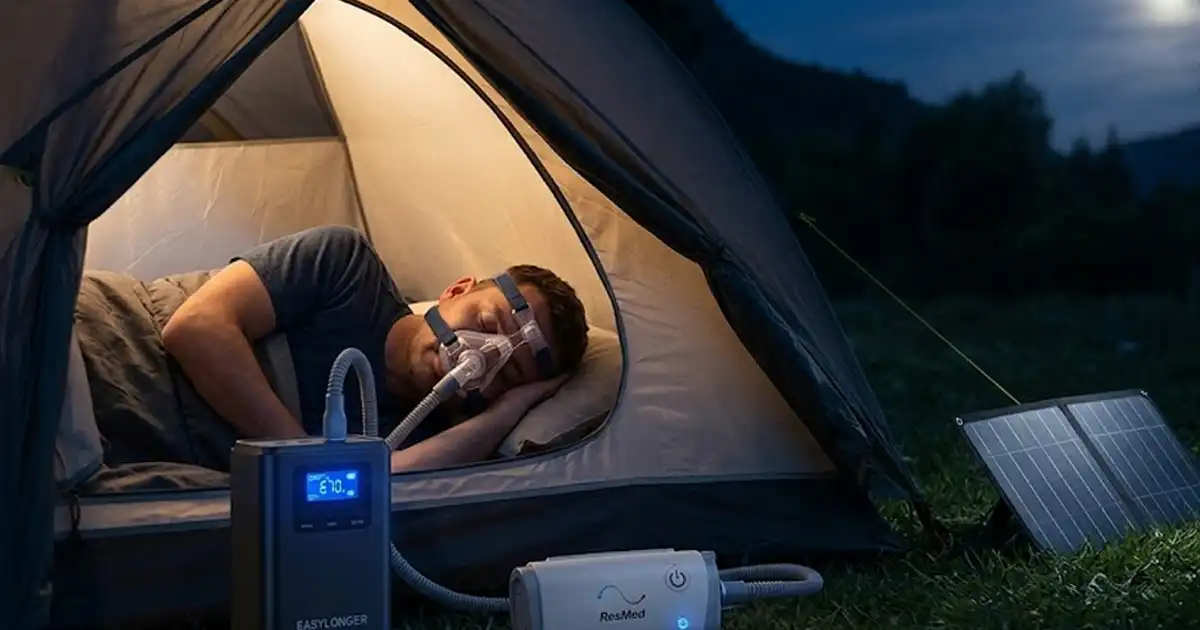
Camping trips (no outlets): Pack one battery per night or bring a larger one with solar charging. The EASYLONGER ES720 (266Wh) covers approximately three AirMini nights without recharging. A 50W panel and the ES720’s solar DC input handles daytime recharging.
Long-haul flights (12+ hours): My LAX-to-Sydney test: AirMini at pressure 8 for 12 hours. The Pilot-24 Lite showed 15% at landing. One sub-100Wh battery covered the flight. At higher pressure, plan for a 148Wh battery and airline pre-approval. Many international business class seats include 110V AC for CPAP.
Backpacking and remote camping: Weight matters here. AirMini plus Pilot-24 Lite totals 1.76 lbs. The Pilot Flex (98Wh) charges via USB-C. Add a small solar panel for an off-grid setup under 3 lbs.
See my best portable power station for cpap guide for bigger battery options.
Maximizing Battery Life on the Road
Turn off the humidifier. The heated humidifier adds 30-60W to draw. The AirMini draws ~6W without humidification and ~35W with heated humidification. That gap is five to six extra hours of battery coverage.
Enable pressure relief. EPR (ResMed) and similar features slightly reduce average pressure and cut power draw by 5-10%. Keep these on during battery use.
Keep the machine cool. A warm machine draws more power. Keep the CPAP in shade at campsites.
Use ramp settings. A CPAP ramp starts therapy at lower pressure and builds to prescription level. Shorter ramps or no ramp slightly reduce average power draw across the session.
Use AC wherever it’s available. Hotels, airports, and lounges all have outlets. Every hour on AC is an hour of battery saved. The American Academy of Sleep Medicine recommends nightly CPAP therapy without interruption — the AC adapter is your first line for that.
See my cpap wattage guide for battery sizing math.
FAQs
How many nights can a CPAP battery last?
It depends on machine and pressure. The Medistrom Pilot-24 Lite (95Wh):
- AirMini at pressure 8: ~14 hours (about two nights)
- AirSense 10 at pressure 10, no humidifier: ~3.5 hours (under one night)
For a full-size CPAP, a 200-300Wh battery covers one full night. See my cpap battery backup guide for a full battery-by-machine chart.
Can I charge my CPAP battery on the airplane?
Generally no. Most seat USB and AC ports are low-wattage. The battery should be fully charged before boarding. If your seat has 110V AC, run the CPAP directly from it. The battery cannot recharge simultaneously from the seat.
What if my hotel doesn’t have an outlet near the bed?
A 6-foot extension cord solves this. Most hotel rooms have an outlet near the TV or desk. An extension cord gets you to the nightstand with reach to spare.
Do I need to notify my airline about the CPAP machine?
No — the CPAP machine itself requires no airline notification. It qualifies as medical equipment and flies free as an extra bag. To use the CPAP in-flight, notify the airline 48 hours in advance. Some airlines require a medical form.
Can I use my CPAP battery on an international trip?
Yes. IATA follows FAA lithium battery limits internationally. A sub-100Wh battery boards any commercial flight worldwide. Most CPAP adapters accept 100-240V — confirm the label before traveling. Confirm on the adapter label before traveling.
Do I need distilled water for my CPAP humidifier while traveling?
Yes for the humidifier. Most US airports sell distilled water past security. Pack a 3.4 oz travel bottle in your carry-on. Put a full bottle in your checked bag for the destination. Empty the humidifier chamber before security — TSA liquid rules apply.
Bottom Line
Three things matter: right battery, home test, and FAA rule knowledge.
Most travelers need: a sub-100Wh CPAP battery, the AC adapter for hotels, a clear zip bag, and a charging plan for each night. Know your machine’s DC input voltage. Confirm the cable before you pack. Empty the humidifier before leaving.
See my cpap battery backup guide for specific battery picks. See my travel cpap battery operated guide for the full comparison.