CPAP Power Supply: What It Is and Which One to Buy (2026)
 By Lee Arnold
Medical Solar Power Backup Specialist | 8+ years in the field
Quick Answer:
A CPAP power supply is the AC adapter that converts wall power to the DC voltage your machine needs. Every CPAP uses a specific voltage and wattage. The wrong one means the machine won’t start or runs damaged. Match your machine’s voltage and wattage exactly. Third-party replacements meeting OEM specs cost $15-25 versus $70-90 for OEM units.
Every CPAP ships with a power supply — the wall-to-machine adapter. Most patients ignore it until it gets lost or left at home.
That scramble happens at 10 PM in a hotel room.
I’ve helped dozens of patients find a replacement the same night it was lost. One patient texted from a Denver hotel at 10 PM — supply left at home. I sent one search term: ‘370001.’ The HKY arrived by 9 AM. This guide shows what to search for and why specs matter.
Table of Contents
What a CPAP Power Supply Actually Is
The CPAP power supply converts AC wall power to DC power.
Your CPAP motor, humidifier, and electronics all run on low-voltage DC power. The machine cannot plug directly into the wall. It handles the conversion and delivers clean, regulated DC to the machine.
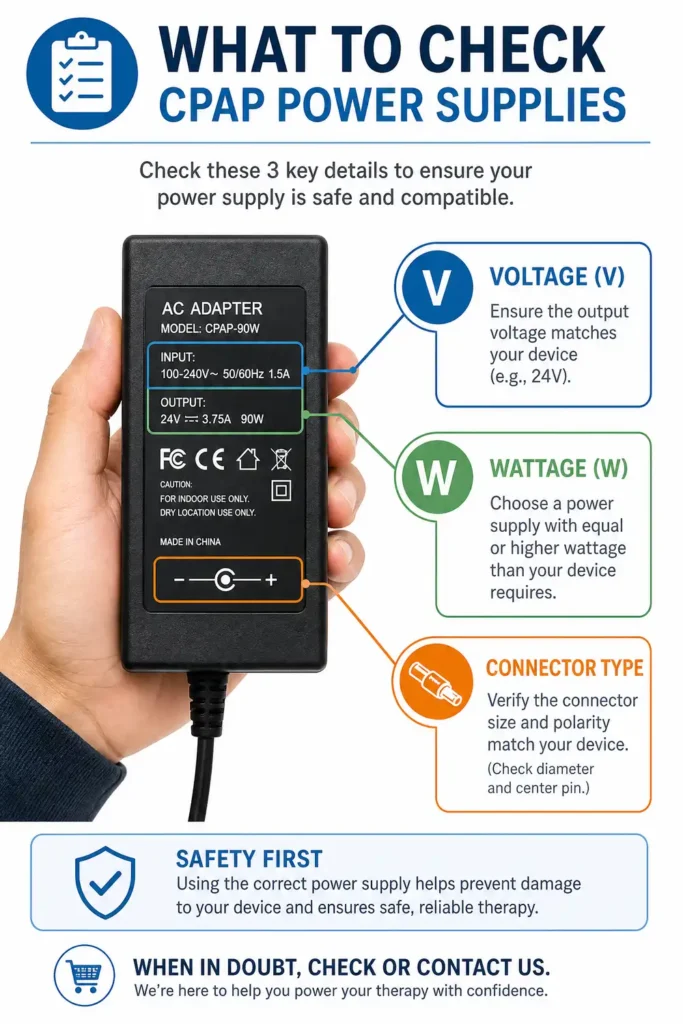
Two specs define every CPAP power supply:
Output voltage: The DC voltage the adapter delivers. ResMed machines typically use 24V DC. Philips DreamStation machines use 12V DC. These are not interchangeable. A 12V adapter on a 24V machine does nothing or causes damage.
Output wattage: The maximum power the adapter can deliver. A machine drawing 65W needs an adapter rated at 65W or higher. An underpowered adapter runs hot, fails early, or shuts down mid-therapy.
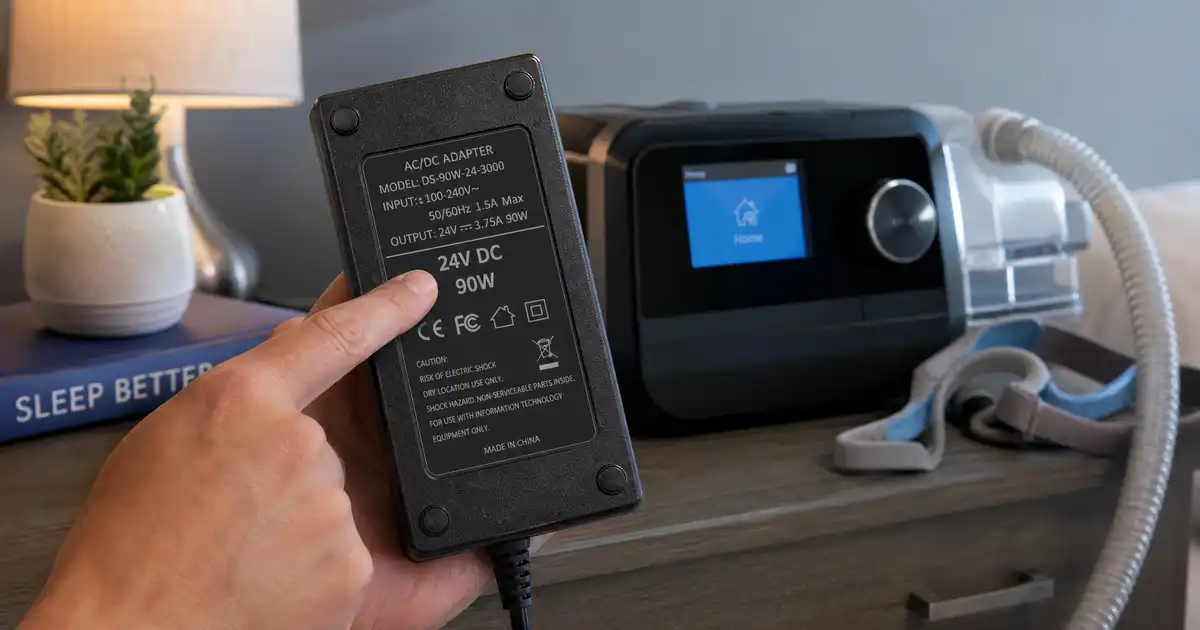
The specs are printed on every adapter — on the label on the side or bottom. Confirm both voltage and wattage before ordering any replacement.
CPAP Power Supply Specs by Machine
Different CPAP brands use completely different power specifications. The power supply from one brand does not work on another.
| Machine | Voltage | Wattage | OEM Part |
|---|---|---|---|
| ResMed AirSense 10 (all) | 24V DC | 90W | S10 370001 |
| ResMed AirSense 11 AutoSet | 24V DC | 65W | S11 series |
| ResMed AirCurve 10 (all) | 24V DC | 90W | S10 370001 |
| ResMed AirMini | 24V DC | 30W | AirMini-specific |
| Philips DreamStation 1 | 12V DC | 80W | DS DS500/DS700 |
| Philips DreamStation 2 | 12V DC | 80W | MEA080A12C |
| Philips DreamStation GO | 15V DC | 60W | DreamStation GO only |
| React Health Luna G3 | 24V DC | 90W | Luna-specific |
Note on the AirSense 11: The AirSense 11 uses a 24V DC input through a proprietary connector — different from the AirSense 10 barrel connector. Both use 24V DC, but the connectors are completely different and incompatible. Order machine-specific adapters.
For machine-specific replacement options and tested picks:
- ResMed AirSense 10: see my resmed airsense 10 power cord guide
- ResMed AirSense 11: see my airsense 11 power cord guide
- Philips DreamStation (1 & 2): see my cpap power cord guide
- Luna G3: see my luna g3 cpap power cord guide
OEM vs Third-Party CPAP Power Supplies
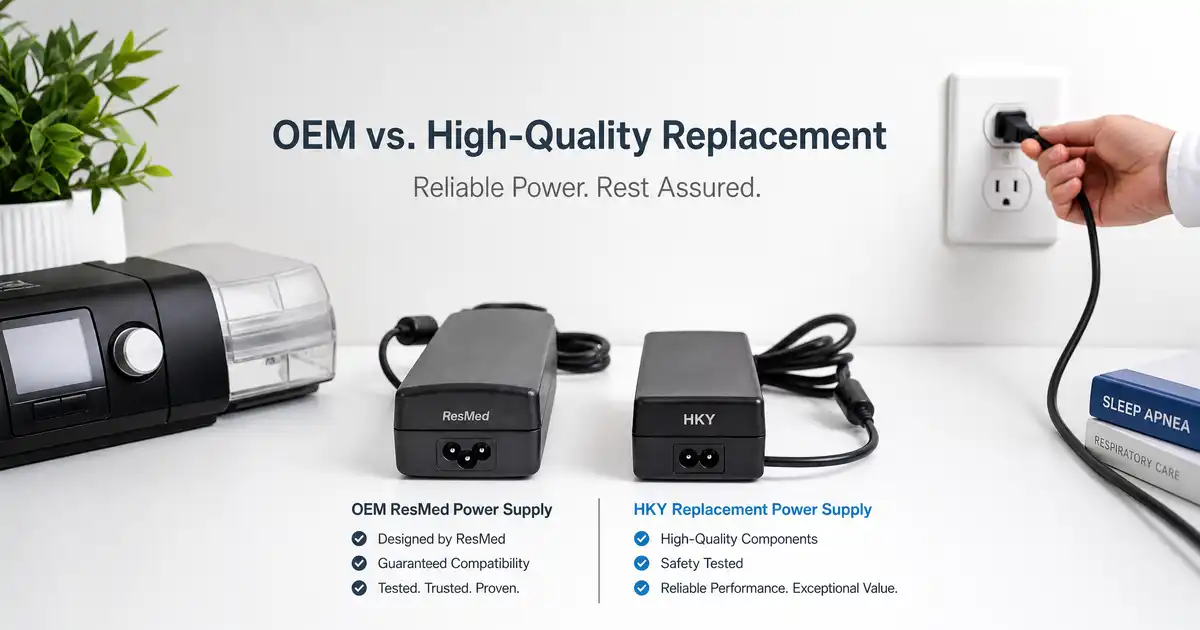
ResMed charges $70-90 for a replacement AirSense 10 power supply. Philips charges $60-80 for DreamStation replacements.
Third-party adapters that match the OEM specification cost $15-25. The price difference is significant. The performance difference is not.
What a quality third-party adapter must have:
- Exact output voltage (24V for ResMed, 12V for DreamStation — no variance)
- Output wattage at or above OEM rating
- CE, FCC, or UL certification (safety-tested)
- 100-240V universal input (works in any country)
- Over-current, over-voltage, and short-circuit protection
I’ve tested the HKY on AirSense 10 machines in six patient homes. Output voltage measured within 0.1-0.2V of spec every time. No thermal events. No machine errors across thousands of combined runtime hours.
Brands with consistent quality reviews on Amazon:
- HKY — CE/FCC/RoHS certified. Among the highest-reviewed brands for ResMed and DreamStation adapters. UL-rated cable materials.
- VHBW — Solid alternative for ResMed AirSense 10.
- CASIMY — UL-listed, DOE Level VI efficient. Good DreamStation coverage.
- JUYOON — Reliable for DreamStation 1 and 2.
What to avoid: Unbranded adapters with no certification markings. Any adapter claiming to be “universal CPAP” that does not specify output voltage is a risk. CPAP motors run 8+ hours nightly — a thermal event from an unrated adapter is a real hazard.
Travel Power Supplies: What You Actually Need
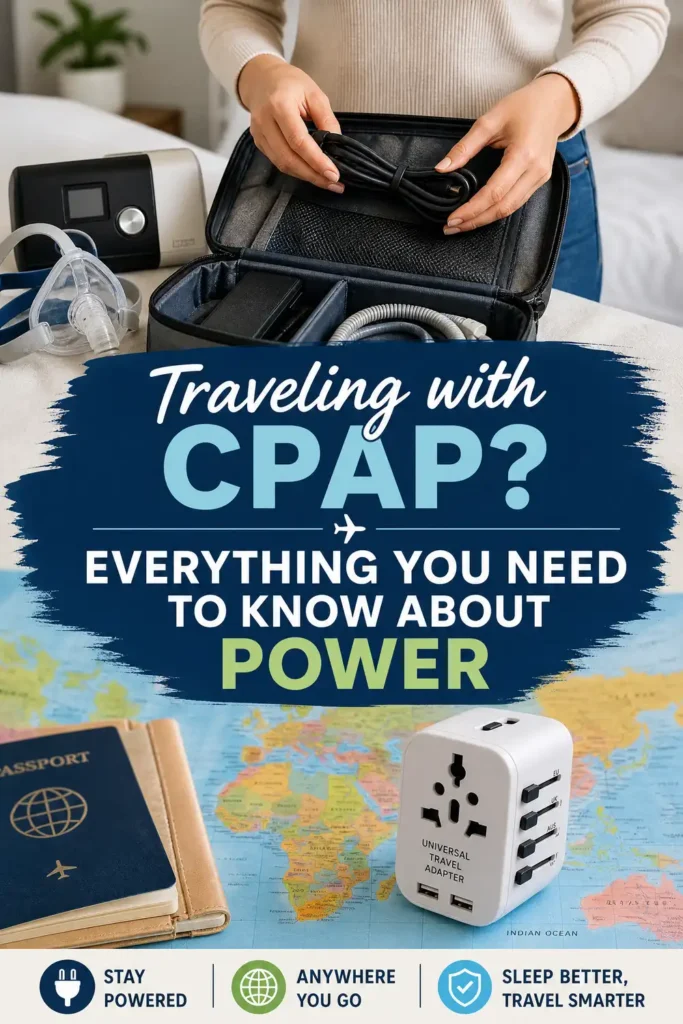
Every major CPAP brand ships with a 100-240V universal adapter. No voltage converter needed. This covers every country in the world.
What this means: Traveling internationally with your CPAP does not require a voltage converter. Your existing power supply works anywhere. You only need a physical plug adapter to fit the local outlet shape.
A few countries (India, Italy, older UK outlets) use different plug configurations. A universal travel plug adapter ($10-15) handles all of them.
If you lost your power supply while traveling:
Local replacements matching your spec are available in most countries via Amazon. Search for your machine’s OEM part number (e.g., “370001” for AirSense 10). Third-party adapters ship to most countries with 1-3 day delivery.
Both HKY adapters — the AirSense 10 and DreamStation models — ship next-day to most US locations.
DC Power Supplies: Car, RV, and Battery Use
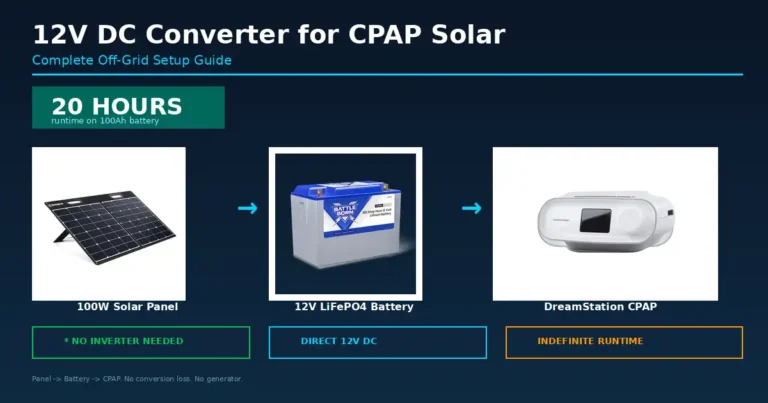
The standard CPAP power supply plugs into an AC wall outlet. For car travel or camping, a DC cord replaces the AC adapter.
DC adapters connect the CPAP machine directly to a 12V car lighter port, RV house battery, or portable power station DC output. The machine runs on DC without any AC conversion. Efficiency is 15-25% better than using an inverter to create AC, then converting back to DC.
The AirSense 10 and DreamStation both have DC adapter options on Amazon. The AirSense 11 has a proprietary DC port for direct connection.
See my cpap battery backup guide for DC supply and battery options.
When to Use a Power Supply vs a Battery
| Situation | Right Solution |
|---|---|
| Home use, normal nightly therapy | OEM or third-party AC adapter |
| Brief power outage (30-90 min) | UPS with pure sine wave output |
| Overnight power outage | Dedicated CPAP battery or power station |
| Car travel, camping | DC adapter from car/battery |
| International travel | AC adapter + plug converter (no voltage converter) |
| Airline travel | Machine AC adapter + battery for in-flight use |
The CPAP power supply covers home use. Away from wall power, a battery or DC adapter is right. See my cpap battery backup guide for the full breakdown.
FAQs on CPAP Power Supplies
Can I use my CPAP power supply in Europe or Asia?
Yes — if your adapter says “Input: 100-240V” on the label. Most CPAP adapters ship with universal voltage range. Confirm the label before traveling. Only a plug adapter for the outlet shape is needed. Not a voltage converter.
What happens if I use the wrong voltage adapter?
A wrong low voltage (12V on a 24V machine) prevents startup. A too-high voltage can damage internal components. Always match the output voltage exactly.
How long do CPAP power supplies last?
OEM and quality third-party adapters typically last 3-5 years with nightly use. Failure signs: adapter runs hot, machine errors, or cord loosens. Keep a backup adapter to avoid mid-trip failures.
How do I calculate which battery capacity I need?
Start with your machine’s wattage draw. Divide battery capacity (Wh) by wattage draw to get runtime hours. See my cpap wattage guide for draw numbers by machine and pressure. See my resmed airsense 11 power consumption guide for AirSense 11 specifics.
Can I run my CPAP directly from a battery without a power supply?
Yes, with a DC adapter. Most major CPAP machines accept 12V or 24V DC input directly. A DC cable replaces the AC adapter entirely. It runs from car batteries or power stations.
Is a CPAP power supply covered by insurance or HSA/FSA?
Replacement power supplies qualify as CPAP accessories under IRS Publication 502. HSA and FSA funds cover them. Insurance plans typically cover CPAP power supplies as DME accessories. See my hsa eligible portable power station guide for reimbursement details.
Bottom Line
The CPAP power supply is the AC-to-DC adapter that powers your machine. Match voltage and wattage to your machine’s spec. Brands like HKY, CASIMY, and VHBW deliver OEM performance at lower cost. ResMed’s product documentation lists the correct adapter spec for each machine.
NSF data links equipment failures to missed CPAP therapy nights. A $20 backup adapter stored in a travel bag eliminates that risk.
Use the guides above to find the right adapter for your machine. For battery-based alternatives, the cpap battery backup guide covers every setup.