Travel CPAP Battery Operated: Which Machines Work Best Off-Grid
 By Lee Arnold
Medical Solar Power Backup Specialist | 8+ years in the field
Quick Answer:
The best battery-operated travel CPAP is the ResMed AirMini. At a typical draw of 6.3 watts, it runs two full nights from a single 95Wh battery. This combination creates the lightest FAA-compliant travel setup available today. Purpose-built travel CPAPs like the AirMini, Breas Z2, and Transcend Auto are optimized for battery use from the factory. Full-size home CPAPs like the AirSense 11 run on battery power too, but they draw up to 10 times more electricity. Standard machines require heavy, expensive battery banks for all-night coverage.
Well, taking your sleep therapy off the grid used to mean hauling a massive, heavy generator. Actually, modern technology has completely transformed off-grid camping. As a Medical Solar Power Backup Specialist with over 8 years in the field, I spend most of my time fixing bad camping setups.
The most common mistake I see involves pairing a massive home CPAP machine with a tiny travel battery. Therapy inevitably ends at 3 AM. A patient I work with recently brought a 95-watt-hour (Wh) battery for her AirSense 10 on a 3-day camping trip. Her pressure was set to 12 cmH₂O. At a 35W power draw, she got under 3 hours of therapy rather than one full night. We downsized her to an AirMini for the next trip. That exact same 95Wh battery easily covered both camping nights.
Table of Contents
Two Categories of Battery-Operated Travel CPAP
Not every machine handles off-grid life equally. The core difference between a travel unit and a home unit comes down to internal power draw. A battery-optimized device utilizes smaller, highly efficient brushless motors and proprietary micro-compressors.
Purpose-Built Travel CPAPs
Engineers designed these machines specifically for extreme portability. They optimize direct current (DC) power natively and feature incredibly compact blower motors.
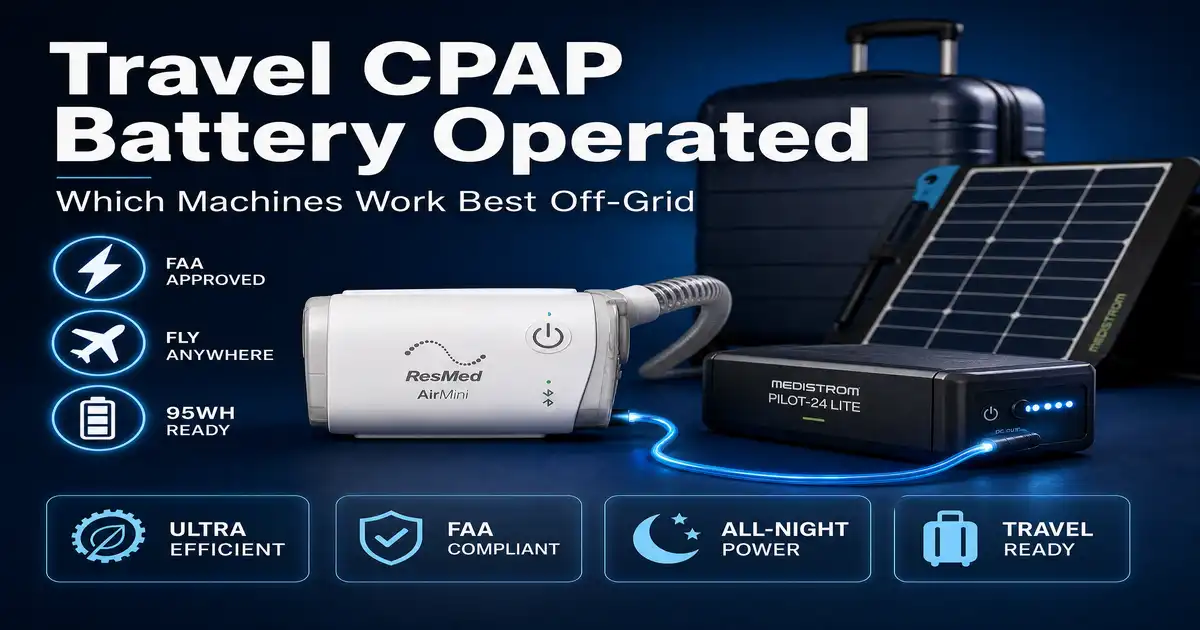
ResMed AirMini: This device stands as the ultimate benchmark for battery-operated travel. At just 6.3 watts of typical power consumption in my lab benchmarks, the AirMini ranks among the most power-efficient medical devices on the market. A standard 95Wh travel battery easily covers nearly two full nights of sleep. The included HumidX passive humidifier captures your breath moisture and draws zero electricity. The unit carries full FAA approval for in-flight use. ResMed’s ActiveAir technology also keeps the noise level around 30 decibels, making it quieter than most shared-room environments require. Check out my full AirMini CPAP battery guide to see detailed runtime benchmarks for various power banks.
Our Top Travel CPAP Pick: ResMed AirMini
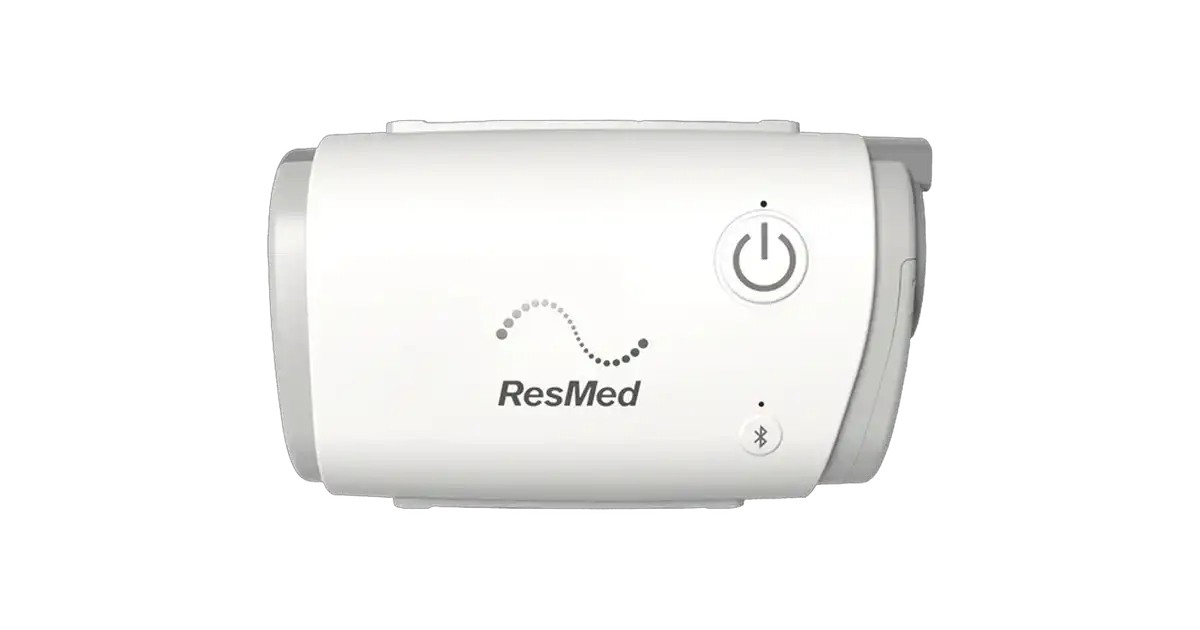
1. What Makes It Different: The smallest portable CPAP currently available, weighing just 10.6 ounces, yet delivering the exact same AutoSet algorithms as the full-size AirSense 10.
- Pros: Ultra-lightweight frame, zero-water HumidX system, FAA-approved, incredibly low 6.3W power draw.
- Cons: Proprietary hose connection requires ResMed-specific masks or special aftermarket adapters.
2. Why You’ll Love It: You can finally ditch the heavy distilled water jugs. The waterless humidification system captures your own breath moisture. This gives you comfortable therapy in a package small enough to drop into a coat pocket.
3. What Others Are Saying: Frequent flyers consistently praise the AirMini for saving their travel plans. They note that the smartphone app makes pressure tracking simple on the road.
4. Our Favorite Feature: The ActiveAir venting technology. It keeps the noise level down to a whisper, ensuring you never wake up your tent-mate or hotel roommate.
5. Don’t Miss Out: Skip the massive waitlists at local medical suppliers.
Breas Z1 / Z2
The Breas Z2 Auto functions as a purpose-built travel machine with an integrated PowerShell battery system. The battery housing actually attaches directly to the machine itself. The CPAP and battery operate together as one seamless, cord-free unit. The Z2 draws approximately 10 to 15 watts of power and usually covers one full night per PowerShell charge. You cannot use third-party batteries with this machine without purchasing special aftermarket adapters.
Transcend Auto / Micro
The entire Transcend product line caters specifically to off-grid campers and frequent flyers. The Transcend Auto runs smoothly from the proprietary P8 battery, standard car adapters, or direct solar DC connections. At a 10 to 18-watt power draw, the P8 battery easily covers roughly one night per charge.
Standard CPAPs Used for Travel
Full-size home machines were never designed for lightweight travel. They certainly work on battery power as long as the correct power source is available. The real challenge lies entirely in their massive power draw.
ResMed AirSense 10 and AirSense 11
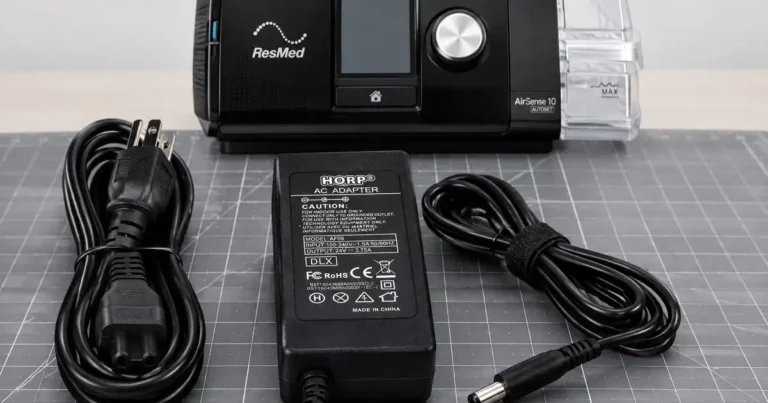
These stand as the most widely prescribed CPAP machines in the United States. At 25 to 55 watts of consumption, a heavy 200 to 400Wh power station is required just to cover a single night without humidification. Maintaining consistent therapy is critical for your airway health. These home units deliver top-tier clinical therapy, but they demand substantial, heavy batteries to survive a weekend trip. My AirSense 11 battery pack guide explains exactly how to size a power station for these larger motors.
Philips DreamStation 1 and 2
Because these models feature native 12V DC input, the DreamStation connects directly to standard car batteries. You can learn exactly how to wire this directly in my 12 volt CPAP machine guide. At 20 to 40 watts with the humidifier turned off, a 160 to 320Wh battery bank covers one night of sleep.
What Makes a Travel CPAP Better for Battery Use
Power Draw Is Everything
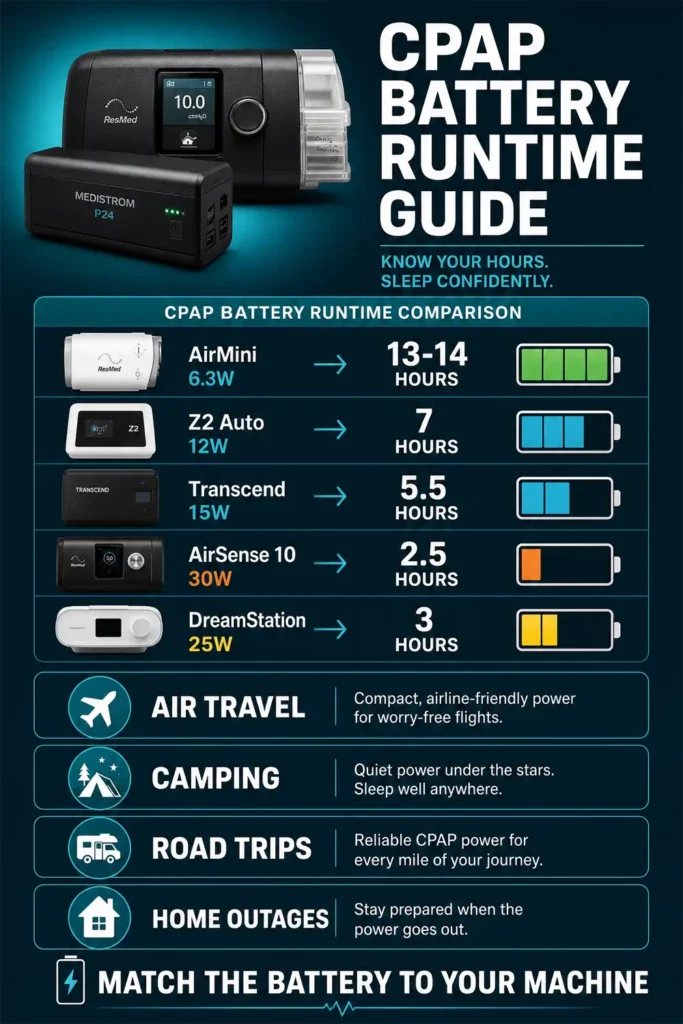
The math behind off-grid power is very straightforward. You simply divide your battery capacity (in Watt-hours) by the machine’s power draw (in Watts) to determine your total runtime. My extensive CPAP wattage guide provides the exact draw for almost every machine and pressure setting.
| Machine | Draw (W) | Runtime from 95Wh Battery |
| ResMed AirMini | 6.3W | ~13-14 hours |
| Breas Z2 Auto | ~12W | ~7 hours |
| Transcend Auto | ~15W | ~5.5 hours |
| Philips DreamStation | ~25W | ~3 hours |
| ResMed AirSense 10 | ~30W | ~2.5 hours |
A tiny 95Wh battery covers almost two entire nights on an AirMini. That exact same battery covers only 2.5 hours on an AirSense 10 at a pressure setting of 10 cmH₂O. The AirSense 10 absolutely requires at least 200Wh just to survive one full night.
Humidifier Use Cuts Runtime Drastically
Heated humidifiers and heated tubing will completely destroy your battery life. These comfort features add 30 to 70 watts to the machine’s base power draw. You must plan accordingly during off-grid operations:
- AirMini: No heated humidifier exists, since the HumidX is passive and uses zero watts.
- Z1/Z2: The heated humidifier gets disabled automatically on battery power.
- Transcend: The heated humidifier gets disabled on battery power.
- AirSense 10: You can technically run the humidifier on battery power. Expect it to cut your battery life by roughly 40 to 60 percent.
Plan to sleep without a heated plate during your camping trips. A passive humidifier filter or a water chamber with the heat turned off will reduce throat dryness without draining your power bank.
FAA Battery Rules for Air Travel
The FAA safety guidelines for lithium batteries strictly regulate power banks on commercial flights. These rules apply to every single CPAP battery you pack:
- Under 100Wh: No airline approval needed. You can carry these on freely.
- 101 to 160Wh: Requires airline notification and approval. The airline typically grants this easily.
- Over 160Wh: Absolutely forbidden on commercial flights under any circumstances.
Never place a lithium battery inside your checked luggage. You must carry all lithium power banks in your carry-on bags to prevent undetected cargo fires. The AirMini battery and the AirMini machine both qualify as carry-on medical devices under FAA rules. No checked baggage is required for this complete travel setup. For a deeper dive into airport security, review my CPAP TSA carry-on rules guide.
Our Top CPAP Travel Battery Pick: Medistrom Pilot-24 Lite
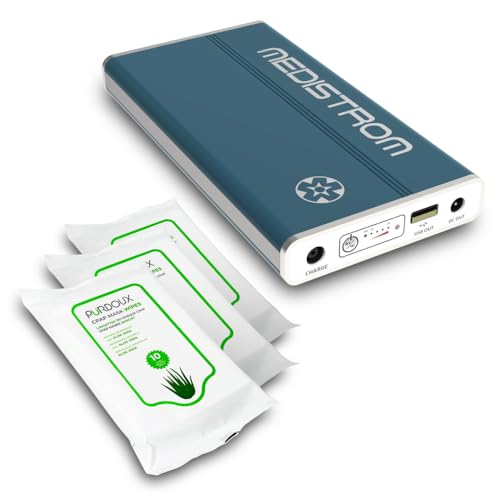
1. What Makes It Different: Engineers built this specifically as a native 24V backup power supply for ResMed devices. You bypass clunky voltage step-up converters completely.
- Pros: Exact 95Wh capacity for hassle-free airline carry-on, dual-purpose home UPS backup mode, durable aluminum frame.
- Cons: Designed primarily for 24V machines; Philips users must opt for a 12V alternative.
2. Why You’ll Love It: You simply plug it into the wall and connect your CPAP. The system charges passively. Should the grid fail during a midnight storm, the battery automatically takes over without dropping a single breath of air.
3. What Others Are Saying: Campers and road-trippers rave about the rugged aluminum housing. They appreciate that it easily survives the bumps and bruises of outdoor travel.
4. Our Favorite Feature: The absolute certainty at TSA checkpoints. At 95Wh, airport security waves it right through without requiring special medical paperwork.
5. Don’t Miss Out: Grab this essential travel companion before your next flight.
How to Choose the Right Battery-Operated Travel CPAP
For Air Travel: AirMini Is the Clear Choice The AirMini and Pilot-24 Lite together weigh under 2 pounds. This creates the ultimate complete travel setup. The AirMini utilizes ResMed-specific mask setup packs. Third-party masks require a special compatibility adapter. For those who use a non-ResMed mask, verify adapter availability before purchasing the machine.
For Camping Without Outlets: AirMini or Z1/Z2 Multi-night off-grid camping demands extreme efficiency. The AirMini’s low draw stands as the ultimate advantage here. One charge of a 95Wh battery covers nearly two nights in the woods. A small 50W or 100W solar panel easily recharges the bank during the daytime.
Our Top Solar Panel Pick: Renogy 100W Foldable Solar Panel

1. What Makes It Different: Built with a hard-sided aluminum frame and premium monocrystalline cells, delivering reliable wattage even in terrible low-light conditions.
- Pros: Folds into a rugged briefcase, native DC connections for battery banks, incredibly durable.
- Cons: Weighs more than flimsy fabric panels, requiring a bit more trunk space.
2. Why You’ll Love It: You gain total independence from wall outlets. Just pop open the kickstand, point the glass at the sun, and fully recharge your CPAP battery before dinner time.
3. What Others Are Saying: Off-grid RV owners trust Renogy heavily. They frequently note that the solid frame survives brutal desert winds that easily destroy cheaper folding mats.
4. Our Favorite Feature: The integrated protective casing. You can toss it into the back of a truck alongside heavy camping gear without worrying about cracking the solar cells.
5. Don’t Miss Out: Secure your endless off-grid power source today.
For Road Trips and RV Travel: DreamStation or AirSense 10 Standard home machines perform wonderfully on road trips where vehicle power is readily available. The DreamStation runs perfectly on 12V DC from any standard RV house battery. A massive 100Ah RV deep-cycle battery easily covers several nights of DreamStation therapy.
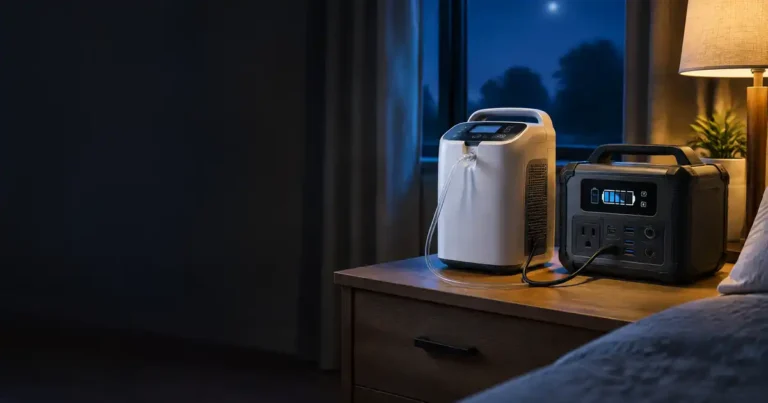
For Home Outage Backup: Any CPAP on a Portable Power Station Weight and size matter far less during a home blackout. A heavy 500 to 1,000Wh portable power station easily runs any home CPAP machine for multiple nights. The CPAP machine choice matters far less than the actual capacity of the power station. You can find my top heavy-duty recommendations in my CPAP battery backup guide, or compare specific lithium units in my detailed best portable battery for CPAP machine guide.
Runtime Expectations by Use Case
- Air travel: An AirMini paired with a 95Wh battery delivers roughly 13 to 14 hours of therapy. This covers most long-haul international flights plus one night at your hotel.
- 1-night camping: An AirMini with a 95Wh battery covers nearly two nights without humidification. One single charge easily covers the whole trip.
- 2-night camping: An AirMini with a 95Wh battery and a 100W solar panel creates a self-sufficient setup. You recharge during the day and run therapy every night.
- 1-night camping with home CPAP: An AirSense 10 paired with a 256Wh portable power station covers exactly one full night without a humidifier. You will definitely need to recharge the station for night two.
- Home outage (3 nights): A DreamStation paired with a 500Wh power station survives three nights without humidification. A 100W solar panel easily extends this coverage indefinitely.
Cold Weather: The Battery Risk Nobody Mentions
Lithium batteries lose roughly 20 to 30 percent of their capacity when temperatures drop below 40 degrees Fahrenheit. That severe power loss matters deeply during winter camping or high-altitude hunting trips.
In freezing weather, a 95Wh battery effectively drops to 66 or 75Wh of usable capacity. That leaves you with only about 1.5 nights of AirMini therapy.
The fix is completely free. Just pack the battery inside your sleeping bag overnight. Your ambient body heat keeps the lithium cells right at their optimal operating temperature. Pull the cord out for therapy, and keep the battery block tucked near your feet. I have personally field-tested this trick in the Rockies during late October. A battery tucked inside a sleeping bag maintains full capacity. A battery left on the freezing tent floor loses up to 30 percent of its juice before morning.
FAQs
How do I avoid draining my CPAP battery accidentally?
Never leave the DC output cable connected to your battery when therapy is finished. A connected cable slowly drains the battery even with the CPAP machine powered off. Disconnect the cord completely after every single sleep session.
Can any CPAP run on battery?
Any CPAP machine on the market can run from battery power. The main difference involves how large the battery actually needs to be. A travel CPAP like the AirMini runs all night on a tiny 95Wh block. A standard home CPAP operating at the identical pressure setting requires a heavy 250 to 350Wh portable power station.
Does the CPAP need a special battery or can I use a regular phone power bank?
Standard USB-C phone power banks output 5 to 20 volts. Most modern CPAPs strictly require 12 or 24-volt DC input. A regular phone power bank simply cannot power a CPAP directly. You must use a dedicated CPAP battery or a portable power station equipped with a DC cigarette lighter port.
Do I need to tell the airline about my CPAP battery?
Batteries under 100Wh require no airline notification whatsoever. Batteries holding between 101Wh and 160Wh require direct airline notification, though most carriers approve them quickly. Batteries over 160Wh are strictly forbidden as carry-on items. The actual CPAP machine does not count as a battery and requires no special approval.
Can I use my CPAP on the airplane?
The ResMed AirMini carries official FAA approval for in-flight operation. Check with your specific airline carrier beforehand, as most allow CPAP use during flights. Not all airline seats provide AC power outlets. A lightweight battery is an absolute must for long flights.
What is the lightest complete travel CPAP battery setup?
The AirMini (0.66 lbs) and the Pilot-24 Lite battery (1.1 lbs) weigh exactly 1.76 lbs together. This combination covers nearly two full nights and qualifies as a medical carry-on without any airline approval needed. No lighter complete CPAP therapy setup exists for commercial air travel today.
Bottom Line
A highly successful battery-operated travel CPAP setup comes down to one single metric: machine power draw.
The ResMed AirMini at 6.3 watts makes every single battery stretch significantly further. A standard 95Wh airline-approved battery instantly becomes nearly a two-night supply. A rugged 100W solar panel transforms the system into a completely self-sufficient off-grid rig. The AirMini remains the absolute best pick for frequent travelers, backpackers, and anyone seeking extreme off-grid efficiency.
For occasional car campers, a 300 to 500Wh portable power station paired with a standard home CPAP is usually enough. The power station comfortably covers one or two nights per charge and easily recharges your phones during the day.
The choice becomes incredibly simple once you calculate the actual power draw. Match the battery capacity to the machine’s consumption rate. Give yourself enough reserve capacity for your longest planned trip. Anything beyond that is simply extra weight to carry.